


Chief Global Strategist
On Tuesday, the Senate Banking Committee will hold hearings to consider the nomination of Kevin Warsh to be the next Fed chair. His confirmation will likely be delayed until the Justice Department’s investigation into Jerome Powell is fully resolved. Despite this, Mr. Warsh’s answers to the committee’s questions could shed light on the future direction of monetary policy.
One particularly important question will be how Mr. Warsh views short-term interest rates and the balance sheet. In an interview on Fox Business last summer, he argued that the Fed should reduce the size of its balance sheet and, since doing so would imply monetary tightening, this would give the Fed the leeway to cut short-term rates. As we outlined in a recent article1, however, shrinking the balance sheet is complicated on both sides of the ledger and would likely raise long-term interest rates in general and mortgage rates in particular – hardly a result that the administration would want, given its aggressive efforts to strong-arm the Fed into lowering rates.
However, assuming that the Fed doesn’t engage in dramatic quantitative tightening to justify lowering short rates, Mr. Warsh has suggested another possible rationale. In a Wall Street Journal op-ed last November2, he argued that AI will be a “significant disinflationary force”. But will it really be disinflationary and, if it is, would that justify more aggressive Fed easing?
AI in the Near Term: A Mild Boost to Growth and Inflation
In the short run, the tsunami of spending dedicated to AI development is likely inflationary rather than deflationary, as the extra demand is hitting the economy in advance of the productivity payoff.
One aspect of this demand is spending on electricity. After more than a decade of no growth, U.S. electricity production rose by 2.5% in 2024, 2.4% in 2025 and was up by 3.0% year-over-year in March of 2026. Much of this increase is due to data center consumption and an increasing share of this consumption is devoted to building and employing AI models – or, in the jargon of the industry, training and inference.
This likely contributed to a 4.6% year-over-year rise in consumer electricity prices in March. However, since electricity has just a 2.5% weight in the CPI basket, rising electricity costs accounted for just 0.1% of March’s 3.3% year-over-year increase in headline CPI.
There are, of course, other potential areas where demand from AI development could feed through to higher prices. Memory chip prices have soared due to the demands of the AI buildout and this is adding to costs for manufacturers of other consumer goods such as laptops, smartphones and even autos. However, only some of this extra cost is likely being passed on to consumers and still isn’t a major source of economy-wide inflation.
The buildout of AI data centers is also boosting the demand for construction workers who saw their wages rise by 4.3% year-over-year in March compared to 3.5% for all private sector workers. However, this increase is more likely due to labor supply issues – over the past year the total number of U.S. construction workers has risen by just 0.7%, reflecting, in part, a huge reversal of immigration trends in a profession that has traditionally employed many immigrants.
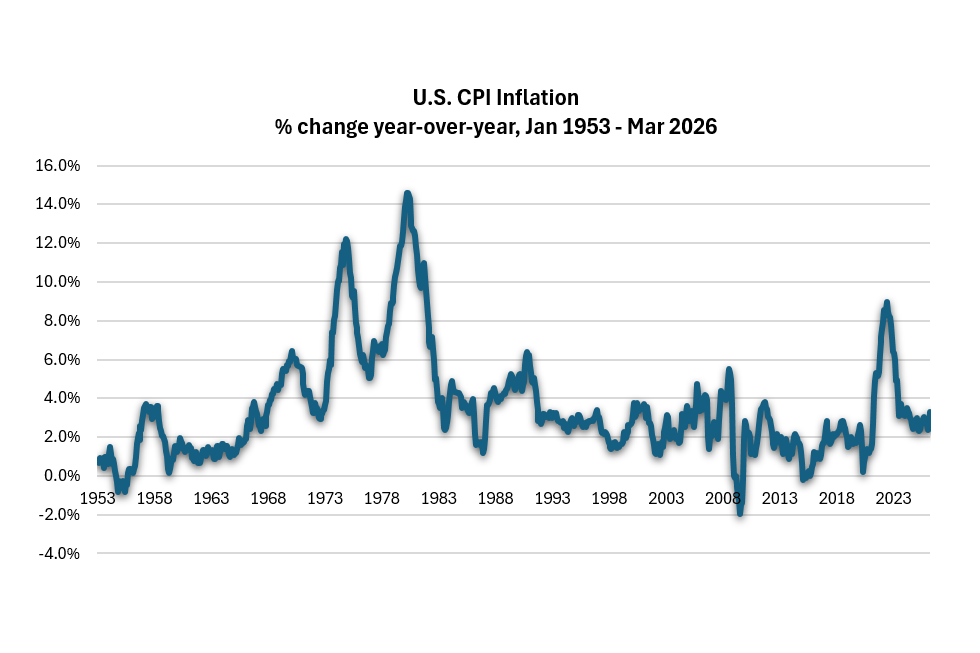
More broadly, the U.S. has seen a pickup in inflation over the past year from 2.4% year-over-year in March of 2025 to 3.3% in March of this year and, we project, 3.6% in April. However, with the unemployment rate actually up slightly from a year ago, this seems to be the result of supply side issues such as the impact of the Iran war, higher tariffs and fewer immigrant workers rather than any AI-driven surge in demand.
Finally, it is unlikely that most corporations have realized significant cost savings from the deployment of the newest AI models yet and even less likely that they would have passed on cost savings to consumers. There is a small but growing number of layoff announcements explicitly attributed to AI and there are some signs of diminished hiring of entry-level workers in the most AI-exposed industries. A fear that AI will “take your job” could also be contributing to even more passivity among workers, with economywide year-over-year wage growth falling to an almost 5-year low in March.
Despite this labor market “scare” effect, however, it does appear that AI is, on balance, adding slightly to inflation in the short run, although it will be far from the most important inflation driver. If this continues to be the case, over say, the next two years, then this alone would negate the idea that a disinflationary impulse from AI supports the need for short-term interest rate cuts.
Long-Term: Amplifying the Inflation Slide
That being said, in the long run, AI is likely to be a significantly disinflationary force.
This argument starts with the potential for AI to boost productivity. However, an equally important issue is how the AI revolution could impact the way these productivity gains are divvied up among businesses, workers and consumers.
Figuring out the size of the potential productivity gains is extremely difficult. However, a few points are perhaps obvious, many of which we discuss in our AI Hub.
First, the productivity gains will vary dramatically by sector and should reflect worker displacement. The Census Bureau’s Business Trends and Outlook Survey shows that in March of this year, AI applications were being used in over 30% of businesses in the technology, information, financial and education sectors but in fewer than 15% of the firms in the construction, retail, leisure and hospitality and transportation sectors.
Second, as in any technological revolution, adoption will lag behind potential and efficient usage will lag behind adoption, This is partly because of organizational inertia and partly due to cost. One example of the inertia effect was the sudden ubiquitous adoption of video calls and video conferencing at the start of the pandemic – the capability had been there for years – it just required some event to force mass adoption. In the case of AI, expense will also become an issue – while retail consumers are able to access AI tools very cheaply today, they are effectively being subsidized by the providers. At the enterprise level, there are presumably many tasks that AI could perform but not, as yet, in a cost-effective manner.
Third, both the capabilities and usage of AI are increasing at an extraordinary pace. While measuring AI capabilities requires a degree of qualitative judgement, anecdotal evidence and the very rapid upgrading of models suggests a frenetic pace of quality improvement. Meanwhile, more concretely, adoption is rising very swiftly. According to Gallup3, in the first quarter of 2026, 50% of employees reported using AI at least some of the time in their role up from 21% in the second quarter of 2023. Over the same short period, the number of employees saying they used AI daily or multiple times a week rose from 11% to 28%.
Fourth, it needs to be recognized that measuring the impact of AI will be a continuing problem. For example, in medicine, more accurate diagnostic tools and AI assistance in the development of better therapies may never be officially counted as an improvement in the quality of the output of the medical sector and, implicitly, a decline in the cost of average care. For consumers, better answers to questions than could be provided by traditional internet browsers may amount to quality improvement that also is unrecognized in inflation, productivity or output. Conversely, national income and product accounts will also be silent on the negative impacts of AI, such as increased isolation of individuals or political manipulation. In addition, AI has an extraordinary potential to advance the pace of technical progress in areas such as robotics, biotech and energy, with these cross-pollination impacts also being largely invisible in economic statistics.
All we can say with confidence at this point is that AI will have a meaningful and accelerating impact on productivity that will likely always be understated in economic statistics.
Returning to the question of inflation, however, there is something else to say: The productivity gains from AI will likely be distributed in a way that is disinflationary rather than inflationary.
To see this, it is important to consider the forces that have generally reduced U.S. inflation in recent decades.
One of these forces has been a decline in labor power. According to the Bureau of Labor Statistics, between 1974 and 2025, union membership as a percentage of all American workers fell from 26% to 10% while the number of major strikes (involving 1,000 or more workers) fell from 424 to 30. If anything, competition from AI will likely further reduce labor power, extending this trend and dampening wage growth.
A second trend depressing inflation has been rising inequality. The percentage of pre-tax income received by the highest-earning 20% of households rose from 43.5% in 1974 to 52.2% in 2024. Richer households save and invest a larger share of their income so this long trend of rising inequality has diverted demand from goods and services to stocks and bonds, reducing consumer inflation and boosting asset prices. If the AI revolution increases inequality it will also feed this trend.
Finally there is the general impact of the information revolution in providing buyers across the economy with better ways to compare prices across sellers, thereby increasing competition and holding down prices. Again, AI will augment this trend.
In short, not only is AI likely to boost productivity growth, it is likely to do so in a way that reduces inflation.
AI Disinflation: No Reason to Lower Rates
But even if Mr. Warsh is right in asserting the potential for AI to reduce inflation in the long run, does that justify near-term Fed easing?
There is a strong case to be made that it does not.
First, AI will likely only become a net disinflationary force after some years while Fed easing this year would impact financial conditions immediately.
Second, we currently estimate that by May, year-over-year PCE inflation could hit 3.9% - almost double the Federal Reserve’s 2% target. If a solution emerges to the Iran conflict allowing oil prices to fall, if the administration and Congress resist the urge to inject more fiscal stimulus into the economy before the mid-term elections and if the administration abandons its plan to replace the struck-down IEEPA tariffs with other tariffs of the same magnitude then inflation could fall back to 2% or below in early 2027. However, there are far too many “ifs” in that statement to use it as a justification for immediate monetary easing.
Finally, as Kevin Warsh might well argue himself, the Fed often attempts to achieve goals beyond its remit with very mixed results. Cutting rates today would, most obviously, help lower mortgage rates and, some would argue, help with the affordability issue for young people trying to buy a home. However, the very reason that homes are unaffordable today is not that mortgage rates are too high. It is that the Federal Reserve allowed mortgage rates stay too low for much too long between the financial crisis and the pandemic, enabling prices to soar. Indeed, super-low interest rates for long stretches of time have fueled a boom in asset prices in general and, since assets are even more unequally distributed across society than income, this has actually worsened inequality over time.
In short, the Federal Reserve is in no position to remedy the problems of inequality through lower interest rates. Nor can it offset the supply-side impacts of policies from the other side of Washington. For investors, the best message from Mr. Warsh’s testimony would be an explicit recognition of this, while still professing confidence in the potential long-term economic benefits of the AI revolution.