


Chief Global Strategist
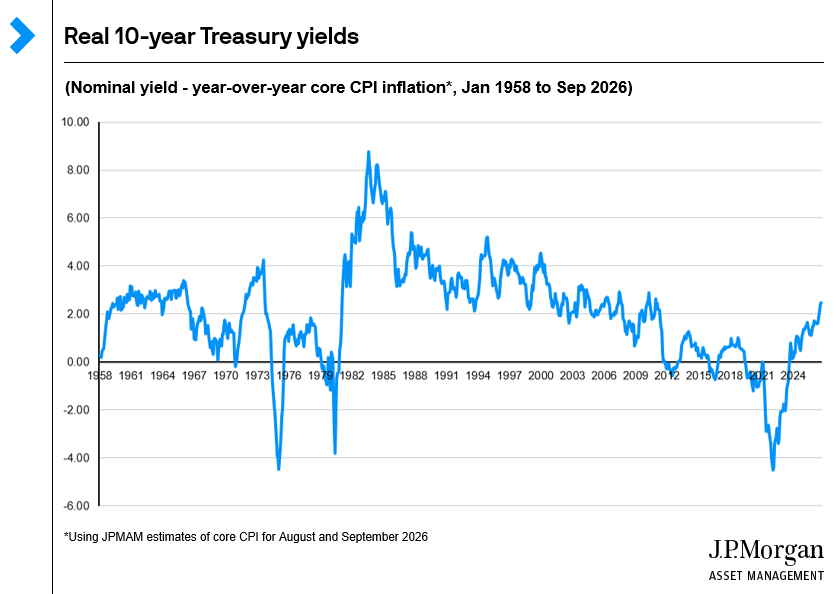
The era of low growth, low inflation and super-low interest rates that followed the Great Financial Crisis was christened by Mohamed El-Erian as “The New Normal”. While this episode largely came to an end with the post-pandemic growth and inflation surge, real interest rates had generally remained below the levels that prevailed in the decades before the financial crisis until recently. However, a steady bond market selloff in 2026, which accelerated over the summer, has now pushed real long-term Treasury yields to their highest levels since 2010.
While it would be tempting to say that this is simply a return to the old normal, the current environment is quite different from that of the decades that preceded the financial crisis. These differences are important from an asset allocation perspective. In the new, new normal, while yields are, once again, an attractive source of income, massively higher federal deficits and debt will likely undermine the traditional role bonds have played in offsetting equity losses in the case of an economic slowdown or stock market crash.
To see this, it’s worth reviewing the old normal, how the new normal emerged from the Great Financial Crisis, why interest rates have risen recently and how today’s financial landscape is different from the average environment in the 50 years that ended in 2007.
The Old Normal
The period between 1958 and 2007 contained many economic and financial convulsions including the Vietnam War, the oil shortages and inflation of the 1970s, the 1987 stock market crash, the fall of the Berlin Wall in 1989, the dotcom bubble, 9/11, wars in Iraq and Afghanistan and seven recessions. However, it was also a time of strong economic progress, with three very long economic expansions and strong stock market gains. Real economic growth averaged 3.4%, and, although inflation drifted steadily lower from the early 1980s on, over the entire period, the core CPI inflation rate averaged 4.1%. Moreover, despite intense budget battles, the federal government debt/GDP ratio averaged just 36%. With the abandonment of the Bretton Woods regime and despite significant ups and downs, the US dollar drifted down over this period, falling at an average pace of almost 1% per year and providing a haircut to foreign investors in dollar-denominated U.S. securities.
While pale in comparison to stock market gains, bonds provided reasonable returns with investors getting paid for saving, for taking duration risk and for taking additional credit risk. The federal funds rate averaged 5.9%, or 1.8% above core CPI inflation. The 10-year Treasury yield averaged 6.8%, or 2.7% above core inflation and 30-year fixed rate mortgages, (at least from 1971 on), provided a further 1.8% spread over 10-year Treasuries.
The New Normal
All of this changed with the advent of the Great Financial Crisis, partly because of the unusual nature of the crisis and the deep recession it produced.
The typical business cycle of the second half of the 20th Century was a drama in four acts. Act 1 involved a generalized overheating, with solid economic growth and full employment boosting wages and inflation. In Act 2, some other catalyst, such as higher oil prices, pushed inflation higher still, forcing the Federal Reserve to raise interest rates and, thereby, smother the demand for housing and any durable goods purchases that households or businesses could postpone. Act 3 saw a plunge in inventories, resulting in cutbacks in production and mass layoffs that rippled through the economy producing further weakness. Finally, in Act 4, the need to rebuild inventories spurred a bounce back in production and employment which was aided by monetary and fiscal stimulus.
However, in the 1980s and 1990s, the economy became less inflation-prone due to (i) declines in unionization, (ii) information technology and global competition that made markets more competitive and (iii) rising inequality that limited the demand for goods and services while boosting the demand for stocks and bonds. The economy also saw slower economic growth as the aging of the baby-boom generation limited labor supply. However, it was also a more stable economy, with a stronger services sector, a smaller manufacturing sector, greater inventory control and a generally quicker response from monetary and fiscal authorities to emerging economic weakness.
This evolving economic structure was very important in the aftermath of the Great Financial Crisis since there was less potential for a sharp rebound in manufacturing or inventories to lead to a V-shaped recovery. Both public policy and the scars of the crisis left the banking system less willing to lend, ensuring mediocre growth in what should have been strong bounce-back years. This slow growth accentuated the economy’s evolving tendency towards low inflation.
Slow growth and low inflation helped reduce bond yields and were powerfully aided by the Fed which held the federal funds rate in a super-low range of 0-0.25% for seven full years from the end of 2008 to the end of 2015. This was supplemented by successive bouts of quantitative easing designed to put extra downward pressure on long-term rates. Foreign central banks, most notably the ECB and the Bank of Japan, maintained super-easy monetary policy themselves, indirectly helping suppress U.S. long-term interest rates. Finally, the U.S. dollar rose steadily in the wake of the crisis, logging annual average gains of 1.5% between December 2007 and December 2021. This steadily appreciating dollar provided a nice bonus to foreign investors in dollar-denominated securities and discouraged U.S. investors from venturing overseas.
Because of all of this, between January 2008 and December 2021, the federal funds rate averaged just 0.7%, 1.3% below a core CPI inflation rate of 2.0%. 10-year Treasury yields averaged 2.4%, implying barely positive real yields, while 30-year mortgage rates averaged just 4.2%, sparking a surge in home prices to levels that are, sadly, unaffordable to many American families at current mortgage rates.
The New, New Normal
The Federal Reserve gradually removed some of its monetary accommodation late in the last decade but then resumed it in full force in response to the pandemic. It was only in 2022, as the inflation caused by the pandemic, the policy response and Ukraine became apparent, that the Fed raised short-term interest rates to levels broadly prevailing 15 years earlier. Over a 17-month period, between March 2022 and July 2023, the Fed raised rates 11 times, boosting the federal funds target range to 5.25%-5.50%. They took back some of this tightening in late 2024 and in late 2025, leaving us at today’s range of 3.50%-3.75%. However, even with this easing, long-term Treasury yields continued to meander higher and, with the disruption caused by the Iran war, a worsening fiscal situation, monetary tightening overseas and greater uncertainty about Fed policy under the new Fed chairman, the 10-year Treasury yield ended last week at 4.78% - its highest level, apart from a short-lived spike three years ago, since 2007.
This Friday, we expect the BLS to report year-over-year core CPI inflation of 2.3%. Measured against this benchmark, the federal funds rate is now 1.3% above core inflation while the 10-year Treasury yield is 2.5% above core inflation – numbers that are close to their averages in the 50 years before the Great Financial Crisis.
However, investors should be careful to recognize what is the same and what has changed.
First, some aspects of the new normal remain. Wealth and income inequality are as extreme as ever and this will continue to do double duty in holding down long-term yields by simultaneously boosting the demand for financial assets, such as bonds, while suppressing the demand for goods and services and thus inflation. The economy is also seeing just mediocre economic growth with GDP rising just 2.1% over each of the last two years, partly due to stagnant labor supply. Other dampeners of inflation, such as the demise of organized labor and the impact of information technology in making markets more competitive, remain in force.
There are also aspects of the environment that are reminiscent of the old normal. The dollar has been trending down, admittedly unevenly, since hitting a peak in October 2022. Foreign central banks are no longer super easy with both the ECB and the Bank of Japan expected to hike rates this month. Moreover, the Federal Reserve, after a period under Ben Bernanke, Janet Yellen and Jerome Powell in which they carefully telegraphed their punches, has retreated to the opaqueness of the Greenspan era, adding a Fed uncertainty premium to long-term yields.
However, the most important factors to balance going forward are those without precedent. One is clearly the potential for AI to boost productivity. While few doubt the long-term potential of the technology, there remains the question of whether the capital spending surge unleashed by AI hopes will boost demand in the economy faster than any supply surge implied by AI productivity gains can absorb it.
On the negative side, a rise of economic nationalism, resulting in much higher tariffs and much lower immigration also has no precedent in the post WWII era and is generally inflationary. The U.S. and other countries have worked down their oil reserves in an attempt to muffle the inflationary impact of the Iran war but this could lead to higher inflation in the event of no resolution to the conflict or some other shock to energy supplies.
Most seriously, we expect that, by the end of this month, the federal government will have logged a fiscal 2026 budget deficit of over $2.0 trillion, or over 6.4% of GDP - an astonishing number for an economy at full employment. This deficit, and a debt that is expected to rise to over 120% of GDP by the middle of the next decade, also have no precedent in the last 70 years. This is occurring at a time when governments of other major countries are also in a significantly worse fiscal position than was the case 15 years ago and, due to the rise in populism, seem less willing to tackle the problem. It is this rising debt burden, more than anything else, that threatens to put U.S. long-term interest rates on a rising path rather than just return them to the average levels that prevailed before the advent of the new normal.
Investment Implications
Despite the complexity of the landscape, for investors, there are three fairly clear implications from all of this.
The first is that we have returned to an environment when bonds can provide solid, positive real returns and, unlike the new normal era, there is no need to tactically underweight fixed income in appropriately balanced portfolios.
The second is that we may have entered a prolonged period of dollar weakness which can amply the returns on foreign stocks that are both cheaper than U.S. stocks and underrepresented in portfolios. This suggests an enhanced opportunity in international equity investing.
The third is that, given our enormous and growing government borrowing needs, we can’t expect Treasuries to rally in reaction to an economic or market downturn to the same extent that they did in the old normal. This being the case, investors need broader sources of diversification, across public and private assets, to protect their wealth when the next bear market arrives.