JP Morgan Asset Management - Home
  • My Collections
    View saved content and presentation slides
  • Logout
  • Products
      Contact Us

      Products

      • Funds Overview
      • Mutual Funds
      • ETFs
      • SmartRetirement Funds
      • 529 Portfolios
      • Alternatives
      • Separately Managed Accounts
      • Money Market Funds
      • Commingled Funds
      • Featured Funds

      Asset Class Capabilities

      • Fixed Income
      • Equity
      • Multi-Asset Solutions
      • Alternatives
      • Global Liquidity
    • Investment Strategies
        Contact Us

        Investment Approach

        • Overview
        • ETF Investing
        • Model Portfolios
        • Separately Managed Accounts
        • Sustainable Investing
        • Commingled Pension Trust Funds

        Tax Capabilities

        • Tax Active Solutions
        • Tax-Smart Platform
        • Tax Insights
        • Tax Information

        Education Savings

        • 529 Plan Solutions
        • College Planning Essentials

        Defined Contribution

        • Retirement Plan Solutions
        • Target Date Strategies
        • Retirement Income
        • Startup and Micro 401(k) Plan Solutions
        • Small to Mid-market 401(k) Plan Solutions

        Annuities

        • Annuity Essentials
      • Insights
          Contact Us

          Market Insights

          • Market Insights Overview
          • Guide to the Markets

            The J.P. Morgan Guide to the Markets illustrates a comprehensive array of market and economic histories, trends and statistics through clear charts and graphs.

          • Quarterly Economic & Market Update

            Watch J.P. Morgan Asset Management Chief Global Strategist Dr. David Kelly as he focuses on the most important themes for investors.

          • Guide to Alternatives

            Objective insights on alternatives industry trends, with charts and data across private equity, private credit, real estate, infrastructure and hedge funds.

          • Market Updates

            Read our weekly commentaries to get market insights that may help inform your investment strategy.

          • On the Minds of Investors

            What investment questions are on the minds of investors? Explore the questions investors ask frequently and find answers at J.P. Morgan Asset Management.

          • Principles for Successful Long-Term Investing

            Eight time-tested strategies for guiding investors through today’s challenges and toward tomorrow’s goals.

          • Weekly Market Recap

            Browse our Weekly Market Recap for a summary of the latest U.S. stock market headlines and insights, including an update on the S&P 500 returns.

          Portfolio Insights

          • Portfolio Insights Overview
          • Asset Class Views

            Commentary, strategic perspectives and in-depth analysis from our investment teams to help guide your portfolio decisions.

          • Taxes

            Our investment specialists and market strategists share their perspectives on key themes and solutions for tax management.

          • Equity

            We highlight themes and implications from our equity team to help guide your portfolio decisions.

          • Fixed Income

            We highlight themes and implications from various fixed income teams to help guide your portfolio decisions.

          • Multi-Asset Solutions

            We review trends across markets and economies, consider what they mean for our multi-asset portfolios and present a positioning update.

          • Alternatives

            Drawing on the insights and experience of more than 800 global alternatives professionals, we share our perspective on the alternatives landscape.

          • Long-Term Capital Market Assumptions

            Our Long-Term Capital Market Assumptions (LTCMAs) deliver forward-looking return, volatility and correlation estimates for 200+ asset and strategy classes in 20+ base currencies.

          • Strategic Investment Advisory Group

            The Strategic Investment Advisory Group approaches today’s investment challenges with a global view across asset classes.

          Retirement Insights

          • Retirement Insights Overview
          • Guide to Retirement

            Our Guide to Retirement, updated annually, provides an effective framework for retirement planning conversations with clients.

          • Principles for a Successful Retirement

            Using slides from the award-winning Guide to Retirement, we present 7 essential retirement planning principles, to help investors make more informed decisions.

          • Retirement Hot Topics

            Monthly short-form articles on timely retirement topics, with concise, up-to-date information for informed retirement planning decisions.

          • Social Security and Medicare Hub

            Our Retirement Insights team’s guidance on Social Security and Medicare strategies, with actionable research for a secure retirement.

          ETF Insights

          • ETF Insights Overview
          • Guide to ETFs

            Explore J.P. Morgan Asset Management’s ETF investing guide with insights on ETF market trends and best investing practices for smarter portfolio decisions.

          • Monthly Active ETF Monitor

            Monthly ETF roundup covering U.S. AUM trends, fund flows, investor positioning, active ETF growth launches, and key developments across the industry.

        • Tools
            Contact Us

            Portfolio Construction

            • Portfolio Construction Tools Overview
            • Portfolio Analysis
            • Model Portfolios
            • Investment Comparison
            • Heatmap Analysis
            • Bond Ladder Illustrator

            Defined Contribution

            • Retirement Plan Tools & Resources Overview
            • Target Date Compass®
            • Heatmap Analysis
            • Core Menu Evaluator℠
            • Price Smart℠
          • Resources
              Contact Us
              • Overview
              • Account Service Forms
              • Tax Information
              • News & Fund Announcements
              • Insights App
              • Webcasts
              • Continuing Education Opportunities
              • Library
              • Market Response Center
              • Artificial Intelligence
              • Podcasts
            • About Us
                Contact Us

                About us

                Backed by $4.6T in assets, we harness our active edge to deliver timely ideas and actionable insights that empower investors to achieve what matters most.

                • Overview
                • Diversity, Opportunity & Inclusion
                • Spectrum: Our Investment Platform
                • Media Resources
                • Our Leadership Team
                • Our Commitment to Research
              • Contact Us
              • DST Vision
              • Shareholder Login
                • My Collections
                  View saved content and presentation slides
                • Logout
              • Financial Professional Login
              Log in
              You are about to leave the site Close
              J.P. Morgan Asset Management’s website and/or mobile terms, privacy and security policies don't apply to the site or app you're about to visit. Please review its terms, privacy and security policies to see how they apply to you. J.P. Morgan Asset Management isn’t responsible for (and doesn't provide) any products, services or content at this third-party site or app, except for products and services that explicitly carry the J.P. Morgan Asset Management name.
              CONTINUE Go Back

              <p>ETF Education</p>

              Explore insights into an evolving investment landscape and the explosive growth of exchange traded funds (ETFs).

              1. Home | US Financial Professionals
              2. Investment Strategies
              3. Exchange Traded Funds (ETF) Investing
              • What is an ETF?

              • How does an ETF work?

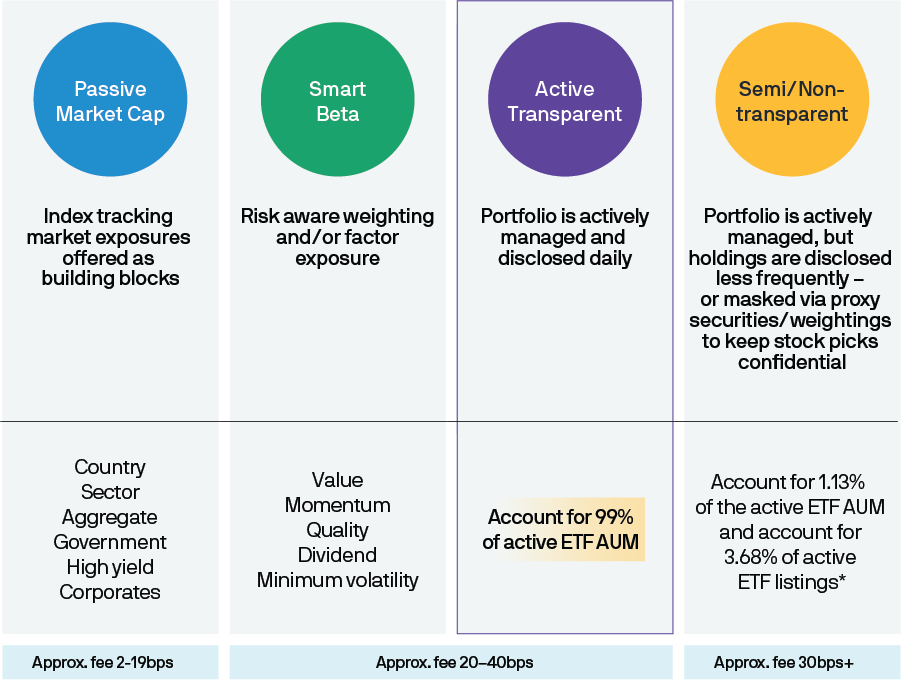
              • What are the different types of ETFs?

              • Why are ETFs tax efficient?

              • How do ETFs trade?

              • Why do ETFs trade at Premiums and Discounts?

              • How do ETFs trade at time of stress?

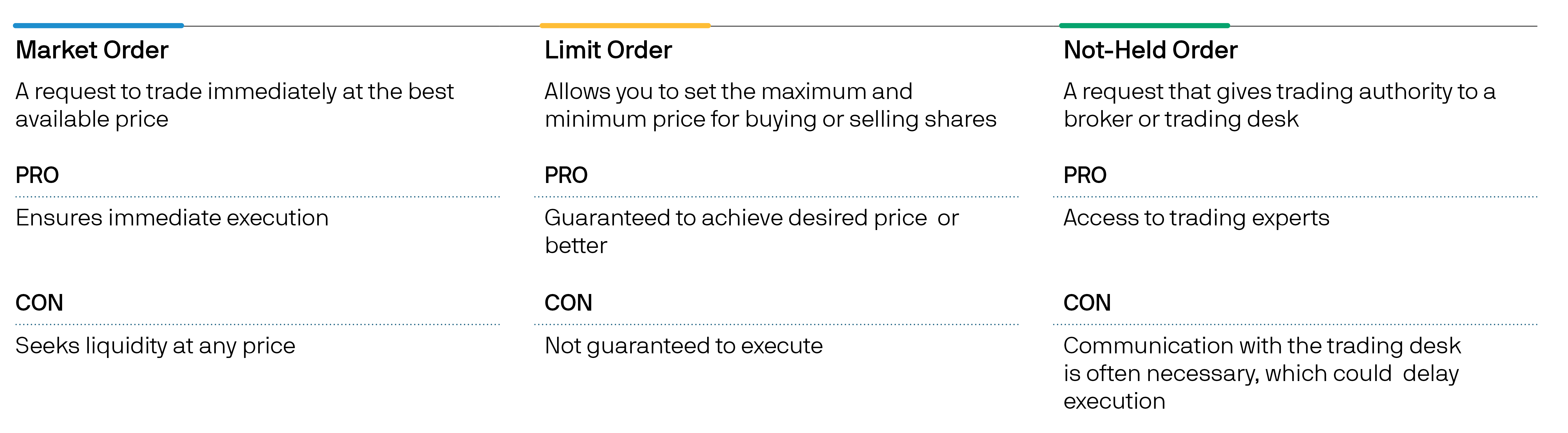
              • How to buy ETFs?

              What is an ETF?

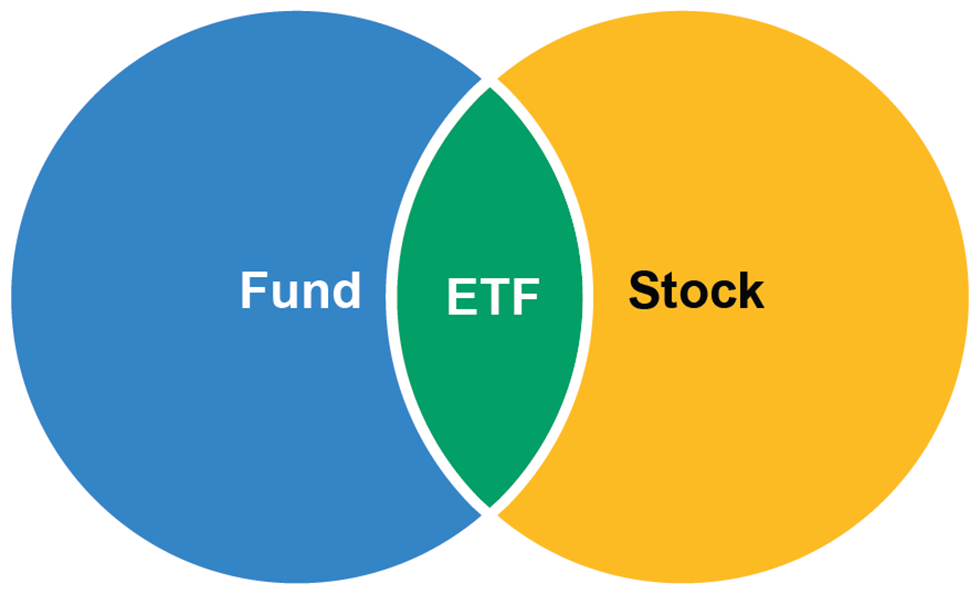
              An exchange-traded fund (ETF) is an investment wrapper which combines the benefits of a fund and a stock.

              A fund offers:

              • Diversified exposure
              • Economies of scale
              • Professional management

              A stock offers:

              • Liquidity
              • Transparency
              • Trading flexibility
              stock-etf-bond
              Source: J.P. Morgan Asset Management. Shown for illustrative purposes only.

              How does an ETF work?

              The structure of the ETF wrapper provides greater opportunity for improved economics.

              • Generally, ETFs do not charge 12b-1 fees
              • In-kind creations/redemptions, where securities are exchanged for ETF shares, contribute to the cost-effectiveness of ETFs
              • Market-makers help mitigate outsized premiums/discounts of the ETF market-price to the ETF net asset value
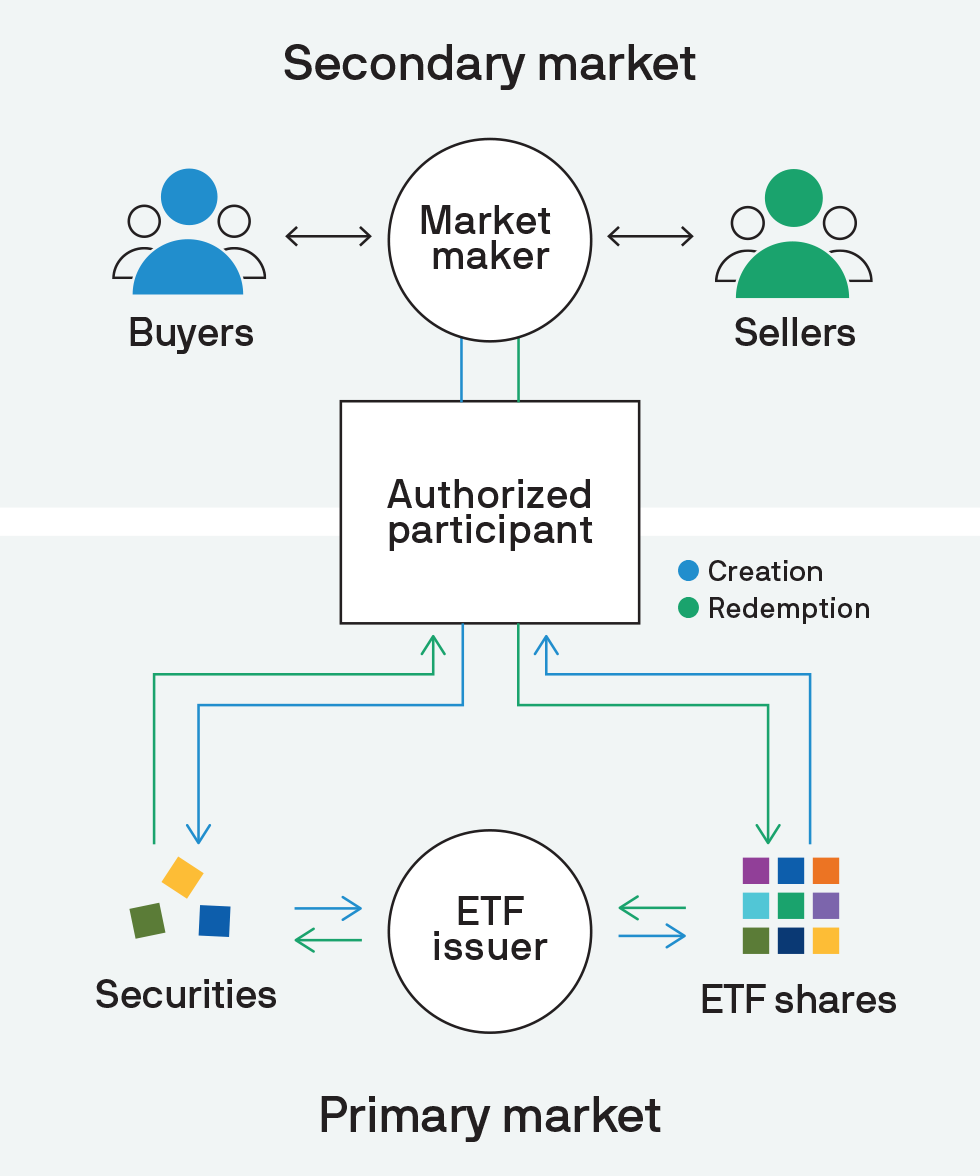
              Chart 4-reworked
              For Illustrative Use Only. Investors must buy and sell units on a secondary market with the assistance of an intermediary (e.g. a stockbroker) and may incur fees for doing so. In addition, investors may pay more than the current net asset value when buying units and may receive less than the current net asset value when selling them.

              Type of ETFs

              types-of-etfs
              *Source: J.P. Morgan Asset Management. Shown for illustrative purposes only.

              Why are ETFs tax efficient?

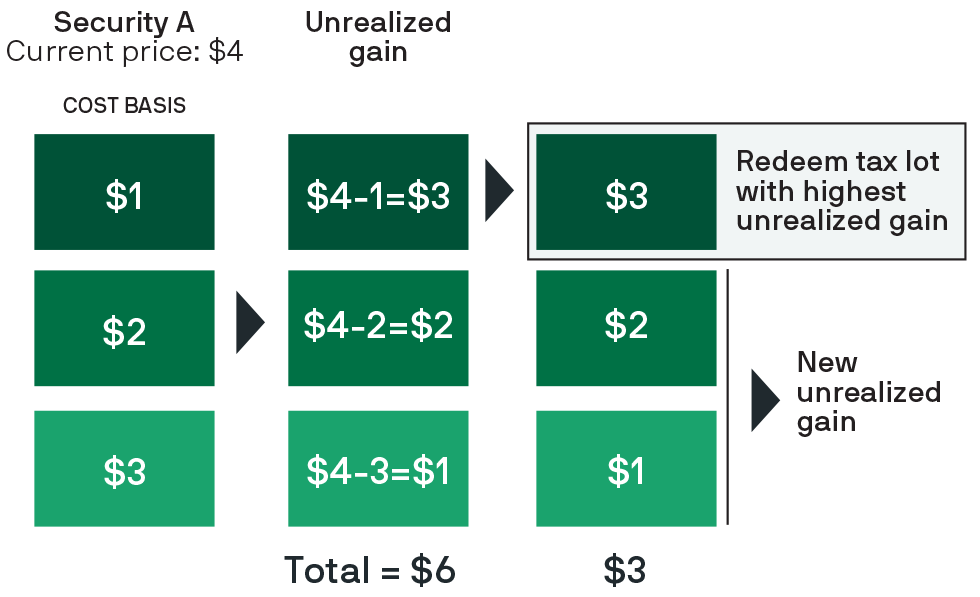
              When redemptions occur, ETFs remove purchases with the lowest cost basis, reducing tax liability.

              • When redemptions occur, purchases of securities with the lowest cost basis are moved out of the portfolio without being taxed. What’s left in the ETF are higher-priced securities, reducing the future tax liability when the ETF is sold.
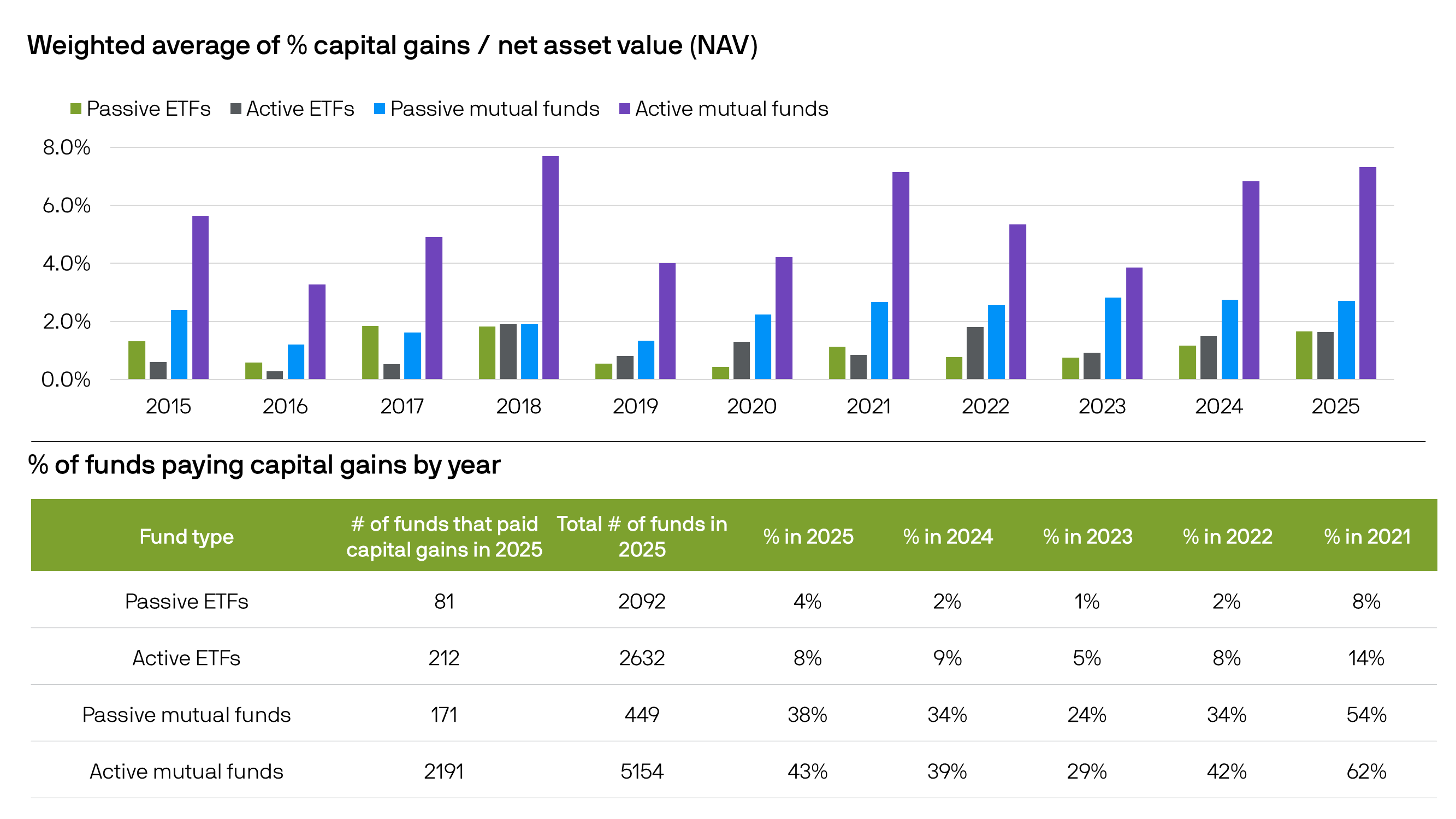
              • Portfolio gains are not distributed annually, so investors do not pay capital gains taxes until the ETF is sold.
              • When investors sell ETFs on an exchange, share are usually transferred to a buyer. No money comes out of the ETF, which means no capital gains taxes because managers aren’t forced to sell securities to raise cash.
              Slide51
              Source: Morningstar, J.P. Morgan Asset Management. Cost basis is the original purchase price used to determine capital gains and losses. Unrealized gain is the profit, if any, on a security that has not been sold (current price minus cost basis). Data as of December 31, 2025. Products are U.S. only.

              How do ETFs trade:

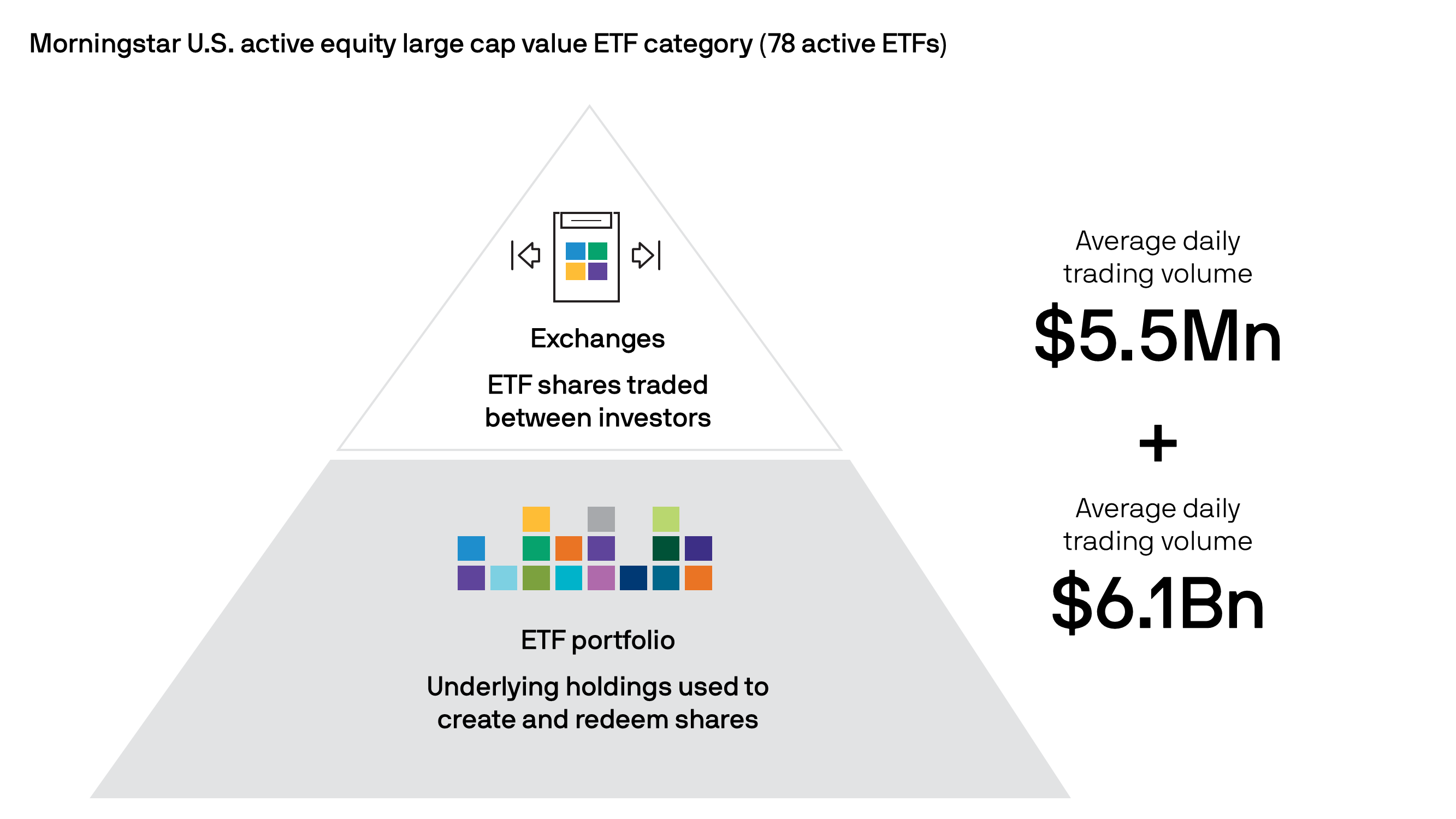
              ETFs offer more liquidity than meets the eye.
              Slide43
              Source: Bloomberg, J.P. Morgan Asset Management; as of December 31, 2025. Top of the pyramid represents the average of the 3-month period average daily volume (ADV) for the 78 active ETFs in the category ending 12/31/25. The bottom of the pyramid represents the average of the 3-month period ADV of the underlying baskets for the 78 active ETFs in the category ending 12/31/25. For illustrative purposes only.

              Why do ETFs trade at premiums and discounts?

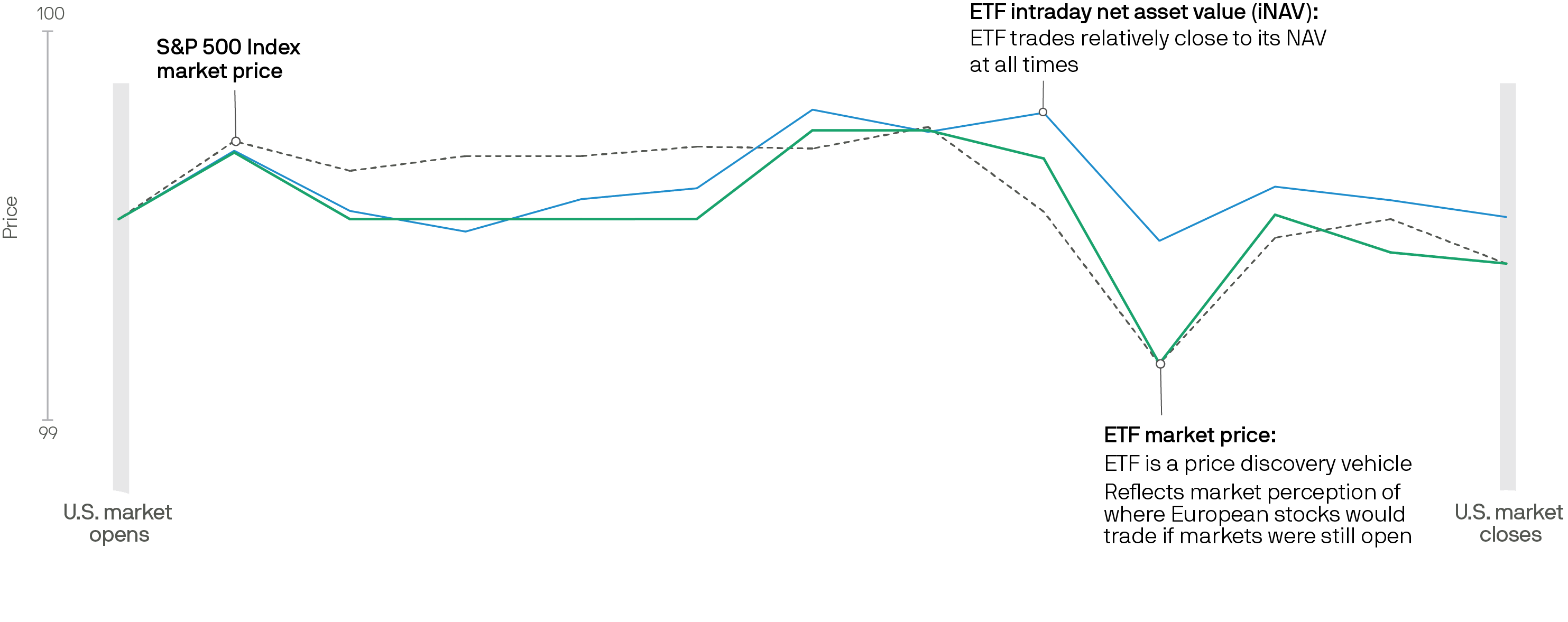
              Premiums and discounts are common with international ETFs.
              why-do-etfs-trade-at-premiums-and-discounts
              Source: J.P. Morgan Asset Management. Shown for illustrative purposes only.

              How do ETFs trade at time of stress?

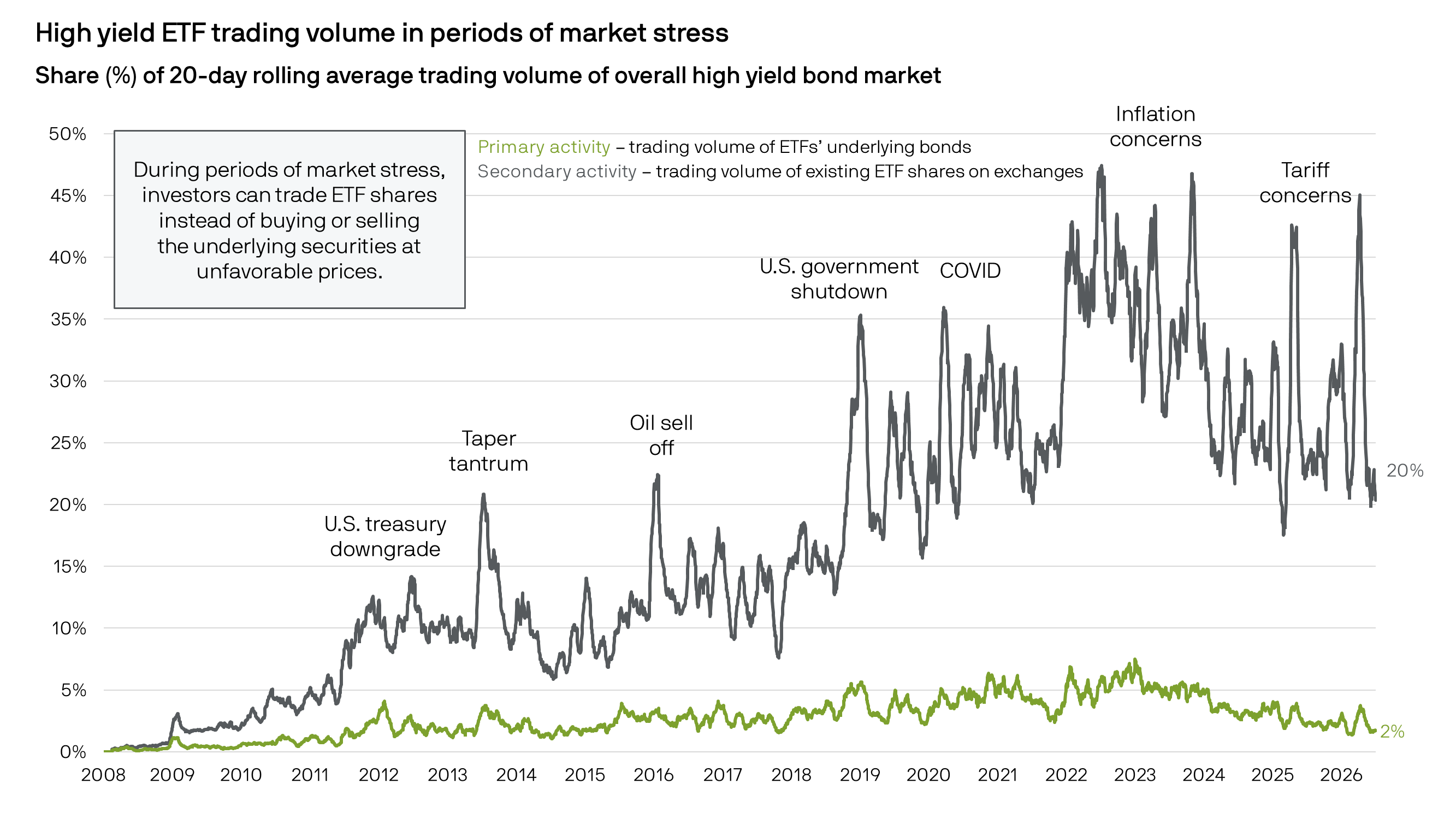
              High yield ETF trading volume in periods of market stress.

              Share (%) of 20-day rolling average trading volume of overall high yield bond market

              • During periods of market stress, investors can trade ETF shares instead of buying or selling the underlying securities at unfavorable prices.
              • In April 2025, trading volume in high yield ETF shares represented 41% of the trading volume of the high yield bond market.
              • During that same period, trading volume of the underlying bonds within high yield ETFs was just 4% of the overall high yield bond market volume.
              Slide45
              Source: Bloomberg, J.P. Morgan Asset Management. High yield ETF market is represented by HYG, JNK, IFLN, HYLB, SJNK, SHGY, USHY, HYLS, ANGL, HYS, BSJL, BSJM, BSJK and BBHY. High yield bond market is represented by FINRA TRACE Market Breadth High Yield Bond Dollar Volume (NTMBHV) and FINRA TRACE 144a HY $ Vol (NTMB4HYV). Guide to ETFs. Data as of June 30, 2026.

              How to buy ETFs?

              how-to-buy-etfs

              ETF Resources