


Allie Schwartz
Vice President, Portfolio Insights Specialist

Randy Aun
Executive Director, Portfolio Insights Specialist
Published:
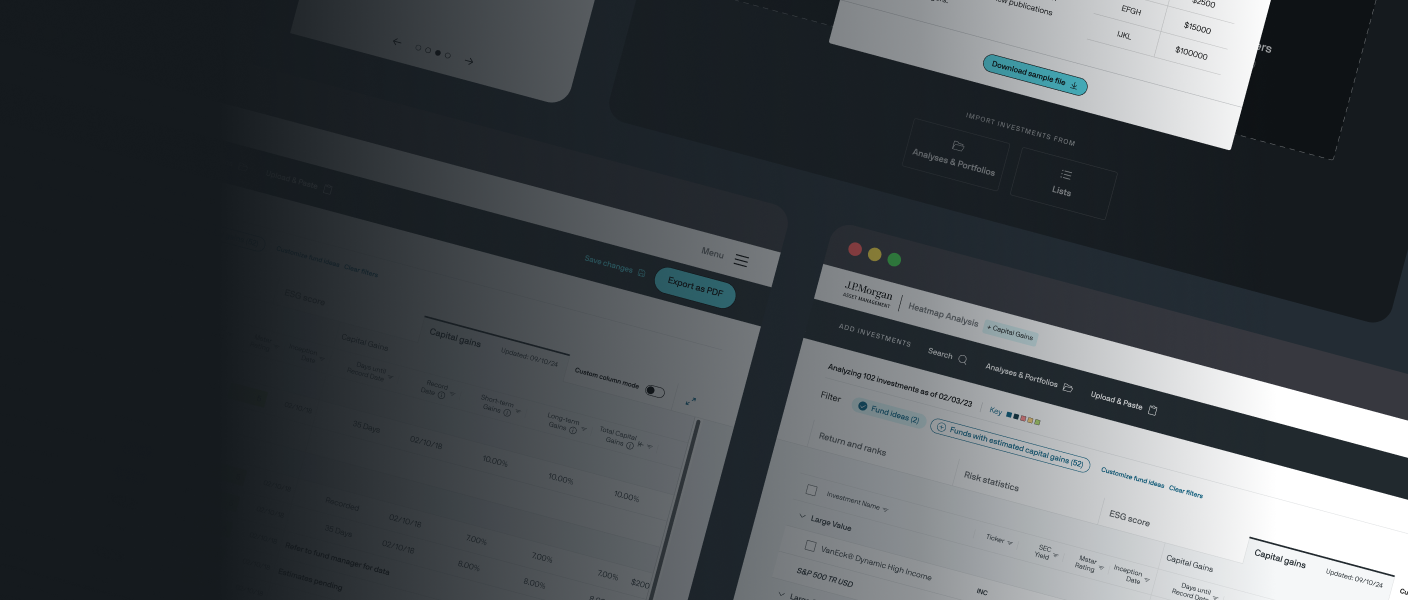
Monitor year-end capital gains distributions in one view. The Heatmap Analysis tool helps advisors spot large distributions and time trades around record dates.
The J.P. Morgan digital Heatmap Analysis tool helps advisors review investments and risk metrics throughout the year. During the fourth quarter, we add capital gains distribution estimates to help advisors assess potential after-tax implications and identify investments that may warrant attention before year-end. It brings together capital gains information for J.P. Morgan and competitor strategies in one place and is designed for fast, repeatable advisor workflows.
Year-end capital gains distributions can materially affect a client’s after-tax outcome. These potential distributions can also arrive as an unwelcome surprise if a client holds funds in a taxable account and distribution estimates aren’t being monitored as key dates approach. As we head into capital gains season, the difference between checking once and monitoring consistently can be the difference between proactive planning and reactive firefighting.
Capital gains season isn’t just a performance story. It’s also a tax planning story. Funds generally must distribute their net realized gains to shareholders, and in taxable accounts those distributions are generally taxable even when they’re reinvested. Staying current helps advisors identify where a distribution may create taxable income, when it may occur and how significant it could be for a given household.
Why monitoring capital gains distributions matters
- Fewer tax surprises, better client experience. A predictable tax outcome can be as valuable as a strong investment outcome. With timely distribution information, advisors can help set client expectations before Form 1099-DIV arrives.
- Plan around key dates. Record dates and distribution types matter. Having these details in front of you supports better coordination across client conversations, portfolio operations and year-end preparation.
- Stronger after-tax planning conversations. Tracking distributions can help clarify a client’s tax bill even when they haven’t sold an investment, which supports year-end planning alongside other tax-related considerations.
How to use the Heatmap Analysis tool for capital gains
Step 1: Review holdings in a single view
Start by reviewing the investments you want to monitor. The Heatmap Analysis tool covers more than 30,000 mutual funds and ETFs, including capital gains estimates for approximately 5,000 investments, and allows advisors to review up to 500 investments at a time. It organizes holdings by peer group, provides performance and risk metrics and surfaces distribution-related information in a single view, so advisors don’t have to collect estimates from each individual fund company.
For advisors new to this part of the calendar, a capital gains distribution is a payout a fund makes to shareholders when it realizes net gains from selling investments inside the portfolio. Mutual funds and other pooled investments generally must distribute those net realized gains each year, and in taxable accounts the distributions are typically taxable to shareholders even when they’re reinvested. In practice, that means a client can owe tax on a fund they never sold.
Step 2: Track large distributions and record dates as estimates update
Review position size and capital gains impact together to identify potentially significant distributions. A large percentage distribution on a small position may matter less than a moderate distribution on a larger holding, so use both measures to put the estimates in context.
Next, check record dates when considering any planned rebalance, tax-loss harvesting trade or new purchase. Timing matters: buying into a fund just before a distribution can mean receiving a taxable payout almost immediately.
Step 3: Look at the type of distribution
Check the short-term versus long-term capital gains breakdown rather than looking only at the total distribution. Two distributions of the same size can affect a client’s taxes differently. Long-term capital gains distributions are generally taxed at long-term capital gains rates. Short-term gains are generally reported as ordinary dividends on Form 1099-DIV and may be taxed at the client’s ordinary income rate. Use the breakdown to frame a discussion about the potential after-tax impact.
Return to the same view as estimates update to check any changes and consider whether year-end portfolio actions or client conversations may be appropriate before distributions are paid. Because estimates can change as key dates approach, the Heatmap Analysis tool provides updates weekly during October, November and December.
Coordinate with a qualified tax advisor for client-specific tax guidance and to confirm how any distributions and related portfolio actions may be treated for tax purposes.
Bottom line
Monitoring year-end capital gains distribution estimates can be a simple way to deliver tangible value during year-end planning: fewer surprises, better timing and clearer after-tax outcomes. The capital gains view within the Heatmap Analysis tool is designed to make that monitoring fast. It brings data into one consistently updated view to help create a repeatable process during one of the busiest times of the year.