logo
  • My Collections
    View saved content and presentation slides
  • Portfolio Analysis
  • Log out
  • Funds
      Contact Us

      Fund Listing

      • Mutual Funds
      • ETFs
      • ETF Range
      • How to Invest

      Capabilities

      • All Funds
      • Alternatives
      • Equities
      • Fixed Income
      • ETF Investing
      • Active research
      • Model Portfolios

      In Focus

      • Investing for Income
      • Investing for Fixed Income
      • Investing for Global and EM Equities
      • Investing for Sustainability
      • Investing for Alternatives
    • Insights
        Contact Us

        Market Insights

        • Market Insights Overview
        • Guide to the Markets

          The J.P. Morgan Guide to the Markets illustrates a comprehensive array of market and economic histories, trends and statistics through clear charts and graphs.

        • Guide to Alternatives

          Objective insights on alternatives industry trends, with charts and data across private equity, private credit, real estate, infrastructure and hedge funds.

        • Guide to Investing in Asia

          The Guide to Investing in Asia explores the diverse economies, markets and investment trends across Asia, including Japan, India, China and Southeast Asia.

        • Weekly Market Recap

          Finding balance in Chinese equities: export sectors could gain from progress on trade, while domestic-facing companies cushion against global trade volatility.

        • On the Minds of Investors

          What investment questions are on the minds of investors? Explore the questions investors ask frequently and find answers at J.P. Morgan Asset Management.

        • Podcasts

          Insights from Tai Hui, Chief Market Strategist, Asia, on what is happening in financial markets, from our Asia Pacific headquarters in Hong Kong.

        • Mid-Year Outlook 2026

          Global uncertainties abound: the Middle East conflict, central banks' response to returning inflation, U.S. policy shifts and the fast-changing AI landscape.

        • Solving for Fixed Income

          Exploring how the current environment has affected fixed income's traditional role and the many other opportunities that can accomplish its traditional objectives.

        • Eye on the Market

          Explore Eye on the Market, timely commentary that offers views on the economy, markets, and investment portfolios by Michael Cembalest.

        Portfolio Insights

        • Portfolio Insights Overview
        • Guide to ETFs

          Explore J.P. Morgan Asset Management’s ETF investing guide with insights on ETF market trends and best investing practices for smarter portfolio decisions.

        • Global Asset Allocation Views

          Amid resilient growth and a fading energy shock, we stay positive on risk assets, favoring U.S., Japan and EM equities and U.S. high yield.

        • Global Equity Views

          The profit outlook is cloudier, but we still expect modest growth. Many of our investors favor quality financials and industrials, avoiding high-priced defensives.

        • Fixed Income

          We highlight themes and implications from various fixed income teams to help guide your portfolio decisions.

        • Global Fixed Income Views

          Central bank credibility, solid profits, capex and resilient consumers lift expansion odds to 85%, outweighing inflation and AI headwinds.

        • Sustainable Investing

          Sustainable Insights

        • Alternatives Insights

          We bring you insights based on our nearly 50 years of experience investing in alternatives and more than 800 alternatives professionals around the globe.

        • Long-Term Capital Market Assumptions

          Our Long-Term Capital Market Assumptions (LTCMAs) deliver forward-looking return, volatility and correlation estimates for 200+ asset and strategy classes in 20+ base currencies.

      • Investment Ideas
          Contact Us
          • Latest ideas
          • Alternatives Outlook
          • Sustainable investing
          • ETF Knowledge
        • Resources
            Contact Us
            • All Resources
            • Multimedia
            • Insights App
            • Digital Portfolio Insights
            • Announcements
          • About Us
              Contact Us

              About us

              Backed by $4.6T in assets, we harness our active edge to deliver timely ideas and actionable insights that empower investors to achieve what matters most.

              • Overview
              • Awards
              • Diversity, Opportunity and Inclusion
              • Spectrum: Our Investment Platform
              • Our Leadership Team
              • Our Commitment to Research
            • Contact Us
              • My Collections
                View saved content and presentation slides
              • Portfolio Analysis
              • Log out
            • Financial Professional Login
            Log in
            You are about to leave the site Close
            J.P. Morgan Asset Management’s website and/or mobile terms, privacy and security policies don't apply to the site or app you're about to visit. Please review its terms, privacy and security policies to see how they apply to you. J.P. Morgan Asset Management isn’t responsible for (and doesn't provide) any products, services or content at this third-party site or app, except for products and services that explicitly carry the J.P. Morgan Asset Management name.
            CONTINUE Go Back
            1. The PBoC – Rate Cuts and Policy Clarification

            • LinkedIn Twitter Facebook Line WhatsApp

            The PBoC - Rate Cuts and Policy Clarification

            09/04/2020

            Aidan Shevlin

            On Friday, 3 April 2020, the Peoples Bank of China (PBoC) announced its second targeted Reserve Requirement Rate (RRR) cut in less than three weeks, reducing the effective RRR for medium and smaller banks to record lows.  Arguably, what’s more important was the accompanying reduction in the interest rate on excess reserves (IOER), the first cut in over a decade; which will pave the way for additional rate cuts and further interest rate reforms.  Both actions also help the PBoC address concerns that its policy response was lagging the aggressive actions taken by other central banks.

            The PBoC’s RRR Hat-Trick:

            The 100bps RRR cut was widely expected following calls for additional monetary policy support at the State Council meetings three days earlier.  The third RRR cut in 2020 will release ~CNY400bn of liquidity, while reducing bank funding costs, alleviating pressure on their loan-to-deposit ratios and increasing their ability to lend to small and medium enterprise clients.

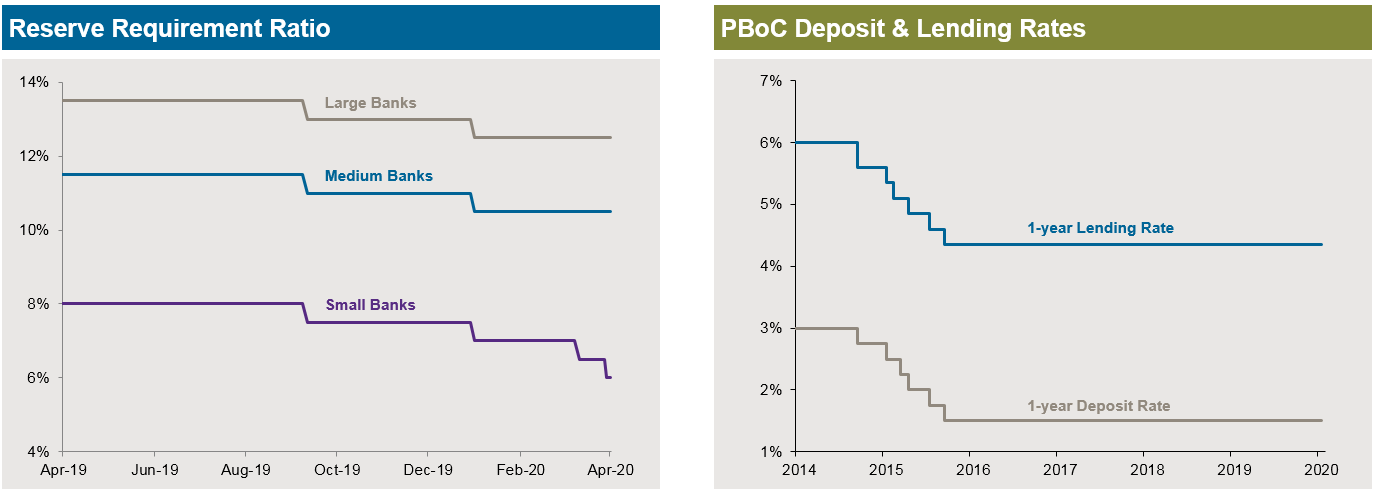
            Unlike open market operations, RRR represent permanent and free increases in commercial bank liquidity.  The previous 50bps targeted rate cut on 13 March released ~CNY550bn of liquidity, while the 2 January 50bps cut released ~CNY800bn of liquidity.  Following the cuts, the RRR for large banks is 12.5%, while it is 9-10.5% for medium banks and 6% for smaller banks.

            Fig 1: RRR rates for small and medium size banks are at record lows while benchmark interest rates remain unchanged
            Source: Bloomberg & J.P. Morgan Asset Management; data as at 5 Apr 2020

            The PBoC’s focus on RRR cuts has also clarified its policy stance and confirmed its hesitancy to change benchmark interest rates - reducing market expectations of a deposit or lending rate cut.  Since interest rates were liberalized in 2015, the central bank has de-emphasized benchmark rates and focused on using its growing arsenal of quasi-monetary policy tools to fine tune liquidity and interest rates.

            A benchmark lending rate cut would be an extremely strong signal of PBoC’s intentions and directly reduce funding costs for borrowers.  But it would also reduce commercial bank’s net interest rate margins unless accompanied by a benchmark deposit rate cut – which the PBoC appears reluctant to do – given the risk of penalizing small retail deposits, which still represent over 60% of commercial bank liabilities.

            IOER – Guiding rates lower:

            Excess reserves are the additional cash balances that commercial banks hold with the PBoC.  The 37bps IOER cut is the first time this rate has been reduced since November 2008.  At the end of 2019, excess cash balances represented 2.4% of total deposits; reducing the IOER will encourage commercial banks to invest their excess cash balances elsewhere – pushing interest rates on risky assets lower.

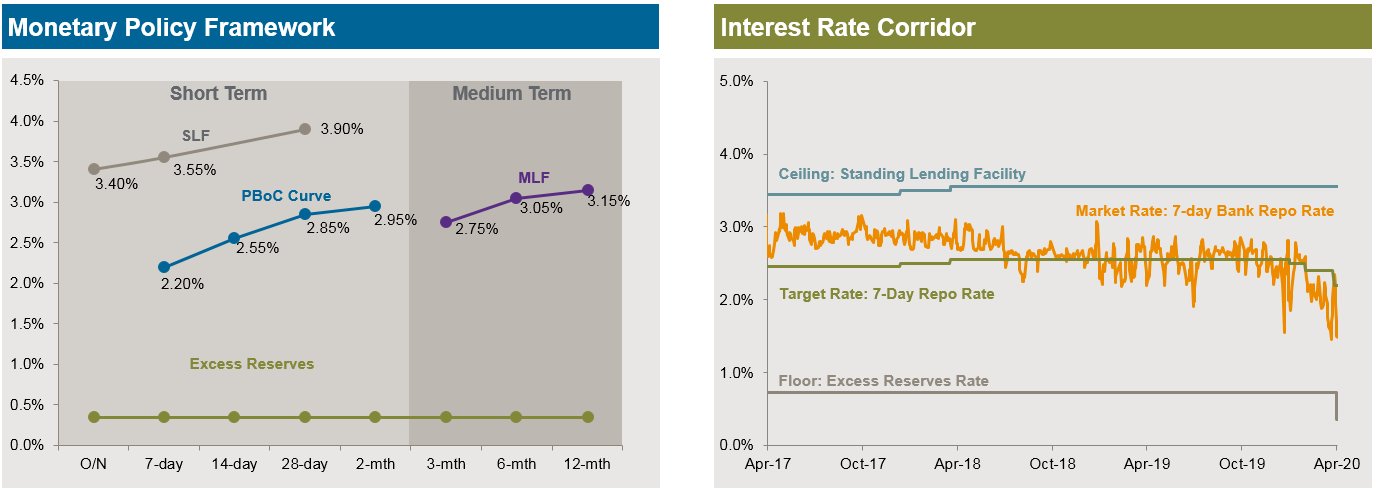
            Fig 2: China’s monetary policy framework is focused on controlling the 7-day reverse repo rate within an interest rate corridor.
            Source: Bloomberg & J.P. Morgan Asset Management: data as at 5 Apr 2020

            The IOER also forms the lower bound of the central banks interest rate corridor, while the 7-day reserve repo rate acts as the target rate and the standing lending facility (SLF) forms the upper bound. 

            Reducing the IOER paves the way for additional rate cuts and improves forward guidance. The PBoC has already cut the 7-day reverse repo rate three times this year - the latest 20bps reduction on the 30th of March to 2.20%.  A SLF cut is now likely as the central bank guides market driven interest rates even lower. 

            PBoC - Converging and clarifying:

            As the first country to be affected by the COVID-19 outbreak, the Chinese economy has witnessed significant economic disruption.  The government and PBoC reacted quickly to stabilize the economy, however, their subsequent fiscal and monetary policy response has been relatively muted by international standards.  While major central banks have slashed interest rates and introduced quantitative easing, the PBoC has relied on a series of mini-steps, including liquidity injections and modest quasi-monetary policy rate cuts to stabilize and support financial markets.

            While high frequency trackers signal a revival in domestic economic activity, the expanding global shutdown threatens to derail China’s prospects of a v-shaped recovery, prompted renewed dovish comments from the Politburo and Standing Committee - which triggered the latest PBoC actions. 

            Implications for RMB Money Markets:  

            The recent PBoC rate cuts will place additional downward pressure on market driven rates, Shibor rates have already trended lower while the yield curve has flattened.  Meanwhile, refinements to the central bank interest rate corridor will pave the way for more aggressive future monetary policy actions, but the PBoCs reluctance to cut benchmark interest rates will increase the divergence between policy and market driven rates – creating additional investment challenges for money market investors.


            • China
            • APAC

            RELATED ARTICLES

            China’s Interest Rate Pivot

            While China’s post-Covid-19 economic data is showing signs of normalization, the government’s focus on stability will have significant implications for monetary policy and interest rates

            Read more

            PBOC: small move, strong signal

            We look at why the People’s Bank of China’s (PBoC) made its recent and notable dovish pivot and its implications for investors

            Read more

            Singapore Dollar – no longer defying gravity

            The Singapore Dollar is no longer defying gravity – we discuss why and the implications for cash investors.

            Read more
            JPMorgan Asset Management

            • Terms & Conditions
            • Financial Services Guide
            • Privacy Policy
            • Cookie Policy
            • Investment Stewardship
            • Voting Policy
            • Unit Pricing Policy
            • Complaint Resolution
            • Sitemap
            J.P. Morgan

            • J.P. Morgan
            • JPMorgan Chase
            • Chase

            Please note:  Following recent amendments to the Corporations Act, where unitholders have provided us with your email address, we will now send notices of meetings, other meeting-related documents and annual financial reports electronically unless the unitholder elects to receive these in physical form and notify us of this election. Unitholders have the right to elect whether to receive some or all of such Communications in electronic or physical form, the right to elect not to receive annual financial reports at all and the right to elect to receive a single specified Communication on an ad hoc basis, in an electronic or physical form.


            All investments contain risk and may lose value. This advertisement has been prepared and issued by JPMorgan Asset Management (Australia) Limited (ABN 55 143 832 080) (AFSL No. 376919) being the investment manager of the fund. It is for general information only, without taking into account your objectives, financial situation or needs and does not constitute personal financial advice. Before making any decision, it is important for investors to consider the appropriateness of the information and seek appropriate legal, tax, and other professional advice. For more detailed information relating to the risks of the Fund, the type of customer (target market) it has been designed for and any distribution conditions please refer to the relevant Product Disclosure Statement and Target Market Determination which have been issued by Perpetual Trust Services Limited, ABN 48 000 142 049, AFSL 236648, as the responsible entity of the fund available on https://am.jpmorgan.com/au.