logo
  • My Collections
    View saved content and presentation slides
  • Portfolio Analysis
  • Log out
  • Funds
      Contact Us

      Fund Listing

      • Mutual Funds
      • ETFs
      • ETF Range
      • How to Invest

      Capabilities

      • All Funds
      • Alternatives
      • Equities
      • Fixed Income
      • ETF Investing
      • Active research
      • Model Portfolios

      In Focus

      • Investing for Income
      • Investing for Fixed Income
      • Investing for Global and EM Equities
      • Investing for Sustainability
      • Investing for Alternatives
    • Insights
        Contact Us

        Market Insights

        • Market Insights Overview
        • Guide to the Markets

          The J.P. Morgan Guide to the Markets illustrates a comprehensive array of market and economic histories, trends and statistics through clear charts and graphs.

        • Guide to Alternatives

          Objective insights on alternatives industry trends, with charts and data across private equity, private credit, real estate, infrastructure and hedge funds.

        • Guide to Investing in Asia

          The Guide to Investing in Asia explores the diverse economies, markets and investment trends across Asia, including Japan, India, China and Southeast Asia.

        • Weekly Market Recap

          Finding balance in Chinese equities: export sectors could gain from progress on trade, while domestic-facing companies cushion against global trade volatility.

        • On the Minds of Investors

          What investment questions are on the minds of investors? Explore the questions investors ask frequently and find answers at J.P. Morgan Asset Management.

        • Podcasts

          Insights from Tai Hui, Chief Market Strategist, Asia, on what is happening in financial markets, from our Asia Pacific headquarters in Hong Kong.

        • Mid-Year Outlook 2026

          Global uncertainties abound: the Middle East conflict, central banks' response to returning inflation, U.S. policy shifts and the fast-changing AI landscape.

        • Solving for Fixed Income

          Exploring how the current environment has affected fixed income's traditional role and the many other opportunities that can accomplish its traditional objectives.

        • Eye on the Market

          Explore Eye on the Market, timely commentary that offers views on the economy, markets, and investment portfolios by Michael Cembalest.

        Portfolio Insights

        • Portfolio Insights Overview
        • Guide to ETFs

          Explore J.P. Morgan Asset Management’s ETF investing guide with insights on ETF market trends and best investing practices for smarter portfolio decisions.

        • Global Asset Allocation Views

          Amid resilient growth and a fading energy shock, we stay positive on risk assets, favoring U.S., Japan and EM equities and U.S. high yield.

        • Global Equity Views

          The profit outlook is cloudier, but we still expect modest growth. Many of our investors favor quality financials and industrials, avoiding high-priced defensives.

        • Fixed Income

          We highlight themes and implications from various fixed income teams to help guide your portfolio decisions.

        • Global Fixed Income Views

          Central bank credibility, solid profits, capex and resilient consumers lift expansion odds to 85%, outweighing inflation and AI headwinds.

        • Sustainable Investing

          Sustainable Insights

        • Alternatives Insights

          We bring you insights based on our nearly 50 years of experience investing in alternatives and more than 800 alternatives professionals around the globe.

        • Long-Term Capital Market Assumptions

          Our Long-Term Capital Market Assumptions (LTCMAs) deliver forward-looking return, volatility and correlation estimates for 200+ asset and strategy classes in 20+ base currencies.

      • Investment Ideas
          Contact Us
          • Latest ideas
          • Alternatives Outlook
          • Sustainable investing
          • ETF Knowledge
        • Resources
            Contact Us
            • All Resources
            • Multimedia
            • Insights App
            • Digital Portfolio Insights
            • Announcements
          • About Us
              Contact Us

              About us

              Backed by $4.6T in assets, we harness our active edge to deliver timely ideas and actionable insights that empower investors to achieve what matters most.

              • Overview
              • Awards
              • Diversity, Opportunity and Inclusion
              • Spectrum: Our Investment Platform
              • Our Leadership Team
              • Our Commitment to Research
            • Contact Us
              • My Collections
                View saved content and presentation slides
              • Portfolio Analysis
              • Log out
            • Financial Professional Login
            Log in
            You are about to leave the site Close
            J.P. Morgan Asset Management’s website and/or mobile terms, privacy and security policies don't apply to the site or app you're about to visit. Please review its terms, privacy and security policies to see how they apply to you. J.P. Morgan Asset Management isn’t responsible for (and doesn't provide) any products, services or content at this third-party site or app, except for products and services that explicitly carry the J.P. Morgan Asset Management name.
            CONTINUE Go Back
            1. Emerging Markets Debt – Time to Buy?

            • LinkedIn Twitter Facebook Line WhatsApp

            Emerging Markets Debt – Time to Buy?

            02/04/2020

            Zsolt Papp

            “Buy when there is blood in the streets”

            This quote is attributed to Baron Nathan Mayer Rothschild (1777-1836) and although there is no evidence that he actually said it, it has entered financial market folklore. Looking back at the past six weeks, there can be little doubt that a lot of blood (metaphorically) has been spilled. And as much as one wishes one could say that this time was different, it both looked and felt awfully familiar for investors in EMD. Spreads widened, prices dropped, investors redeemed money and perma bears had their field day. 

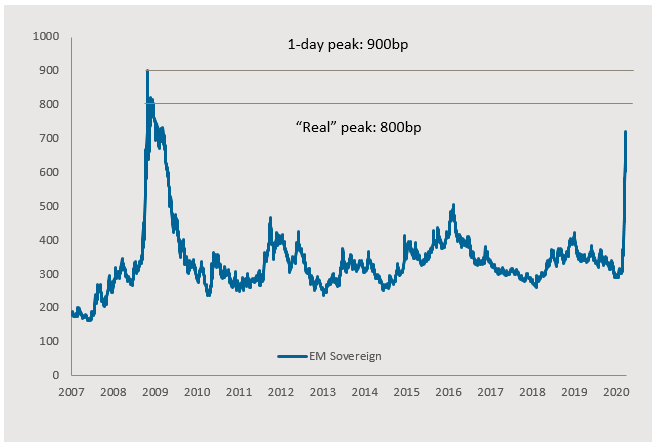
            EM Sovereign composite spread (bps) close to peak?
            Source: Bloomberg, JPMAM, Data as at 27.03.2020. JPM EMBI Global Diversified 

            Is this time any different?

            As the chart above shows, the EM sovereign bond spreads widened to around 700bp in late March from a low of 300bp in early February. This is not quite as high as during the global financial crisis (GFC), but the chart also shows that this was a one-day event (23rd October, 2008). It briefly recovered to 640bp then sharply widened back to 800bp and subsequently settled around that level for about one month. After that it started to decline, initially at a relatively leisurely pace but it rapidly accelerated after another 10 weeks. The post-double-dip peaked was therefore around 800bp.

            This time, it has not (yet?) reached the either of the two peaks, which suggests that we could see more spread widening, at worst as much as up to 150-200bp. However, there is good reason to believe that spreads could be closer to the peak than history suggests. So what is different? First, this is not a financial sector crisis, in contrast to 2008.  The spread widening in 2008 was driven by the fear that the global banking and credit system was broken and that practically nobody could get financing. This time the banking system works reasonably well, no major financial institution is in distress, and the ability to provide credit remains intact. 

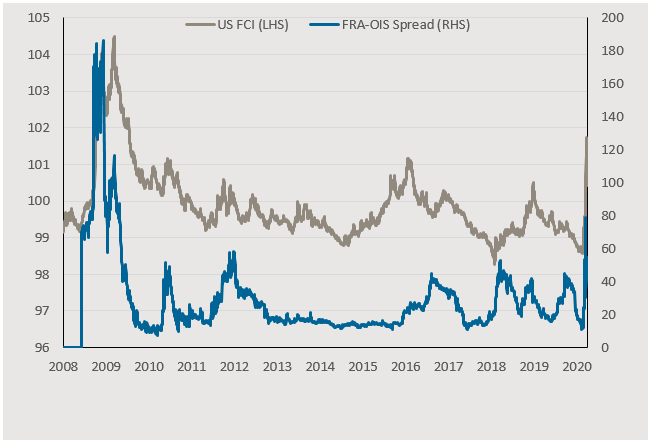
            US Financial Conditions less stressed than in 2008 
            Source: Bloomberg, JPMAM, Data as at 31.03.2020. GS US Financial Conditions Index

            Admittedly, there has been some stress in the financial system, as illustrated by the FRA-OIS spread in the chart above. However, the current level of 47.5bp is significantly below levels seen during the GFC period and while additional spread widening cannot be ruled out, central banks are much more sensitive to liquidity in the banking system than pre-GFC.  In 2008, stock markets started to fall in June but central banks waited until September with the first cuts (the ECB actually even hiked rates in July). This time the reaction gap was only four weeks and much broader across DM and EM central banks.

            The latter is particularly important because it underpins that EMs are in much better shape than in 2008 or in 2013 (remember the taper tantrum?). Numerous EM central banks have already cut interest rates this year, including the People’s Bank of China (PBOC), Reserve Bank of India (RBI), Banco de México (Banxico), Banco Central do Brasil (BCB) and Bank of Russia (CBR).

            The fiscal policy response has been also much faster and bigger than during GFC. The US alone have announced a fiscal package of 5.7% of GDP and Germany and the UK have presented similarly large stimuli. EM countries are also implementing sizeable fiscal packages as the measures announced so far amount to 2.25% of EM GDP.

            All good then?

            It could be concluded from the above that such measures should lead to a sharp rebound in economic activity. But the painful and often repressed memory from previous crises is that recoveries are rarely walk in the park. Economists expect the worst recession since WWII and as the disruption caused by COVID-19 is deeper and more global on reach than previous similar events it could take longer to make up production losses.

            Inevitably, defaults will rise in such a scenario, but the interesting question is by how much. Analysts are now expecting Global HY defaults to rise to 6-8% and EM HY to around 5% (CIB research doubled the forecast to 4.8% from 2.4%). The region most at risk is Middle East & Africa due to large size of the oil & gas sector. Analysts expected the default rate to increase to 7.2% from 1.6% in 2019. However, Latin America (2.3% => 5.4%), Asia (1.6% => 4.0%) and EM Europe (0.0%  => 4.0%) are also forecast to suffer significant increases in defaults.

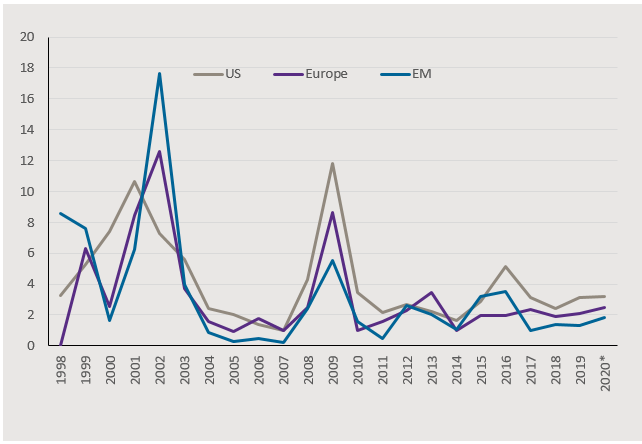
            HY corporate default rates (%)
            Source: Standard & Poor’s, *Data as at 23.03.2020

            Some readers might be surprised that the forecast for EM is less bad than for Global HY, but this is actually in line with historical data. Except for 2002, which was a bit of an “annus horribilis” for EM, mainly because of the impact of Argentina’s sovereign default on the corporate sector, default rates have been similar or lower than in the US or Europe. Credit fundamentals also support the better outlook for EM corporates. Going into this crisis, leverage metrics for EM corporates were significantly better than for DM. Net leverage, for example, for EM HY stood at 3.2x vs 4.0x for US HY and interest coverage at 5.3x compared to 4.5x.

            Sovereign credit quality is also likely to suffer, not only from lower growth but also from generous fiscal packages. Most EM countries have sufficient financial space to implement these stimuli (eg local market funding, bi or multilateral sources, savings) and as bond markets recover, access to refinancing should become available again. In some cases, though, the IMF will probably have to step in to avoid current account crises and help organise orderly debt restructurings.

            The good news is that the IMF has substantial financial firepower. Total financial sources amount to around SDR 975bn (USD 1.3trn) of which SDR 715bn are available for lending (the rest is set aside as a liquidity buffer). Current IMF credits amount to SDR 117bn, which leaves SDR 598bn (USD 815bn) for additional lending to countries in need.

            Is it time to buy?

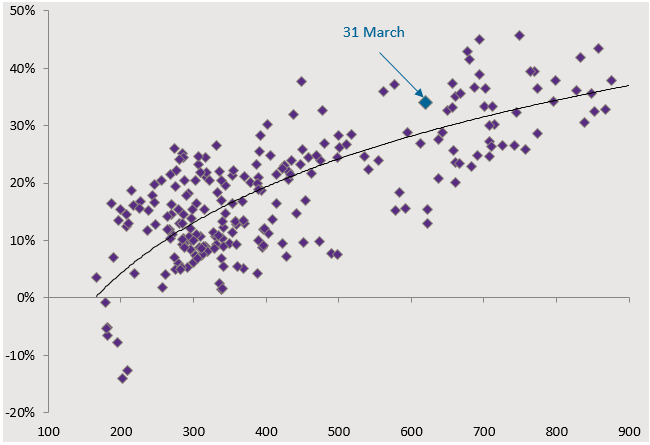
            Investors sensitive to market timing should consider the risk of a double dip. We have seen it in the GFC and cannot rule it out from happening again. For investors taking the longer term view, however, the chart below could provide the answer.

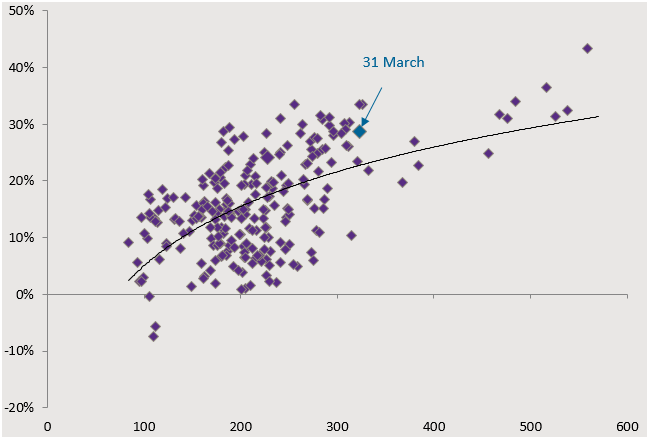
            Based on historical data, current spread level suggests ~30% return in next  24 months for EM debt
            Source: Bloomberg, JPMAM, Data as at 31.03.2020. JPM EMBI Global Diversified spread and return

            The last four weeks have created deep value and at current levels EM debt has historically returned more than 30% over two years. In addition, two-year returns have always been positive. Investors may well be able to still enter the market at similar levels in a couple of weeks and perhaps spared themselves the pains of a double-dip. However, gradually building up positions enables investors to participate in a rally without having to chase it after it has started.

            There is also a less risky alternative from a credit perspective. The sell-off has also created deep value in EM Investment Grade, as the spread has widened to 330 basis points. As the chart below shows, returns at these spread levels have been around 20% over two years. In addition, default rates have been historically very low. The latest high for BBB- rated EM IG corporates was in 2008 with 1% and the median default rate stands at 0% according to S&P.

            Low credit risk alternative: EM Investment Grade also offers double-digit returns at current spread levels
            Source: Bloomberg, JPMAM, Data as at 31.03.2020. JPM EMBI Global Diversified Investment Grade spread and return

            Let me end this blog on another quote attributed to Baron Rothschild: “buy on the sound of cannons, sell on the sound of trumpets”. I am quite certain that we haven’t yet heard the trumpets, but the last few weeks did sound very much like cannons to me.

            • Emerging Markets

            RELATED ARTICLES

            Add extra guacamole for a dollar!

            Emerging Markets Local Currency debt emerged as one of our best ideas at our most recent investment quarterly meeting. This isn't just about the US Dollar; we like what we see in local EM.

            Read more

            Emerging Markets: Don’t Fight the Central Banks

            The opportunity cost of not investing in EM debt remains very high. Most importantly the same applies for the rest of fixed income: don’t fight the central banks.

            Read more

            A new era for alpha generation in local emerging markets?

            The global savings glut has been driving asset price valuations for the last decade or so. Emerging Markets and investors need to prepare for a potential new world.

            Read more
            JPMorgan Asset Management

            • Terms & Conditions
            • Financial Services Guide
            • Privacy Policy
            • Cookie Policy
            • Investment Stewardship
            • Voting Policy
            • Unit Pricing Policy
            • Complaint Resolution
            • Sitemap
            J.P. Morgan

            • J.P. Morgan
            • JPMorgan Chase
            • Chase

            Please note:  Following recent amendments to the Corporations Act, where unitholders have provided us with your email address, we will now send notices of meetings, other meeting-related documents and annual financial reports electronically unless the unitholder elects to receive these in physical form and notify us of this election. Unitholders have the right to elect whether to receive some or all of such Communications in electronic or physical form, the right to elect not to receive annual financial reports at all and the right to elect to receive a single specified Communication on an ad hoc basis, in an electronic or physical form.


            All investments contain risk and may lose value. This advertisement has been prepared and issued by JPMorgan Asset Management (Australia) Limited (ABN 55 143 832 080) (AFSL No. 376919) being the investment manager of the fund. It is for general information only, without taking into account your objectives, financial situation or needs and does not constitute personal financial advice. Before making any decision, it is important for investors to consider the appropriateness of the information and seek appropriate legal, tax, and other professional advice. For more detailed information relating to the risks of the Fund, the type of customer (target market) it has been designed for and any distribution conditions please refer to the relevant Product Disclosure Statement and Target Market Determination which have been issued by Perpetual Trust Services Limited, ABN 48 000 142 049, AFSL 236648, as the responsible entity of the fund available on https://am.jpmorgan.com/au.