logo
  • My Collections
    View saved content and presentation slides
  • Portfolio Analysis
  • Log out
  • Funds
      Contact Us

      Fund Listing

      • Mutual Funds
      • ETFs
      • ETF Range
      • How to Invest

      Capabilities

      • All Funds
      • Alternatives
      • Equities
      • Fixed Income
      • ETF Investing
      • Active research
      • Model Portfolios

      In Focus

      • Investing for Income
      • Investing for Fixed Income
      • Investing for Global and EM Equities
      • Investing for Sustainability
      • Investing for Alternatives
    • Insights
        Contact Us

        Market Insights

        • Market Insights Overview
        • Guide to the Markets

          The J.P. Morgan Guide to the Markets illustrates a comprehensive array of market and economic histories, trends and statistics through clear charts and graphs.

        • Guide to Alternatives

          Objective insights on alternatives industry trends, with charts and data across private equity, private credit, real estate, infrastructure and hedge funds.

        • Guide to Investing in Asia

          The Guide to Investing in Asia explores the diverse economies, markets and investment trends across Asia, including Japan, India, China and Southeast Asia.

        • Weekly Market Recap

          Finding balance in Chinese equities: export sectors could gain from progress on trade, while domestic-facing companies cushion against global trade volatility.

        • On the Minds of Investors

          What investment questions are on the minds of investors? Explore the questions investors ask frequently and find answers at J.P. Morgan Asset Management.

        • Podcasts

          Insights from Tai Hui, Chief Market Strategist, Asia, on what is happening in financial markets, from our Asia Pacific headquarters in Hong Kong.

        • Mid-Year Outlook 2026

          Global uncertainties abound: the Middle East conflict, central banks' response to returning inflation, U.S. policy shifts and the fast-changing AI landscape.

        • Solving for Fixed Income

          Exploring how the current environment has affected fixed income's traditional role and the many other opportunities that can accomplish its traditional objectives.

        • Eye on the Market

          Explore Eye on the Market, timely commentary that offers views on the economy, markets, and investment portfolios by Michael Cembalest.

        Portfolio Insights

        • Portfolio Insights Overview
        • Guide to ETFs

          Explore J.P. Morgan Asset Management’s ETF investing guide with insights on ETF market trends and best investing practices for smarter portfolio decisions.

        • Global Asset Allocation Views

          Amid resilient growth and a fading energy shock, we stay positive on risk assets, favoring U.S., Japan and EM equities and U.S. high yield.

        • Global Equity Views

          The profit outlook is cloudier, but we still expect modest growth. Many of our investors favor quality financials and industrials, avoiding high-priced defensives.

        • Fixed Income

          We highlight themes and implications from various fixed income teams to help guide your portfolio decisions.

        • Global Fixed Income Views

          Central bank credibility, solid profits, capex and resilient consumers lift expansion odds to 85%, outweighing inflation and AI headwinds.

        • Sustainable Investing

          Sustainable Insights

        • Alternatives Insights

          We bring you insights based on our nearly 50 years of experience investing in alternatives and more than 800 alternatives professionals around the globe.

        • Long-Term Capital Market Assumptions

          Our Long-Term Capital Market Assumptions (LTCMAs) deliver forward-looking return, volatility and correlation estimates for 200+ asset and strategy classes in 20+ base currencies.

      • Investment Ideas
          Contact Us
          • Latest ideas
          • Alternatives Outlook
          • Sustainable investing
          • ETF Knowledge
        • Resources
            Contact Us
            • All Resources
            • Multimedia
            • Insights App
            • Digital Portfolio Insights
            • Announcements
          • About Us
              Contact Us
              • Overview
              • Awards
              • Diversity, Opportunity and Inclusion
              • Spectrum: Our Investment Platform
              • Our Leadership Team
              • Our Commitment to Research
            • Contact Us
              • My Collections
                View saved content and presentation slides
              • Portfolio Analysis
              • Log out
            • Financial Professional Login
            Log in
            You are about to leave the site Close
            J.P. Morgan Asset Management’s website and/or mobile terms, privacy and security policies don't apply to the site or app you're about to visit. Please review its terms, privacy and security policies to see how they apply to you. J.P. Morgan Asset Management isn’t responsible for (and doesn't provide) any products, services or content at this third-party site or app, except for products and services that explicitly carry the J.P. Morgan Asset Management name.
            CONTINUE Go Back
            1. Add extra guacamole for a dollar!

            • LinkedIn Twitter Facebook Line WhatsApp

            Add extra guacamole for a dollar!

            16/10/2020

            Giles Bedford

            Kush Purohit

            Choosing to become an emerging markets (EM) local currency manager is something of an esoteric professional choice. It is an intellectually taxing task, and not commonly glamourous - even for the gifted. Unlike our more swashbuckling hard currency options, EM local can go years without being much in favour, so it probably isn’t a good choice if you like being the centre of attention. The reason for this is simple: Local curves might often be steep, but the US dollar is also mostly dominant. Currencies, such as Zloty, Lira and Rand just don’t commonly appeal as better choices for most investors versus a reserve currency. Skilled local currency managers make huge returns in local markets, only to see the mighty US Dollar pedestrianize their gains. It is probably fair to say that if Sisyphus was a bond investor, he’d be an EM local currency manager.

            Therefore it is probably newsworthy that our local currency team is currently nowhere near miserable, and is in danger of getting excited about their space.

            This unfamiliar sensation has been percolating for a while. At the baseline, EM Local Currency assets have always offered the compound appeal of the pure beta of local currency exposure and the opportunity to play domestic treasury curves. That combination looks reasonably appealing right about now – after all, the steeper local curves in emerging markets look like a kind of tropical mountain paradise compared to the rolling prairie that is European investment grade.   

            That appeal appeared to play out during our most recent Investment Quarterly meeting in September, as the committee spent some time debating the case for a softening US dollar with core yields low and the policy pumps on. Right on cue, emerging market local currency debt emerged as a favoured idea at the end of the session several hours later. This combination of events is not a coincidence: investors like to look to EM local currency assets as an alternative when the US dollar is expected to weaken. They are usually right: as a softening dollar generally brings a small pickup in return.

            But to drive a sustained rally in the space, we need a broader confluence of factors, and this is why our EM local team is beginning to smile. The most optimal scenario sees emerging market growth accelerating at a time when developed market growth is relatively slow – and the US Dollar subsequently less ascendant. To really run, we need a few other things in place: it helps if the EM macro story is on an improving trajectory, local policymakers are doing mostly predictable things, and global appetite for commodities and manufactured goods is improving. When such a confluence happens, EM local currency can really move – and it seems we are getting closer to exactly this potential scenario. Spice that mix with the appeal of higher real yields to attract flows and the appeal is clear.

             “Buy the emerging markets local currency carry story!” is such a common refrain in our space that it is almost an anthem. And while it is true that EM commonly offers an elevated carry, it really has to reach preposterous levels to drive material crossover flows singularly without an additional catalyst. The usual argument offered by fund selectors happily rejecting this higher carry is that it is seen to come packaged with the inconvenient potential for alarming levels of volatility. We will refrain from the usual reply about macro improvement, because the simple fact is this: No matter how often the EM community talks about robust and resilient fundamentals, and no matter how many white papers, thought pieces and conferences we do, EM’s greatest source of shock remains foreign investors setting fire to their confidence and fleeing their positions ahead of some alleged apocalypse. This is ultimately why buying dips typically works in emerging markets – because life goes on.

            COVID-19 has made growth in EM somewhat controversial. Emerging market bears would have you believe that underinvested healthcare systems would be poorly placed to manage a dangerous disease in countries with less developed infrastructure – leave aside that emerging markets have largely defeated endemic poverty over the last 30 years.  Meanwhile, emerging market bulls point to the region’s relative youth and vigorous public policy response as sufficient to protect the macro story. The unfolding data tells a story somewhere in the middle. While emerging countries did see a drop in growth this year, they have also shown resilience in the face of the pandemic and are now recovering swiftly, helped by experience gained in managing other infectious disease outbreaks. Ultimately, this recovery in growth in EM should reinforce that EM really is a different asset class than it was, in say, 1997.

            The resulting EM growth recovery is increasingly becoming very difficult to ignore. The problem is, you’ve probably heard most of it before.

            Back at the investment quarterly meeting, our CIO threw up his hands in mock frustration as our Head of EMD began his presentation with the now traditional Chinese growth argument. “Is there anything more to EM than China?” he asked, demanding to know what was happening in the other roughly 85 countries that make up our space. The answer to that one is this: China is booming post pandemic and that is driving export growth across the EM complex. Analysis from JP Morgan shows China now accounts for 13% of EM (ex-China) exports, double the share of the US and Euro Area which stand at around 6%. This is somewhat new; this relationship was the other way round at the start of the millennium. 

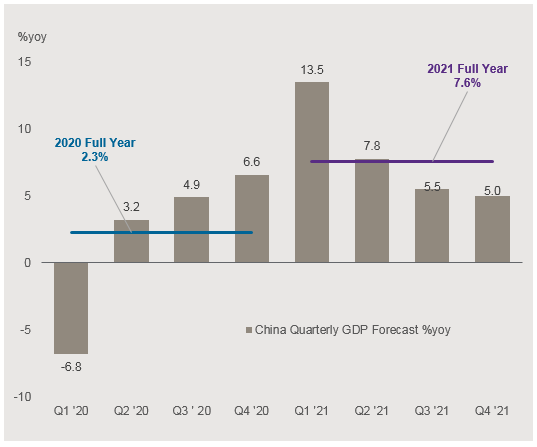
            With all due respect to New Zealand, China is the first large economy to really put COVID-19 behind it, and the growth impact of this success is vivid. Most visible through pickups in demand across the service sector, China’s growth is surging as life gets back to normal. Our expectations for China reflect this recovery: we look for China’s GDP growth to be around 2.3% in 2020, but we forecast that accelerating strongly into 2021, where we expect 7.6% growth. While positive for China, this growth in turn supports the outlook for the wider Chinese supply chain, lifting EM’s export performance. We see this reflecting in a marked increase in trade between emerging countries, as China’s voracious consumer appetite returns.

            China: base case strong recovery in 2021
            Source: JPMAM as of 18 September 2020

            The upshot of all this is that EM is transitioning from COVID-19 slowdown to star growth performer without experiencing a widespread macro crises triggered by the disease. We continue to look for EM growth of -1.4% in 2020, but expect the broader base of our universe to swing positive after the second half of 2021, to reach 5.7% for 2021 as a whole. That is notable, particularly when compared with the equivalent European and US recoveries: the difference between the two could see emerging markets growing some 3.9% faster than the developed world over a short period. Very little of this is currently fully reflected in EM risk premiums. Know this: EM has had some big years in the past – we have happy memories of people yelling “roof it!” on trading floors around the City as some Indonesian small cap did just that in response – but from low to high this swing is forecasted to be bigger than any previous acceleration in the space.

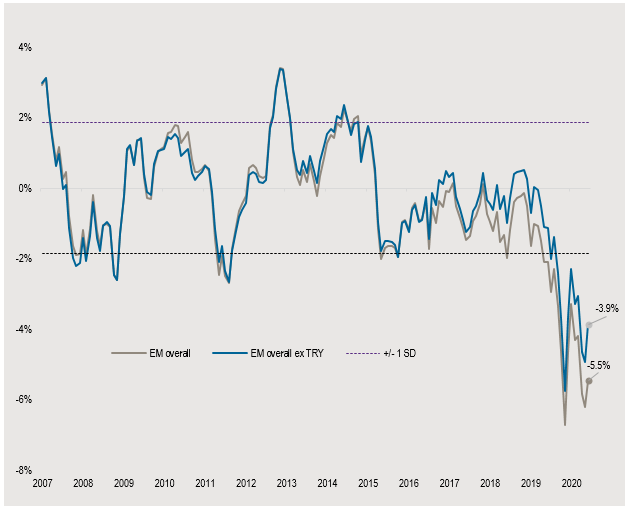
            So what will trigger the inflows to drive those returns? Flows tend to follow improving expectations of returns, and those relate to improving growth forecasts. But what sparks the actual rally is likely to be a valuation opportunity that just seems too good. Enter the current real effective exchange rate picture for EMFX, which shows the EM currency complex trading around 4% cheap after removing some more volatile lines.

            Global EM REER % Deviation from Fair Value
            Source: J.P. Morgan, FV determined by JP Morgan BEER Model as of October 2020

            So where does all of this lead? Well, local currency tends to work really work well when EM offers a growth premium over the developed world, where developed markets don’t offer much of an income alternative, where flows are beginning to accelerate as a few people notice, and where most people… have not noticed yet. All of which seems very familiar currently. To say that it isn’t always like this in local currency is an understatement, so you can perhaps pardon our team’s quiet excitement. 

            • Emerging Markets
            • Emerging Markets Debt

            Related Content

            Venezuela and Beyond: the Brave New World of Emerging Markets

            Rising U.S. foreign policy influence ups the stakes on an important election year for Latin America, while uncovering important areas of value within Emerging Market (EM) sovereign debt.

            Read more

            How I learned to stop worrying and love EM local currency

            “Now let's get this thing on the hump — we got some flyin' to do.” (Major T. J. "King" Kong in Dr. Strangelove or: How I Learned to Stop Worrying and Love the Bomb)

            Read more

            Emerging Markets: Don’t Fight the Central Banks

            The opportunity cost of not investing in EM debt remains very high. Most importantly the same applies for the rest of fixed income: don’t fight the central banks.

            Read more
            JPMorgan Asset Management

            • Terms & Conditions
            • Financial Services Guide
            • Privacy Policy
            • Cookie Policy
            • Investment Stewardship
            • Voting Policy
            • Unit Pricing Policy
            • Complaint Resolution
            • Sitemap
            J.P. Morgan

            • J.P. Morgan
            • JPMorgan Chase
            • Chase

            Please note:  Following recent amendments to the Corporations Act, where unitholders have provided us with your email address, we will now send notices of meetings, other meeting-related documents and annual financial reports electronically unless the unitholder elects to receive these in physical form and notify us of this election. Unitholders have the right to elect whether to receive some or all of such Communications in electronic or physical form, the right to elect not to receive annual financial reports at all and the right to elect to receive a single specified Communication on an ad hoc basis, in an electronic or physical form.


            All investments contain risk and may lose value. This advertisement has been prepared and issued by JPMorgan Asset Management (Australia) Limited (ABN 55 143 832 080) (AFSL No. 376919) being the investment manager of the fund. It is for general information only, without taking into account your objectives, financial situation or needs and does not constitute personal financial advice. Before making any decision, it is important for investors to consider the appropriateness of the information and seek appropriate legal, tax, and other professional advice. For more detailed information relating to the risks of the Fund, the type of customer (target market) it has been designed for and any distribution conditions please refer to the relevant Product Disclosure Statement and Target Market Determination which have been issued by Perpetual Trust Services Limited, ABN 48 000 142 049, AFSL 236648, as the responsible entity of the fund available on https://am.jpmorgan.com/au.