

logo
Financial Professional Login
Log in
Hello
  • My Collections
    View saved content and presentation slides
  • Portfolio Analysis
  • Log out
  • Funds
    Overview

    Fund Listing

    • Mutual Funds
    • ETFs
    • ETF Range
    • How to Invest

    Capabilities

    • Alternatives
    • Equities
    • Fixed Income
    • ETF Investing
    • Model Portfolios

    In Focus

    • Investing for Income
    • Investing for Fixed Income
    • Investing for Growth
    • Investing for Sustainability
    • Investing for Alternatives
  • Insights
    Overview

    Market Insights

    • Market Insights Overview
    • Guide to the Markets
    • Guide to Alternatives
    • Guide to Investing in Asia
    • Weekly Market Recap
    • On the Minds of Investors
    • Podcasts
    • U.S. Policy Pulse Hub
    • Solving for Fixed Income
    • Eye on the Market

    Portfolio Insights

    • Portfolio Insights Overview
    • Guide to ETFs
    • Global Asset Allocation Views
    • Global Equity Views
    • Global Fixed Income Views
    • Sustainable Investing
    • Alternatives Insights
    • Long-Term Capital Market Assumptions
  • Investment Ideas
    Overview
    • Latest ideas
    • Alternatives Outlook
    • Sustainable investing
    • ETF Knowledge
  • Resources
    Overview
    • Multimedia
    • Insights App
    • Digital Portfolio Insights
    • Announcements
  • About Us
    Overview
    • Awards
    • Diversity, Opportunity and Inclusion
    • Spectrum: Our Investment Platform
    • Our Leadership Team
  • Contact Us
  • Role
  • Country
Hello
  • My Collections
    View saved content and presentation slides
  • Portfolio Analysis
  • Log out
Financial Professional Login
Search
Menu
Search
You are about to leave the site Close
J.P. Morgan Asset Management’s website and/or mobile terms, privacy and security policies don't apply to the site or app you're about to visit. Please review its terms, privacy and security policies to see how they apply to you. J.P. Morgan Asset Management isn’t responsible for (and doesn't provide) any products, services or content at this third-party site or app, except for products and services that explicitly carry the J.P. Morgan Asset Management name.
CONTINUE Go Back

U.S. President Trump's order to investigate other markets' trade practices sheds light on his administration's trade and foreign policy approach. The likelihood of permanent tariffs has increased due to the potentially widespread nature of reciprocal tariffs and operational difficulties of calculating product-level tariff rates and holding negotiations with each market.

In brief

Tariff news continue to unsettle markets, with stocks vulnerable to tariffs underperforming the S&P 500 by 6% since the U.S. election day1. Last week, U.S. President Trump introduced the "Fair and Reciprocal Plan" to address practices deemed unfair by his administration. This plan aims to equalize tariff rates and increase tariffs in response to non-tariff barriers, like value added taxes (VATs), government subsidies, regulations and legal actions against U.S. companies. Equalizing tariff rates may have a significant impact on certain markets and industries. Furthermore, targeting non-tariff barriers is complex and could cause significant economic disruption. With negotiations possible before the April 1st deadline, the future of these tariffs remains uncertain and could unevenly affect markets.

Here are the markets most at risk:

  1. European Union (EU): The EU accounts for 17% of U.S. imports, the largest of any trading bloc and had a trade surplus of USD 175billion with the U.S. in 2023. While the U.S. and EU have similar average tariff rates of 3.4% and 4.1% on each other’s imports, respectively, disparities arise at the product level. For example, the EU imposes a 10% tariff on U.S. autos, whereas the U.S. applies a 2.5% tariff on European autos. A contentious issue is the EU's VAT, which the White House now considers a tariff. In short, VATs are consumption taxes paid by producers at each stage in the supply chain and by consumers at the time of sale. European companies can usually reclaim the VATs paid on their business-related purchases, with the consumer-paid VATs going to the government. The Trump administration argues that this gives European companies an unfair advantage, especially due to the size of VATs in Europe, which average 20%, significantly higher than the average U.S. sales tax of 6.6%. If the U.S. retaliates against VATs, reciprocal tariffs could exceed 20%, presenting significant downside to the EU’s already fragile economy.
  2. Emerging Markets: Tariffs are common in emerging markets to protect nascent industries. India and Brazil have average tariff rates of 11.5% and 7.4%, respectively, on all imports. India, which had a USD 43billion trade surplus with the U.S. in 2023, has begun reducing tariffs on certain products to ease tensions. Brazil, which maintains a slight trade deficit with the U.S., may face less targeting, though high tariffs on products like U.S. autos and ethanol are still pain points.

U.S. President Trump's order to investigate other markets' trade practices sheds light on his administration's trade and foreign policy approach. The likelihood of permanent tariffs has increased due to the potentially widespread nature of reciprocal tariffs and operational difficulties of calculating product-level tariff rates and holding negotiations with each market. Currency depreciation can help offset the tariffs, as seen in 2018-2019, and U.S. President Trump's focus on the stock market as a success barometer could limit negative impacts; however, uncertainty may harm business sentiment. For investors, staying diversified and being mindful of vulnerable industries and companies is critical.

Many markets could face increased tariffs
Most favored market trade-weighted average duties, all imported goods, 2023
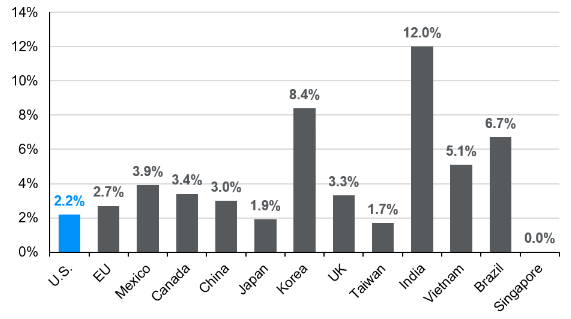
Source: WTO, J.P. Morgan Asset Management. Markets shown represent the 12 largest U.S. trading partners by volume.
 
 
1 Stocks identified as vulnerable to tariffs are represented by the J.P. Morgan U.S. Global Tariffs Index.


09rt252002034951
  • Economy
  • Equities
  • Markets
  • Elections
  • Tariffs
JPMorgan Asset Management

  • Terms & Conditions
  • Financial Services Guide
  • Privacy Policy
  • Cookie Policy
  • Investment Stewardship
  • Voting Policy
  • Unit Pricing Policy
  • Complaint Resolution
  • Sitemap
J.P. Morgan

  • J.P. Morgan
  • JPMorgan Chase
  • Chase

Please note:  Following recent amendments to the Corporations Act, where unitholders have provided us with your email address, we will now send notices of meetings, other meeting-related documents and annual financial reports electronically unless the unitholder elects to receive these in physical form and notify us of this election. Unitholders have the right to elect whether to receive some or all of such Communications in electronic or physical form, the right to elect not to receive annual financial reports at all and the right to elect to receive a single specified Communication on an ad hoc basis, in an electronic or physical form.


All investments contain risk and may lose value. This advertisement has been prepared and issued by JPMorgan Asset Management (Australia) Limited (ABN 55 143 832 080) (AFSL No. 376919) being the investment manager of the fund. It is for general information only, without taking into account your objectives, financial situation or needs and does not constitute personal financial advice. Before making any decision, it is important for investors to consider the appropriateness of the information and seek appropriate legal, tax, and other professional advice. For more detailed information relating to the risks of the Fund, the type of customer (target market) it has been designed for and any distribution conditions please refer to the relevant Product Disclosure Statement and Target Market Determination which have been issued by Perpetual Trust Services Limited, ABN 48 000 142 049, AFSL 236648, as the responsible entity of the fund available on https://am.jpmorgan.com/au.