


Investing for climate change
Investors have a role in helping to slow, stabilize, potentially reverse—or adapt to some inevitable—climate change
17/12/2021
Dr. Sarah Kapnick*
The effects of climate change—extreme storms, heat, drought,1 rising seas—are being felt in every region of the world. They increase water and food scarcity, physical risks and damage to lives and property. To date, most climate investing has gone to building out renewable energy generation and storage. Adaptation, by contrast, has been underfunded.
Looking at the sources of carbon (Exhibit 1) makes it clear that reducing energy emissions, important as it is, won’t be enough. Along with emissions reduction across all sectors, carbon removal and the retrofitting of physical assets for some inevitable climate change will be needed, too. Each of these three Rs offers investors a range of potential opportunities.
Energy production and consumption are major sources of the emissions causing climate change, but other sources also need reduction
Exhibit 1: Sources of global greenhouse gas emissions
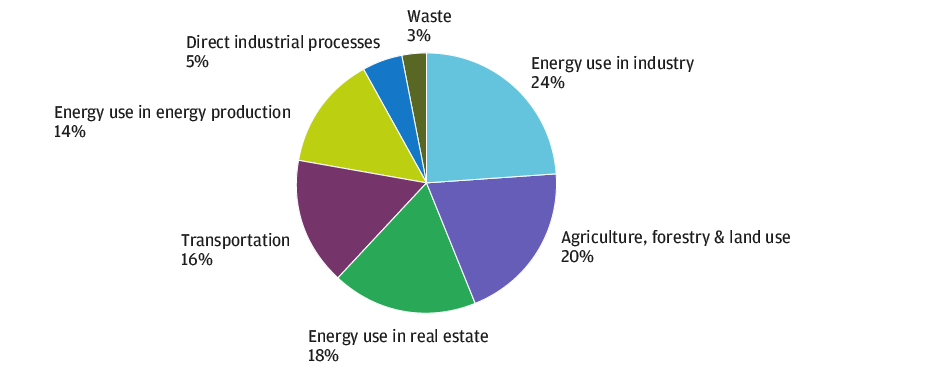
Source: Climate Watch, World Resources Institute; data as of 2016. Direct industrial processes include cement (3%), chemicals and petrochemicals (2.2%). Energy use in industry includes mining and quarrying, construction, textiles, wood products and transport equipment (such as car manufacturing). Data is latest available; global granular sectoral composition is not updated regularly.
How can investors participate in stabilizing climate change—achieving a “net-zero” world in which emissions from a range of sources are brought to zero or balanced out by carbon removal? Along with investments to reduce emissions in (decarbonize) the energy supply, here is a set of approaches that employ all three Rs to adapt to climate change: greenhouse gas reduction, removal and retrofitting.
The three Rs of climate investing: Reduce, remove and retrofit
Investors can participate in these three approaches through associated investment opportunities in traditional and emerging technologies (Exhibit 2).
Investors can participate in the three Rs’ and the opportunities they present
Exhibit 2: Climate investing approaches and how they work
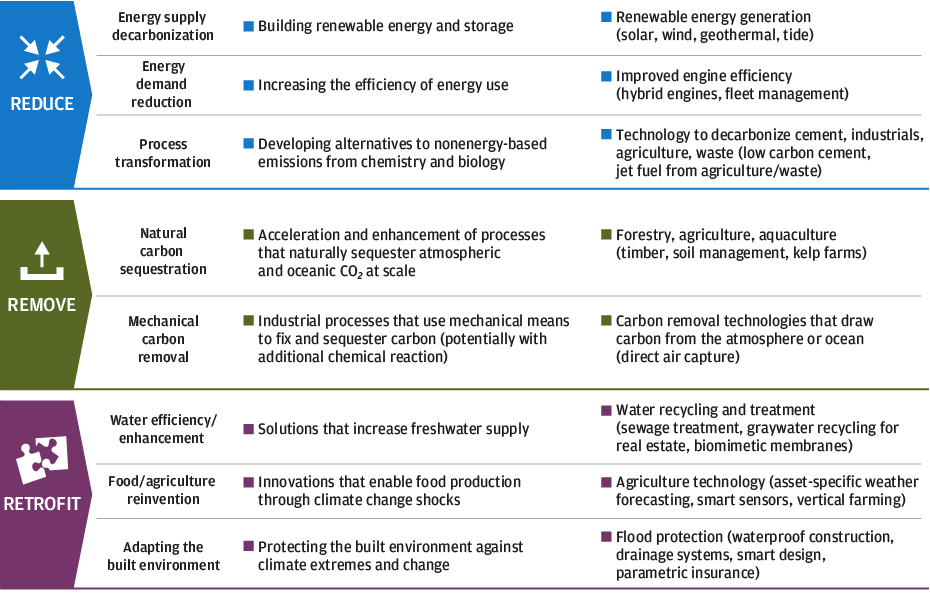
Source: J.P. Morgan Asset Management; information as of December 2021.
Reduce
Emissions reduction, which includes the decarbonization of the energy supply, has been a major focus of climate investments. There are also less well-known opportunities to reduce energy demand and to transform other (nonenergy) carbon-intensive processes.
Decarbonization of the energy supply can be accomplished by accelerating renewable energy generation and storage. The deployment of these technologies can be further incentivized through regulation such as market-based Renewable Portfolio Standards for utilities, which increase the amount of clean energy.
Reductions in energy demand can also decrease emissions (especially in the near term, before the power grid comes to rely on renewable sources) while reducing operating costs, making reductions economically desirable even absent climate considerations.
The transformation of carbon-intensive processes is also needed—for example, introducing lower carbon versions of cement formulation; finding raw materials that can substitute for those presently derived from oil and gas (e.g., plastics, fertilizer); and improving resource efficiency more broadly to reduce demand for virgin raw materials, catalyze more recycling and develop a circular economy.
Remove
Carbon removal is necessary to reach net zero in situations where carbon-neutral substitutes are not available. Excess greenhouse gases can be removed (sequestered) from the atmosphere two ways—naturally and mechanically. Greenhouse gases can even be removed from the ocean, which absorbs CO2.2
Nature-based carbon removal: Carbon is naturally sequestered in trees, plants, soils and plankton. The mature forestry industry currently provides investible timber products.3 Nonprofits, governments and private funders have supported the development of other nature-based removal projects (e.g., soils, kelp, mangroves), but standards for verifying carbon removal are still evolving.
Mechanical carbon removal: The technology to lock carbon underground or within new materials is still nascent. The U.S. Department of Energy recently announced the Carbon Negative Shot, with the goal of reducing the cost of mechanical removal below USD 100 per ton of carbon or its equivalent (tCO2e).4 For perspective, a similar program was developed for solar more than a decade ago. The success of today’s solar industry suggests such actions can bear fruit over time.
Retrofit
The World Bank estimates that up to USD 500 billion will be needed each year until 2050 to globally adapt to climate change. Yet even as adaptation requires upfront costs, it can lead to multiples of benefits from avoided damages.5 We highlight three broad adaptation categories, each with potential investment opportunities.
Water efficiency: Solutions are needed to increase water supply in the face of regional droughts, changes in precipitation patterns and overpumping of wells. In the U.S. in 2020, droughts alone caused USD 259 billion in damages.6
Reinventing food and agriculture: Global population growth and changing consumer habits will raise food demand by 2050, requiring greater agricultural productivity. At the same time, resource scarcity, from water to arable land, is placing stress on regional productivity. Agriculture will need to adapt to changing climate conditions and if it is to feed a greater number of people.
The built environment: Investments are needed to protect against damage from climate extremes and to allow for continuous operations. Due to their multi-decade lifetimes, buildings and infrastructure need to be built or retrofitted to withstand the climate of the future, in addition to climate change that has already happened.
Where do we go from here?
Some of these opportunities are spearheaded by start-ups seeking venture funding for innovations involving a higher risk of technological failure but potentially higher returns. More mature options, like energy production, have longer track records with lower return profiles. These differing return profiles create an opportunity for diversification across climate investing. All of these areas are important to addressing the effects of climate change, and investing across them can create robust return opportunities for investors.
Several nonprofits have developed grant programs, technology scaling and fundamental research on climate solutions. For more information, please look into Elemental Excelerator, Prime Coalition, Center for Climate and Energy Solutions and Carbon180.
1 Dr. Sarah Kapnick*, “Preparing for climate change: How drought will change the U.S. West,” J.P. Morgan Asset Management, August 16, 2021.
2 National Academies of Sciences, Engineering, and Medicine, A Research Strategy for Ocean-based Carbon Dioxide Removal and Sequestration Washington, DC: National Academies Press, 2021.
3 Dr. Sarah Kapnick*, “The global carbon market: How offsets, regulations and new standards may catalyze lower emissions and create new opportunities,” J.P. Morgan Asset Management, October 14, 2021.
4 The Carbon Negative Shot, unveiled in November 2021, is the U.S. government’s first major effort in carbon dioxide removal, based at the Department of Energy Office of Fossil Energy and Carbon Management. It calls for innovation in the expanding field as a key facet of achieving net-zero emissions by 2050.
5 Arame Tall, Sarah Lynagh, Candela Blanco Vecchi et al., “Enabling Private Investment in Climate Adaptation and Resilience: Current Status, Barriers to Investment and Blueprint for Action,” World Bank, March 2, 2021.
6 Data from the National Oceanic and Atmospheric Administration.
Risk Summary
Investing on the basis of sustainability/ESG criteria involves qualitative and subjective analysis. There is no guarantee that the determinations made by the adviser will align with the beliefs or values of a particular investor. Companies identified by an ESG policy may not operate as expected, and adhering to an ESG policy may result in missed opportunities.
*Dr. Sarah Kapnick is a former Managing Director and Senior Climate Scientist and Sustainability Strategist for Asset and Wealth Management (AWM). Following her time at J.P.Morgan, she joined the National Oceanic and Atmospheric Administration (NOAA) as their chief scientist.
Related Articles
The global carbon market
Sarah Kapnick, Ph.D., our Senior Climate Scientist and Sustainability Strategist, explains why interest in carbon markets and emissions trading systems is surging—to both help halt climate change, and for investors, to potentially achieve long-term returns.