
logo
  • My Collections
    View saved content and presentation slides
  • Portfolio Analysis
  • Log out
  • Funds
      Contact Us

      Fund Listing

      • Mutual Funds
      • ETFs
      • ETF Range
      • How to Invest

      Capabilities

      • All Funds
      • Alternatives
      • Equities
      • Fixed Income
      • ETF Investing
      • Active research
      • Model Portfolios

      In Focus

      • Investing for Income
      • Investing for Fixed Income
      • Investing for Global and EM Equities
      • Investing for Sustainability
      • Investing for Alternatives
    • Insights
        Contact Us

        Market Insights

        • Market Insights Overview
        • Guide to the Markets

          The J.P. Morgan Guide to the Markets illustrates a comprehensive array of market and economic histories, trends and statistics through clear charts and graphs.

        • Guide to Alternatives

          Objective insights on alternatives industry trends, with charts and data across private equity, private credit, real estate, infrastructure and hedge funds.

        • Guide to Investing in Asia

          The Guide to Investing in Asia explores the diverse economies, markets and investment trends across Asia, including Japan, India, China and Southeast Asia.

        • Weekly Market Recap

          Finding balance in Chinese equities: export sectors could gain from progress on trade, while domestic-facing companies cushion against global trade volatility.

        • On the Minds of Investors

          What investment questions are on the minds of investors? Explore the questions investors ask frequently and find answers at J.P. Morgan Asset Management.

        • Podcasts

          Insights from Tai Hui, Chief Market Strategist, Asia, on what is happening in financial markets, from our Asia Pacific headquarters in Hong Kong.

        • Mid-Year Outlook 2026

          Global uncertainties abound: the Middle East conflict, central banks' response to returning inflation, U.S. policy shifts and the fast-changing AI landscape.

        • Solving for Fixed Income

          Exploring how the current environment has affected fixed income's traditional role and the many other opportunities that can accomplish its traditional objectives.

        • Eye on the Market

          Explore Eye on the Market, timely commentary that offers views on the economy, markets, and investment portfolios by Michael Cembalest.

        Portfolio Insights

        • Portfolio Insights Overview
        • Guide to ETFs

          Explore J.P. Morgan Asset Management’s ETF investing guide with insights on ETF market trends and best investing practices for smarter portfolio decisions.

        • Global Asset Allocation Views

          Amid resilient growth and a fading energy shock, we stay positive on risk assets, favoring U.S., Japan and EM equities and U.S. high yield.

        • Global Equity Views

          The profit outlook is cloudier, but we still expect modest growth. Many of our investors favor quality financials and industrials, avoiding high-priced defensives.

        • Fixed Income

          We highlight themes and implications from various fixed income teams to help guide your portfolio decisions.

        • Global Fixed Income Views

          Central bank credibility, solid profits, capex and resilient consumers lift expansion odds to 85%, outweighing inflation and AI headwinds.

        • Sustainable Investing

          Sustainable Insights

        • Alternatives Insights

          We bring you insights based on our nearly 50 years of experience investing in alternatives and more than 800 alternatives professionals around the globe.

        • Long-Term Capital Market Assumptions

          Our Long-Term Capital Market Assumptions (LTCMAs) deliver forward-looking return, volatility and correlation estimates for 200+ asset and strategy classes in 20+ base currencies.

      • Investment Ideas
          Contact Us
          • Latest ideas
          • Alternatives Outlook
          • Sustainable investing
          • ETF Knowledge
        • Resources
            Contact Us
            • All Resources
            • Multimedia
            • Insights App
            • Digital Portfolio Insights
            • Announcements
          • About Us
              Contact Us
              • Overview
              • Awards
              • Diversity, Opportunity and Inclusion
              • Spectrum: Our Investment Platform
              • Our Leadership Team
              • Our Commitment to Research
            • Contact Us
              • My Collections
                View saved content and presentation slides
              • Portfolio Analysis
              • Log out
            • Financial Professional Login
            Log in
            You are about to leave the site Close
            J.P. Morgan Asset Management’s website and/or mobile terms, privacy and security policies don't apply to the site or app you're about to visit. Please review its terms, privacy and security policies to see how they apply to you. J.P. Morgan Asset Management isn’t responsible for (and doesn't provide) any products, services or content at this third-party site or app, except for products and services that explicitly carry the J.P. Morgan Asset Management name.
            CONTINUE Go Back
            1. Alternatives Asset Class outlook

            • LinkedIn Twitter Facebook Line WhatsApp

            Alternatives outlook: Providing essential portfolio support

            Alternatives can offer AID (alpha, inflation protection, dislocation opportunities) for the trek through 2023

            13/01/2023

            Jamie Kramer

            Pulkit Sharma

            As elevated inflation likely lingers through 2023, the case for alternatives becomes especially compelling, particularly for core real assets

            Entering 2022, we encouraged investors to embrace hybrids – asset classes that exhibit characteristics of both fixed income and equity (examples include core real assets, hedge funds and special situations lending) – to navigate a changing investing environment. As the year unfolded, public markets suffered significant drawdowns and, unusually, public equities and fixed income were correlated to each other. Hybrids proved critical in delivering alpha, income and diversification. In a year of elevated market volatility, hybrids’ stable returns were especially attractive.

            In prior publications, we discussed how alternatives can bring “AID” to the traditional asset portfolio in the form of alpha, income and diversification. We believe alternatives will continue to deliver on these outcomes over the long term. But as we look toward the forbidding terrain of 2023, we face new challenges: sticky inflation, higher interest rates and elevated volatility. In this environment, alternatives can provide the new essential AID that portfolios require: alpha, inflation protection and dislocation opportunities.

            Thus armed, we can meet the opportunities and risks we are sure to encounter as we make the trek through 2023.
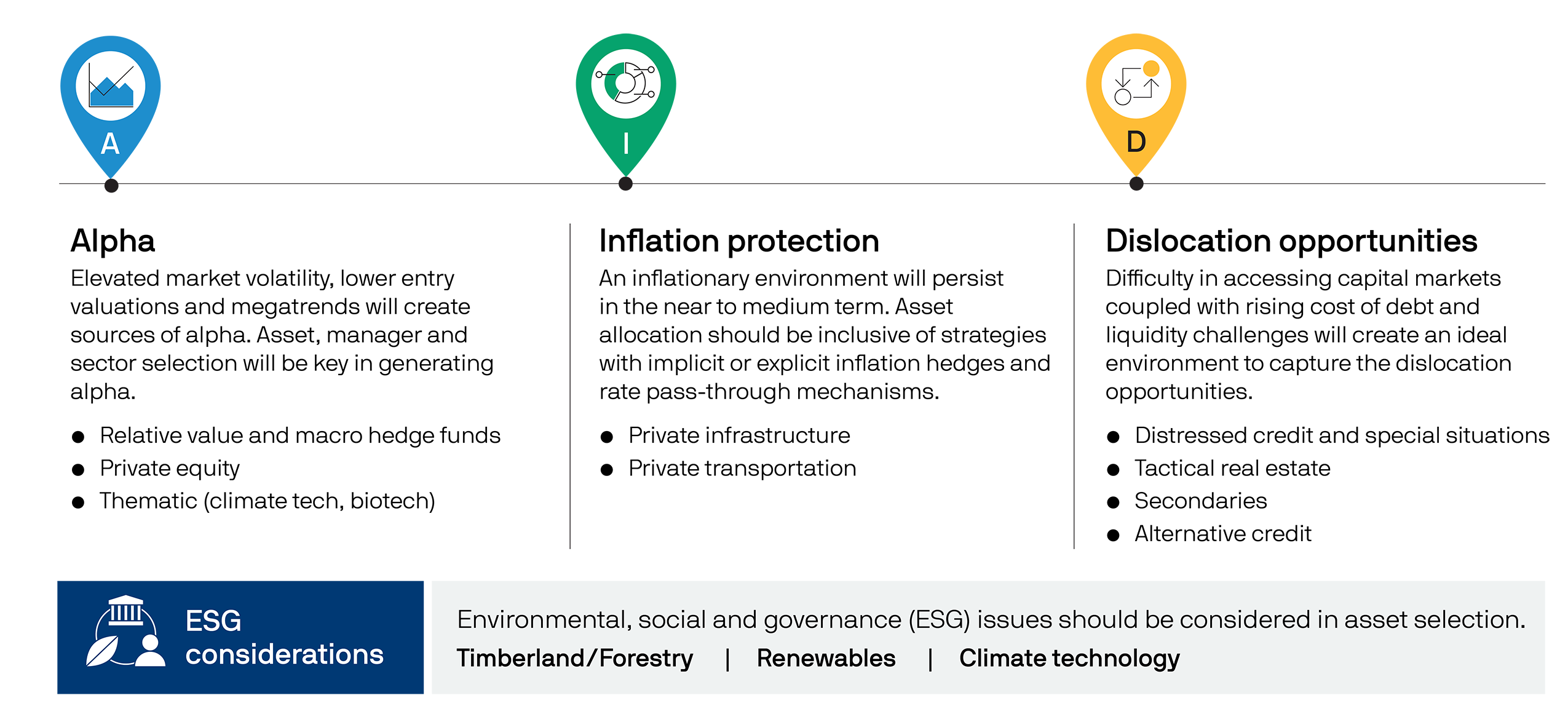
             

            Alpha: Active portfolio design, hedge funds and private equity

            Market volatility generally creates return dispersion and can serve as a vehicle for generating alpha. In this new environment, active management – through selecting investment categories, managers and assets – will be key to producing enhanced returns.

            In the hedge fund space, strategies uncorrelated with traditional equity and fixed income investments, such as macro and relative value, seem best positioned to take advantage of alpha opportunities arising from market volatility. These strategies can operate across both geographies and asset classes, and are typically nimbler in terms of portfolio repositioning. This operational breadth may lead to outperformance vs. other hedge fund strategies.

            In private equity, lower entry valuations and tailwinds from megatrends such as climate technology and biotech can be potential sources of alpha. Historically, private equity vintages tend to outperform coming out of a recessionary environment, suggesting that 2023 may be an ideal time to add to private equity.

            Inflation protection: Infrastructure and transportation

            As elevated inflation likely lingers through 2023, the case for allocating to alternatives becomes especially compelling, particularly for core real assets such as infrastructure and transportation. Typically, core real assets have implicit or explicit inflation hedges in place, which are generally applied with a modest time lag.

            In infrastructure, an explicit inflation hedge might take the form of a utility’s embedded pass-through pricing mechanism, in which revenues adjust with inflation indices. Many regulated utilities in Europe and the UK operate with a link between their weighted-average cost of capital and their allowable return on equity, which allows corporate earnings to rise as inflation impacts a company’s cost of capital.

            In transportation, an example of an implicit inflation hedge can be found in new leases, especially for liquefied natural gas (LNG) carriers, where asset values continue to benefit from pricing power via the ongoing energy crisis and the subsequent shift from fossil fuel to LNG. In addition, maritime transport assets are generally created using recyclable commodities (e.g., steel). Scrap values of those assets typically rise as commodity prices appreciate, which historically tracks closely with inflation.


            Dislocation opportunities: Special situations, tactical real estate, secondaries and alternative credit

            Diminished liquidity from nearly frozen capital markets, the rising cost of debt and overallocation to private markets from the “denominator effect”1 will likely push companies and investors to look to alternative lenders for liquidity solutions.

            This should create opportunities in distressed credit and special situations lending, where lenders can provide rescue financing, acquiring the debt of high quality companies at attractive prices. Similar opportunities exist in tactical real estate, where managers can buy select assets from financially troubled owners at a discount.

            As liquidity becomes harder to come by, the secondary market (buying preexisting private fund assets, called “secondaries”) looks to be well positioned. Secondaries can provide liquidity to the growing ranks of limited partners, such as pension funds and insurers, that are looking to rebalance their portfolios after alternatives grew and public assets shrank, exceeding their strategic target allocations. These mandated sales often come at a discount, potentially providing the purchaser with instant value capture.

            Lastly, given a reduced volume of transactions in the real estate equity market, alternative credit providers (i.e., lenders) can step in, providing liquidity via commercial mortgage loans and mezzanine loans, at more favorable terms. Overall, active capital deployment will be key for managers to be able to capture value in these “dislocated” assets.

            Long-term focus on ESG

            For a successful trek through 2023, in our view, investors will also want to incorporate environmental, social and governance (ESG) factors into their investing decisions. As global policymakers and asset managers increasingly focus on ESG, it will become a critical consideration for investors as well. On the environmental front, opportunities in areas such as climate technology, timberland and renewable energy can offer direct exposure to the theme.

            Conclusion

            Alternatives have played a pivotal role in investors’ portfolios over the last decade by providing an uncorrelated source of alpha, income and diversification to traditional assets. Facing a rocky terrain of persistently rising consumer prices, higher interest rates and elevated market volatility in 2023, investors need sturdy active gear. With their ability to offer AID – alpha, inflation protection and dislocation opportunities – alternatives will be essential for the journey ahead.


            1 Denominator effect refers to a scenario in which the value of one portion of the portfolio experiences a severe drawdown and other portfolio segments that did not experience a drawdown become overallocated in the overall portfolio.


            09fk222712170706

            1023292330

            See more of our 2023 outlooks across alternatives

            Explore more

            • Alternatives
            JPMorgan Asset Management

            • Terms & Conditions
            • Financial Services Guide
            • Privacy Policy
            • Cookie Policy
            • Investment Stewardship
            • Voting Policy
            • Unit Pricing Policy
            • Complaint Resolution
            • Sitemap
            J.P. Morgan

            • J.P. Morgan
            • JPMorgan Chase
            • Chase

            Please note:  Following recent amendments to the Corporations Act, where unitholders have provided us with your email address, we will now send notices of meetings, other meeting-related documents and annual financial reports electronically unless the unitholder elects to receive these in physical form and notify us of this election. Unitholders have the right to elect whether to receive some or all of such Communications in electronic or physical form, the right to elect not to receive annual financial reports at all and the right to elect to receive a single specified Communication on an ad hoc basis, in an electronic or physical form.


            All investments contain risk and may lose value. This advertisement has been prepared and issued by JPMorgan Asset Management (Australia) Limited (ABN 55 143 832 080) (AFSL No. 376919) being the investment manager of the fund. It is for general information only, without taking into account your objectives, financial situation or needs and does not constitute personal financial advice. Before making any decision, it is important for investors to consider the appropriateness of the information and seek appropriate legal, tax, and other professional advice. For more detailed information relating to the risks of the Fund, the type of customer (target market) it has been designed for and any distribution conditions please refer to the relevant Product Disclosure Statement and Target Market Determination which have been issued by Perpetual Trust Services Limited, ABN 48 000 142 049, AFSL 236648, as the responsible entity of the fund available on https://am.jpmorgan.com/au.