

JP Morgan Asset Management - Home
Log in
Log in
Hello
  • Accounts & Documents
    Digital servicing offering for active investors
  • My Collections
    View saved content and presentation slides
  • Log out
  • Products
    Overview

    Investment Vehicles

    • ETFs
    • Commingled Funds
    • Mutual Funds
  • Investment Strategies
    Overview

    Investment Options

    • Alternatives
    • Beta Strategies
    • Equities
    • Fixed Income
    • Global Liquidity
    • Multi-Asset Solutions
    • Commingled Funds

    Capabilities & Solutions

    • ETFs
    • Global Insurance Solutions
    • Liability-Driven Investing
    • Pension Strategy & Analytics
    • Outsourced CIO
    • Retirement Plan Solutions
    • Target Date Strategies
    • Retirement Income
    • Sustainable investing
  • Insights
    Overview

    Market Insights

    • Market Insights Overview
    • Eye on the Market
    • Guide to the Markets
    • Guide to Investing in Asia
    • Guide to Alternatives
    • Market Updates

    Portfolio Insights

    • Portfolio Insights Overview
    • Alternatives
    • Asset Class Views
    • DB Insights
    • Equity
    • Fixed Income
    • Long-Term Capital Market Assumptions
    • Portfolio Strategy
    • Strategic Investment Advisory Group

    Retirement Insights

    • Retirement Insights Overview
    • Guide to Retirement
    • Retirement Hot Topics
    • Social Security and Medicare Hub

    ETF Insights

    • ETF Insights Overview
    • Guide to ETFs
    • Monthly Active ETF Monitor
  • Resources
    Overview
    • Center for Investment Excellence Podcasts
    • Insights App
    • Library
    • Public Pension Plans
    • Endowments, Foundations, and Healthcare
    • Taft-Hartley
    • Corporate Defined Benefit
    • Market Response Center
    • Morgan Institutional
    • Artificial Intelligence
    • Webcasts
  • About Us
    Overview
    • Diversity, Opportunity & Inclusion
    • Spectrum: Our Investment Platform
    • Media Resources
    • Our Leadership Team
    • Our Commitment to Research
  • Contact us
  • Role
  • Country
Hello
  • Accounts & Documents
    Digital servicing offering for active investors
  • My Collections
    View saved content and presentation slides
  • Log out
Log in
Search
Menu
Search
You are about to leave the site Close
J.P. Morgan Asset Management’s website and/or mobile terms, privacy and security policies don't apply to the site or app you're about to visit. Please review its terms, privacy and security policies to see how they apply to you. J.P. Morgan Asset Management isn’t responsible for (and doesn't provide) any products, services or content at this third-party site or app, except for products and services that explicitly carry the J.P. Morgan Asset Management name.
CONTINUE Go Back
  1. Will the Fed cause inflation?

  • LinkedIn Twitter Facebook WhatsApp

Will the Fed cause inflation?

05/27/2020

Alex Dryden

Over the last few years, the velocity of money has fallen to record low levels, meaning that money, whilst it's being printed, is not moving quickly around the economy, and therefore isn't generating the inflationary heat like it would do a few decades ago.

Alex Dryden

Listen to On the Minds of Investors

05/27/2020

The balance sheet of the U.S. Federal Reserve (Fed) has increased by 2.9 trillion USD since the start of March, meaning that in just over eleven weeks it has grown more than it did in the five years following the Financial Crisis. Such a dramatic loosening of monetary policy has led investors to worry about the potential for inflation in the years ahead. History is littered with examples of countries who have turned to the printing press during times of distress and the end result is typically inflation or even hyper-inflation. However, this time around expansionary monetary policy may not result in runaway inflation.

Historically, an increase in the money supply leads to higher levels of inflation, but investors should remember that supply is only one driver of overall prices. Another important component is the speed at which money moves around the system – often referred to as the velocity of money. As we highlight in the below chart, the velocity of money is at record low levels. The sluggish speed at which money moves through the economy means that the money supply can increase significantly without necessarily causing high levels of inflation.

Economists don’t have a clear explanation as to why the velocity of money has been falling so sharply, instead attributing it to a range of factors including but not limited to: 

  • Aging demographic profiles: Older individuals save and spend in a different way compared to younger people.

  • Banking regulation: Tougher capital requirements mean that banks need to keep more cash on hand to meet regulations. This limits the speed at which money moves through the system.

  • Conservative fiscal mindset: Post the Financial Crisis, economic agents are adopting a fiscally cautious approach dampening the demand for loans and slowing the speed at which cash moves through the system as individuals opt to save rather than spend.

  • Rising inequality: Wealthier individuals tend to save and invest excess money rather than spend it. As inequality levels rise this can slow the speed at which money moves through the economy.

While these drivers may be diverse, they are similar in that they are all quite structural in nature and are unlikely to disappear overnight. This means that the money supply may be able to rise quite dramatically without triggering dramatic increases in inflation. With that being said, investors are right to watch inflation carefully. A shift in inflation can have a profound impact across asset classes. 

Velocity of money
Quarterly, nominal GDP/money supply (m2)
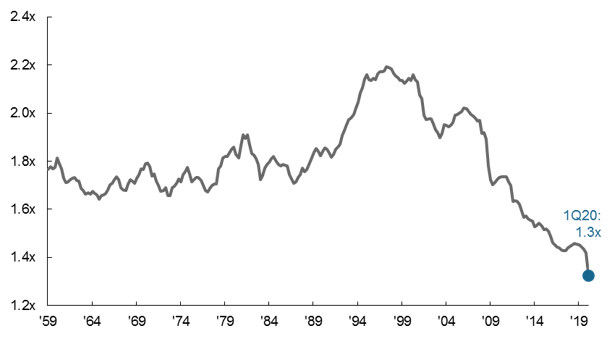
Source: BEA, FactSet, Federal Reserve System, J.P. Morgan Asset Management. Data are as of May 19, 2020.

0903c02a828e8866

EXPLORE MORE

On the Minds of Investors

What investment questions are on the minds of investors? Explore the questions investors ask frequently and find answers at J.P. Morgan Asset Management.

Read more

Guide to the Markets

The J.P. Morgan Guide to the Markets illustrates a comprehensive array of market and economic histories, trends and statistics through clear charts and graphs.

Read more

Asset Class Views

Get quarterly commentary and in-depth analysis on equities, fixed income and other asset classes, written by our senior investment teams.

Read more
  • Economy