JP Morgan Asset Management - Home
  • Accounts & Documents
    Digital servicing offering for active investors
  • My Collections
    View saved content and presentation slides
  • Log out
  • Products

      Investment Vehicles

      • ETFs
      • Commingled Funds
      • Mutual Funds
    • Investment Strategies

        Investment Options

        • Investment Strategies Overview
        • Alternatives
        • Beta Strategies
        • Equities
        • Fixed Income
        • Global Liquidity
        • Multi-Asset Solutions
        • Commingled Funds

        Capabilities & Solutions

        • ETFs
        • Global Insurance Solutions
        • Liability-Driven Investing
        • Pension Strategy & Analytics
        • Outsourced CIO
        • Retirement Plan Solutions
        • Target Date Strategies
        • Retirement Income
        • Sustainable investing
      • Insights

          Market Insights

          • Market Insights Overview
          • Eye on the Market
          • Guide to the Markets
          • Guide to Investing in Asia
          • Guide to Alternatives
          • Market Updates

          Portfolio Insights

          • Portfolio Insights Overview
          • Alternatives
          • Asset Class Views
          • DB Insights
          • Equity
          • Fixed Income
          • Long-Term Capital Market Assumptions
          • Portfolio Strategy
          • Strategic Investment Advisory Group

          Retirement Insights

          • Retirement Insights Overview
          • Guide to Retirement
          • Retirement Hot Topics
          • Social Security and Medicare Hub

          ETF Insights

          • ETF Insights Overview
          • Guide to ETFs
          • Monthly Active ETF Monitor
        • Resources
            • Resources Overview
            • Center for Investment Excellence Podcasts
            • Insights App
            • Library
            • Public Pension Plans
            • Endowments, Foundations, and Healthcare
            • Taft-Hartley
            • Corporate Defined Benefit
            • Market Response Center
            • Morgan Institutional
            • Artificial Intelligence
            • Webcasts
          • About Us

              About us

              Backed by $4.6T in assets, we harness our active edge to deliver timely ideas and actionable insights that empower investors to achieve what matters most.

              • Overview
              • Diversity, Opportunity & Inclusion
              • Spectrum: Our Investment Platform
              • Media Resources
              • Our Leadership Team
              • Our Commitment to Research
            • Contact us
              • Accounts & Documents
                Digital servicing offering for active investors
              • My Collections
                View saved content and presentation slides
              • Log out
            • Log in
            Log in
            You are about to leave the site Close
            J.P. Morgan Asset Management’s website and/or mobile terms, privacy and security policies don't apply to the site or app you're about to visit. Please review its terms, privacy and security policies to see how they apply to you. J.P. Morgan Asset Management isn’t responsible for (and doesn't provide) any products, services or content at this third-party site or app, except for products and services that explicitly carry the J.P. Morgan Asset Management name.
            CONTINUE Go Back
            1. Should investors worry about the jobs market?

            • LinkedIn Twitter Facebook WhatsApp

            Should investors worry about the jobs market?

            02/13/2020

            Alex Dryden

            The latest job openings figures in the December JOLTS report makes for a concerning read. Job openings declined by 5.4% m/m and were down 14% y/y, its largest annual decline since 2009 with the slowdown widespread across sectors. As we highlight in this week’s chart, a decline in openings has occurred during the last two U.S. recessions. However, investors should be wary of the figures for a number of reasons:

            • The data on job openings only goes back to 2000. While an interesting indicator for the previous two U.S. recessions, its lack of history limits its reliability in forecasting future recessions.
            • The labor market is often a lagging indicator of economic conditions. While economic growth slowed in 2019, cuts by the U.S. Federal Reserve, as well as a cooling of trade tensions, has helped stabilize the economy heading into 2020. Therefore, the labor market may be playing catch-up and does not yet reflect the recent improvements.

            • The recent changes may be a bi-product of disgruntled employers. With the unemployment rate at 3.6%, the U.S. labor market is at its tightest level in over 50 years. Disgruntled employers, unable to find workers with the necessary skills and tired of the expensive and time-consuming process of advertising openings, may have opted to pull the opening altogether.

            Taken at face value, the fall in job openings is concerning and warrants careful monitoring. However, limited data, changes in the economic backdrop and disgruntled employers may be offsetting factors that explain the fall in job openings.

            Hires, job openings and layoffs and discharges

            SHARE OF TOTAL NONFARM EMPLOYMENT, SEASONALLY ADJUSTED, PERCENT
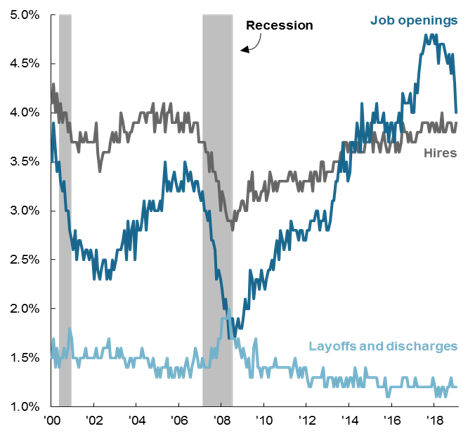
            Source: FactSet, U.S BLS, J.P Morgan Asset Management. Data are as of 12 February 2020.


            0903c02a82805d2f