



Aidan Shevlin
Head of International Liquidity Fund Management
Published:

In Brief
- The PBoC announced to shift its main policy rate from the 7-day reverse repo to an overnight reverse repo rate. The new benchmark was set at 1.25%, effective from November 2.
- The move is aimed at improving the central bank’s management of short-term interest rates . It will align operations more closely with the interbank overnight rate (DR001) and make short-rate guidance more precise.
- For RMB cash investors, the shift toward DR001 as the anchor raises the importance of overnight rates - which should become the primary determinants of money-market pricing and cash yields.
Introduction
At the Financial Street Forum on the 19th of October, PBoC Governor Pan Gongsheng outlined several significant updates to China’s monetary policy framework, including a planned shift in the main policy benchmark from the 7-day reverse repo rate to an overnight reverse repo rate. On 30 October, sooner than many market participants had expected, the PBoC formally confirmed the transition, setting the new overnight policy rate at 1.25%, effective from 2 November.
In parallel, the PBoC signaled a broader change in pricing conventions: greater use of the interbank overnight repo rate (DR001) as a reference for loan pricing for stronger corporates, continued LPR use for households and smaller firms, and an eventual retirement of legacy benchmark deposit and lending rates. The Governor also flagged a new liquidity tool to help non-bank institutions manage large redemptions and reduce bond-market instability risks.
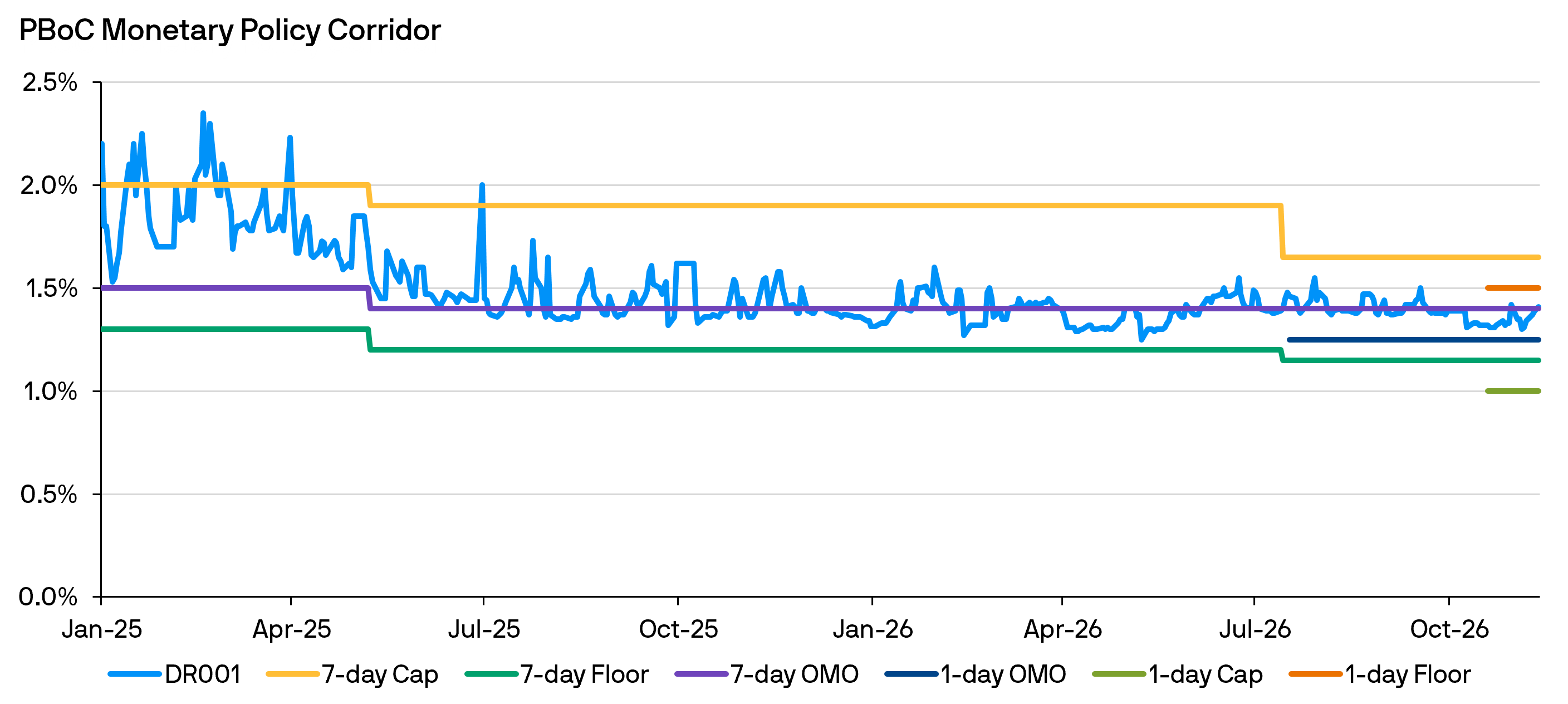
The announcement builds on recent changes to both the short-end policy rate corridor and the PBoC’s liquidity management tools. In June, the PBoC tightened the corridor from 70bp to 50bp by setting temporary overnight repo and reverse repo rates at 25bp below and 25bp above the 7-day policy rate, respectively. It also began conducting routine overnight reverse repo operations in late June, which have been used more frequently to address seasonal swings in liquidity.
The PBoC will now conduct overnight reverse repo operations daily at a fixed rate, with the amount determined by liquidity demand. Meanwhile, the previous 7-day operations (at 1.40%) will no longer serve as a fixed policy benchmark, rather being used mainly around liquidity needs such as tax dates and month-ends, with a fixed amount and bids on the rate. Related facilities (including the previous cap and floor) have also been re-anchored, lowering the policy corridor by 15bp to 1.00–1.50%.
Fig 1: The migration to overnight interest rates will shift China’s interest rate corridor lower.
Source: J.P. Morgan Asset Management, data as of 2 November 2026.
Implications
Historically, the PBoC has relied on a complex patchwork of monetary policy tools to control the price, quantity and availability of liquidity. The latest announcement is a continuation of the decades long modernization of China’s monetary policy mechanisms, moving towards a more priced based framework and more effective policy transmission.
The change strengthens the role of overnight funding (particularly DR001) in money-market pricing, consistent with the framework shift anticipated following the original PBoC announcement. While the 15bps adjustment to the interest rate corridor is not a de-facto rete cut, it does suggest easier liquidity conditions and puts downward pressure on Chinese bond yields and swap rates. The move may also support a bull-flattening bias, while leaving less scope for another near-term policy-rate cut.
For RMB cash investors, the center of gravity shift is further shifting toward overnight focus: short tenor repo behavior, corridor calibration, and O/N OMO sizing (especially around month- and quarter-end) will matter more for carry, roll-down, and reinvestment risk. Overall, the reforms point to a more price-based, market-driven framework where future easing could increasingly arrive via benchmark migration and improved transmission, not only conventional policy cuts.