



Head of International Liquidity Fund Management

In Brief
- MAS tightened policy again in July, increasing the S$NEER policy-band appreciation rate “very slightly” while keeping the width and centre unchanged. Smaller than April’s move, it still signals an inflation-fighting stance.
- Growth momentum has surprised positively, supported by AI-related technology demand. Inflation risks remain tilted higher as imported energy, food and electronics input costs are expected to pass through more broadly.
- The S$NEER is likely to remain supported, while short-term rates likely to remain volatile, caught between Fed policy shifts, MAS currency tightening and uncertain liquidity conditions.
Smaller step, same direction
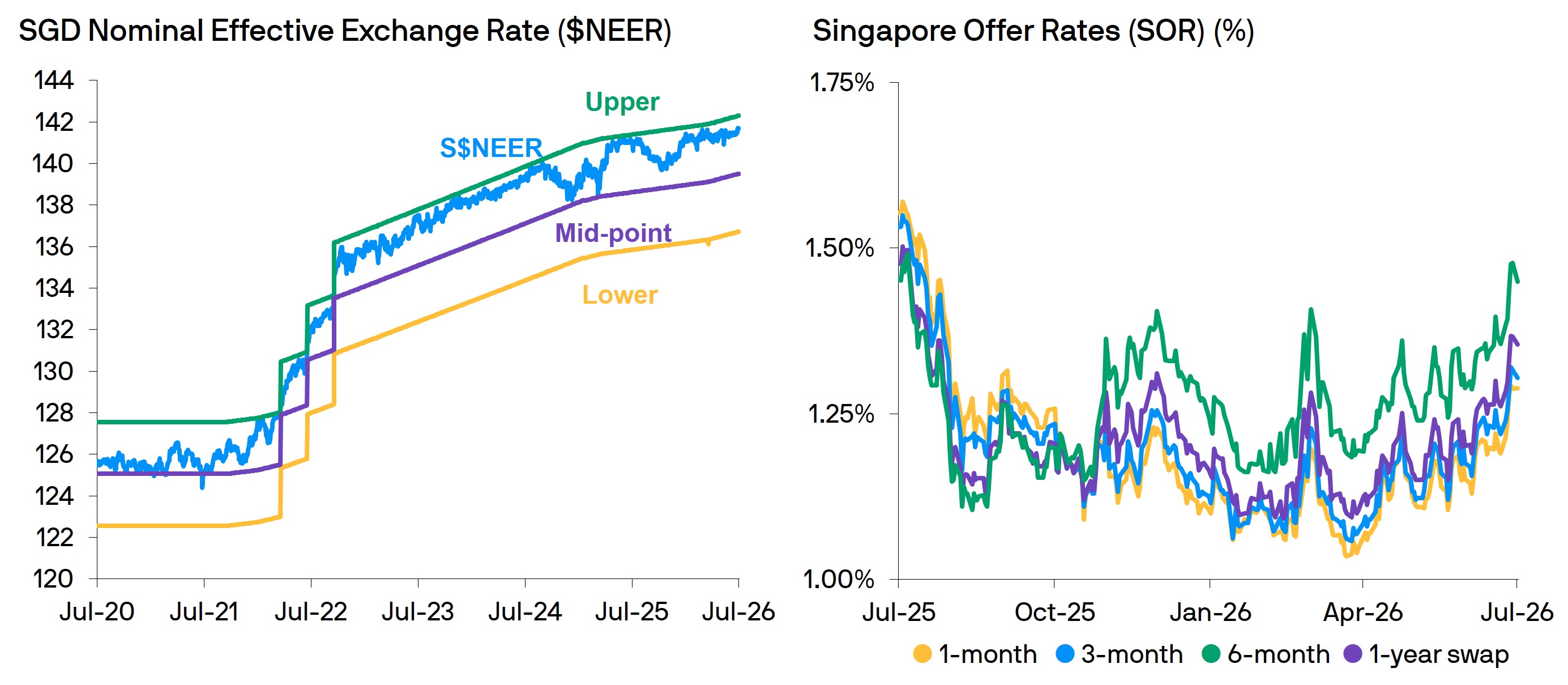
At its July 2026 policy meeting, the Monetary Authority of Singapore delivered another hawkish decision. It announced it would “increase the rate of appreciation of the policy band very slightly” (estimated by 0.25% to 1.25%), while leaving the width and centre point of the S$NEER band unchanged.
The July move builds on April’s decisive tightening, but in a more measured way. Growth has been “more resilient than anticipated” while inflation has trended higher, albeit by less than expected. MAS remains concerned that external price pressures will “remain elevated” and feed into domestic prices. July’s decision was a calibrated extension of tightening to at anchor inflation without overburdening growth.
Fig 1: S$NEER remains in top half of trading range; SOR yields have increased on tighter liquidity and growing Fed rate hike expectations.
Source: Bloomberg, Goldman Sachs, and J.P. Morgan Asset Management; as of 27 July 2026.
Growth robust, inflation persistent
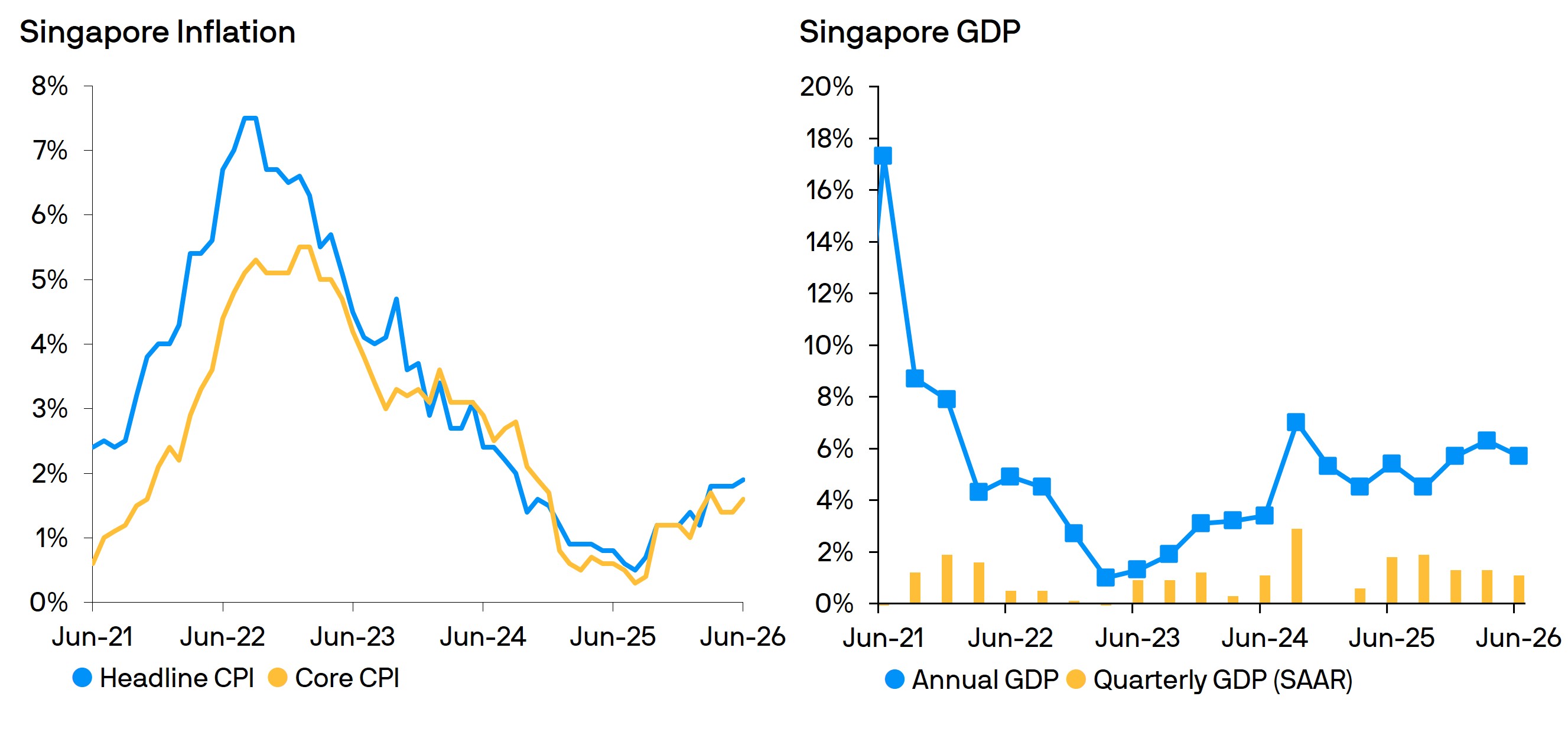
Singapore’s growth backdrop has improved relative to MAS’s earlier forecasts, with GDP expanding 5.7% y/y in Q2-26. Growth was driven by robust AI-related investment, while most other sectors expanded in line with trend. MAS now expects the positive output gap to widen slightly, supported by continued technology spending, a strong construction pipeline and steady financial-sector growth underpinned by credit expansion.
Inflation has evolved broadly in line with MAS’s April forecasts. Core inflation rose to 1.5% y/y in Q2 from 1.2% in January–February, before the Middle East conflict. Price increases were concentrated in fuel, food and transport. While domestic inflation pressures appear more contained than feared, MAS expects “import costs are likely to rise in the quarters ahead” as higher fuel and electronic input prices feed through supply chains.
MAS also warned that growth and inflation outlooks remain subject to “significant uncertainty” due to the macroeconomic outlook. Tighter financial conditions, higher energy costs or a pullback in AI-related investment could undermine growth. Renewed energy price spikes could cause inflation to “pick up more strongly than anticipated” or prove “more persistent than projected.”
Fig 2: Inflation has trended up on higher imported food and energy costs; fortunately, growth remains resilient.
Source: Bloomberg and J.P. Morgan Asset Management; as of 27 July 2026.
Tightening stance, but calibrated
MAS’s July statement confirms a calibrated rather than aggressive tightening stance. Growth is stronger than previously expected, the output gap is widening and imported inflation pressures remain persistent. These conditions justify a slightly restrictive policy and further appreciation path for the S$NEER. However, the smaller increase relative to April suggests MAS is mindful of policy lags and two-sided risks.
Only a minority of economists expected the MAS move, with most anticipating no change. The SGD strengthened after the announcement and remains among Asia’s best-performing currencies in recent months. Singapore SOR and government bond yields also rose, extending their sell-off from first-quarter lows. Tighter local liquidity and expectations of a more hawkish Fed have driven the recent rise in rates. While Singapore interest rates typically decline during an MAS tightening cycle, heightened macro and central bank uncertainty have increased rate volatility and made the outlook less predictable.
For SGD investors, the outlook remains broadly supportive. The S$NEER remains in the upper half of its appreciating policy band, and MAS policy should continue to reinforce this positioning. Meanwhile, SGD interest rates are likely to remain volatile, caught between Fed policy shifts, MAS currency tightening and uncertain liquidity conditions. In this environment, disciplined liquidity management, selective duration extension and diversification remain key to navigating ongoing macro volatility.