JP Morgan Asset Management - Home
  • My collections
    View saved content and presentation slides
  • Log out
  • Products

      Funds

      • Performance & Yields
      • Liquidity
      • Ultra-Short
      • Short Duration

      Solutions

      • Funds Overview
      • Empower Share Class
      • Academy Securities
      • Cash Segmentation
      • Separately Managed Accounts
      • Managed Reserves Strategy
      • Capitalizing on Prime Money Market Funds
    • Insights

        Liquidity Insights

        • Liquidity Insights Overview
        • Global Liquidity Investment Outlook

          Global Liquidity Investment Outlook

        • Tokenization

          Explore the full whitepaper to learn how tokenized MMFs can transform your approach to cash management and position your organization at the forefront of digital finance.

        • Case Studies

          Read about companies with specific cash management challenges and the solutions when they worked with J.P. Morgan Asset Management.

        • Partnership with fintechs

          A focus on digital innovation and institutional liquidity solutions drive our dynamic partnership with fintech.

        • Leveraging the Power of Cash Segmentation

          The most effective strategy incorporates a clear investment policy, well-defined goals and parameters for liquidity, quality and return.

        • Cash Investment Policy Statement

          How to write an investment policy statement for your organization

        Market Insights

        • Market Insights Overview
        • Eye on the Market

          Explore Eye on the Market, timely commentary that offers views on the economy, markets, and investment portfolios by Michael Cembalest.

        • Guide to the Markets

          The J.P. Morgan Guide to the Markets illustrates a comprehensive array of market and economic histories, trends and statistics through clear charts and graphs.

        • Market Updates

          Read our weekly commentaries to get market insights that may help inform your investment strategy.

        Portfolio Insights

        • Portfolio Insights Overview
        • Currency

          Our currency team provides solutions for clients, controlling risk using passive management strategies and generating returns by actively managing global currencies.

        • Fixed Income

          We highlight themes and implications from various fixed income teams to help guide your portfolio decisions.

        • Long-Term Capital Market Assumptions

          Our Long-Term Capital Market Assumptions (LTCMAs) deliver forward-looking return, volatility and correlation estimates for 200+ asset and strategy classes in 20+ base currencies.

        • Sustainable investing

          We believe that ESG considerations can play a critical role in a long-term investment strategy.

        • Strategic Investment Advisory Group

          The Strategic Investment Advisory Group approaches today’s investment challenges with a global view across asset classes.

      • Resources
          • Overview
          • MORGAN MONEY
          • Account Management & Trading
          • Global Liquidity Investment Academy
          • Announcements
          • Webcasts
        • About us

            About us

            Backed by $4.6T in assets, we harness our active edge to deliver timely ideas and actionable insights that empower investors to achieve what matters most.

            • Overview
            • Diversity, Opportunity & Inclusion
            • Spectrum: Our Investment Platform
            • Sustainable and social investing
            • Our Leadership Team
          • Contact us
          • English
          • MORGAN MONEY LOGIN
            • My collections
              View saved content and presentation slides
            • Log out
          • Log in
          • MORGAN MONEY LOGIN
          Log in
          You are about to leave the site Close
          J.P. Morgan Asset Management’s website and/or mobile terms, privacy and security policies don't apply to the site or app you're about to visit. Please review its terms, privacy and security policies to see how they apply to you. J.P. Morgan Asset Management isn’t responsible for (and doesn't provide) any products, services or content at this third-party site or app, except for products and services that explicitly carry the J.P. Morgan Asset Management name.
          CONTINUE Go Back
          1. Emerging markets and the negative yield conundrum for fixed income investors

          • LinkedIn Twitter Facebook WhatsApp

          Emerging markets and the negative yield conundrum for fixed income investors

          10/17/2019

          Frederick Bourgoin

          Zsolt Papp

          The flipside of the 30-year bond market rally is that developed market bond yields have been decreasing to record low levels and more recently even into negative territory. This poses a major problem for fixed income investors, which in some cases is materially exacerbated by the high cost of hedging. In response, developed market investors have been increasingly diversifying into non-core assets such as emerging markets (EM) or high yield (HY). However, these asset classes are gradually also being affected by the “negative yield disease”. In view of this, we argue that one option for investors is to take active FX risk.

          Significant problem for EUR and CHF-based investors

          Chart 1 shows the share of negative yielding bonds in developed and emerging government bond markets, respectively. Importantly, we not only looked at bonds in their respective reference currencies, but also at yields hedged to Swiss Franc (CHF) and Euro (EUR). The picture is quite sobering, in particular for CHF-based investors. 94% of the developed government bond market universe is negative yielding when hedged to CHF. The situation is only marginally less dramatic for EUR-based investors. This is also not an entirely new phenomenon: in fact, it’s been a dominant market feature since 2015 for CHF and 2016 for EUR based investors.
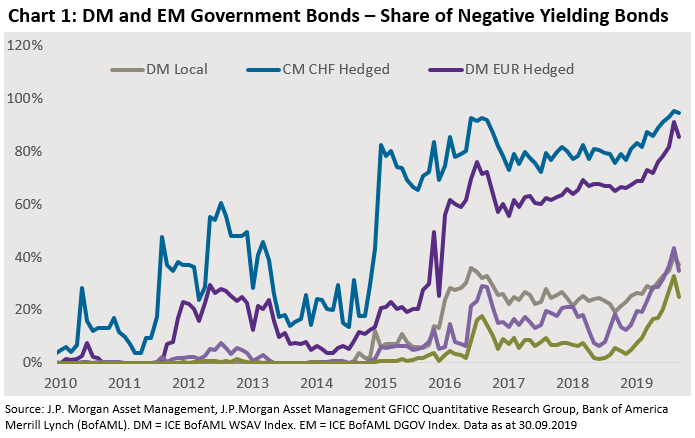
          DM and EM government bonds - share of negative yielding bonds

          Chart 1 also shows that EM is not immune. While there are no negative yielding bonds in the USD-denominated universe of EM government bonds, the share is already 25% hedged in EUR and 33% in CHF, respectively.

          Dramatic impact on yield levels

          The impact on yield levels is dramatic for some investors. DM government bonds hedged in CHF offer a yield of -0.65%, which begs the question if “fixed loss” might not be a more appropriate term instead of “fixed income” for Swiss Franc-based investors. The outlook for EUR and JPY-based investors is only marginally less dramatic with hedged yields of -0.31% and -0.16%, respectively.
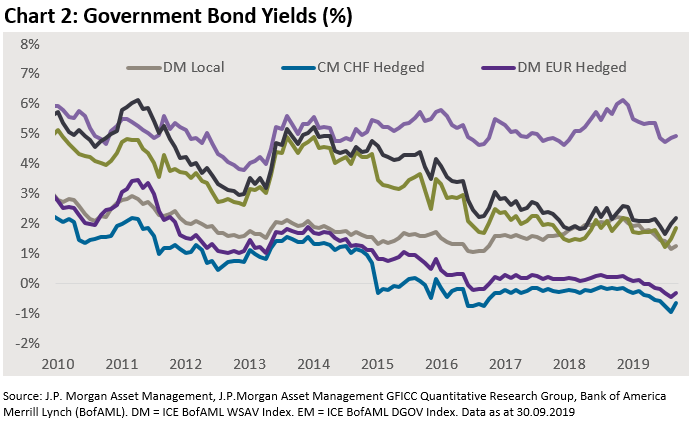
          government bond yields (%)

          In contrast, EM (and HY) hedged yields remain comfortably in positive territory. It may not sound like much, but a CHF-hedged yield of 1.9% for EM government bonds looks very appealing when compared to -0.61%. Moreover so, as adding EM debt to a global bond portfolio does not necessarily mean adding more risk. Giles Bedford showed earlier in September (No Longer “Why” but “How”: The case for emerging markets debt matures, September 26, 2019) how the role of EM in fixed income portfolios is changing as it offers a higher Sharpe measure than the Bloomberg Global Aggregate.

          In view of this, we would expect investors to increase diversification into non-core bond markets, especially as institutional allocation is still very low. According to Mercer, only 18% of European pension schemes have an average allocation of 5% to EM, which implies that there is ample room to increase exposure. Allocation to HY is equally very low.[1]

          Unhedged vs hedged yield

          In addition to diversification, we believe that investors will also have to consider taking active currency risk in order to avoid the negative yield trap. First, unhedged yield levels are much more attractive, as clearly shown in Chart 2. Second, unhedged returns for EM government bonds have been significantly higher as hedging can wipe out as much as 60% of the return in some cases. Table 2 shows the performance of Swiss and Euro government bonds vs EM government bonds since entering the zero / negative yield spiral in early 2015. Third, this problem is likely to last and negative yields could even get more negative, as Jason Davis showed in his blog last week (Negative Rates – How low can you go? October 10, 2019). 
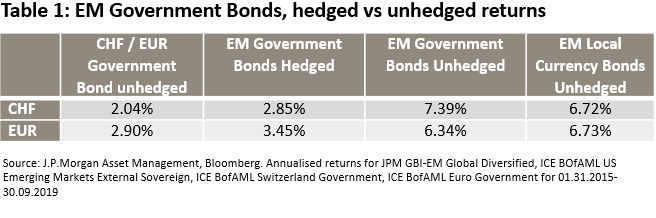
          EM Government bonds, hedged vs unhedged returns

           In sum, there are several valid reasons why investors should consider taking active currency risk. One approach would be to invest in a traditional USD-denominated bond strategy, as illustrated by the ICE BofAML DGOV index, and hedge in the reference currency. Another approach would be to invest in EM local currency bonds, such as represented by the JPM GBI-EM Global Diversified index. Table 1 shows that this would have generated similar returns to USD-denominated bonds for EUR and CHF-based investors.

          The latter leads to the question of whether it is a good moment to take active currency risk? We know from (sometimes painful) experience that in crises EM currencies can go lower and therefore valuation analysis has to be taken with a grain of salt. Nevertheless, Chart 3 shows that EM FX is currently trading at long-time lows and not far off the historical low. This would therefore lend support to the view that current levels could offer an attractive point of entry.
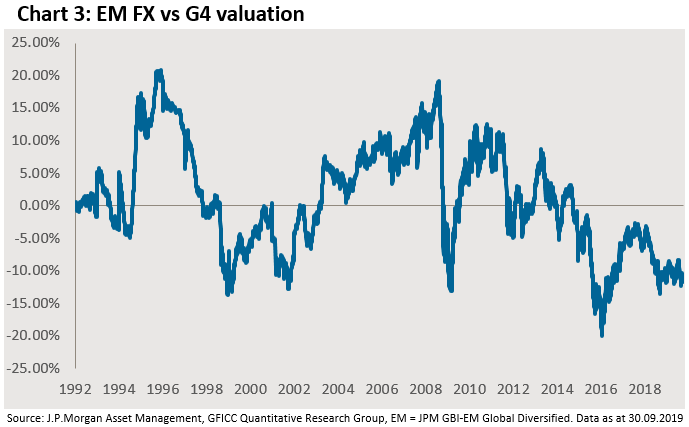
          EM FX vs G4 valuation

          So how do investors react to the idea of taking active currency risk? What we can observe is that strategies actively investing in local currency Rates and FX have seen significant inflows. Unconstrained bond funds attracted USD 57bn so far this year and EM local currency bond strategies (retail and institutional) USD 6.4bn. This is still below the amount going into EM hard currency strategies (USD 48.7bn) but it nevertheless illustrates that investors are prepared to take active currency exposure.

          In sum, the growing share of negative yielding bonds requires investors to diversify away from core fixed income. EM bonds are offering a solution to this problem. However, as the high cost of hedging is eating into the income achieved in EM bonds, investors will also have to consider taking active currency risk in their portfolios. Flow of funds indicates that there is already some investor appetite, and as negative yields are likely here to stay (and potentially grow), we would expect demand for active currency solutions to increase.

          [1] Mercer, European Asset Allocation Survey 2019

          • Emerging Markets
          • Eurozone
          • Rates
          • Currency

          RELATED ARTICLES

          EM central banks – the case for an asymmetrical beta to the fed

          EM Central Banks have a relatively high beta to Fed policy rates. We believe EM Central Banks will deliver a significant cutting cycle across most countries.

          Read more

          No longer “why” but “how”: the case for emerging markets debt matures

          In a world where real yield is increasingly scarce, it is our view, emerging markets debt deserves a larger role in a global fixed income portfolio.

          Read more

          Emerging Markets Debt: Stronger than it’s ever been

          In our view, emerging markets debt deserves the positive attention it has been receiving in an era of central bank interference and global hunt for yield.

          Read more
          J.P. Morgan Asset Management

          • Investment stewardship
          • About us
          • Contact us
          • Privacy policy
          • Cookie policy
          • Sitemap
          • Accessibility
          J.P. Morgan

          • J.P. Morgan
          • JPMorgan Chase
          • Chase

          READ IMPORTANT LEGAL INFORMATION. Legal Disclaimer >

          The value of investments may go down as well as up and investors may not get back the full amount invested.

          Copyright 2026 JPMorgan Chase & Co. All rights reserved.