
JP Morgan Asset Management - Home
  • Products
    Overview

    Funds

    • Performance & Yields
    • Liquidity
    • Ultra-Short
    • Short Duration

    Solutions

    • Empower Share Class
    • Academy Securities
    • Cash Segmentation
    • Separately Managed Accounts
    • Managed Reserves Strategy
    • Capitalizing on Prime Money Market Funds
  • Insights
    Overview

    Liquidity Insights

    • Liquidity Insights Overview
    • Case Studies
    • Partnership with fintechs
    • Leveraging the Power of Cash Segmentation
    • Cash Investment Policy Statement

    Market Insights

    • Market Insights Overview
    • Eye on the Market
    • Guide to the Markets
    • Market Updates

    Portfolio Insights

    • Portfolio Insights Overview
    • Currency
    • Fixed Income
    • Long-Term Capital Market Assumptions
    • Sustainable investing
    • Strategic Investment Advisory Group
  • Resources
    Overview
    • MORGAN MONEY
    • Global Liquidity Investment Academy
    • Account Management & Trading
    • Announcements
    • Navigating market volatility
    • 2024 US Money Market Fund Reform
  • About us
    Overview
    • Diversity, Opportunity & Inclusion
    • Spectrum: Our Investment Platform
    • Sustainable and social investing
    • Our Leadership Team
  • Contact us
  • English
  • Role
  • Country
MORGAN MONEY LOGIN
Search
Menu
Search
You are about to leave the site Close
J.P. Morgan Asset Management’s website and/or mobile terms, privacy and security policies don't apply to the site or app you're about to visit. Please review its terms, privacy and security policies to see how they apply to you. J.P. Morgan Asset Management isn’t responsible for (and doesn't provide) any products, services or content at this third-party site or app, except for products and services that explicitly carry the J.P. Morgan Asset Management name.
CONTINUE Go Back
  1. Cash: it’s what you do with it that matters

  • LinkedIn Twitter Facebook WhatsApp

Cash: it’s what you do with it that matters

02/14/2020

David Lebovitz

Tyler Voigt

In Brief
  • Earnings are the main driver of stock market returns, but how earnings are used is also important.

  • Historically, companies favored capital spending (capex), but more recently have shown a preference for dividends and buybacks.

  • Companies with high buyback yields have outperformed this cycle, but the corresponding reduction in capex will matter in the long-run.

  • The rise of the capital-lite business has implications for how investors should think about growth vs. value.

  • Looking ahead, portfolios should balance shareholder returns and long-term growth.

Profits matter, but the devil is in the details

While multiple expansion was responsible for the majority of returns last year, over the long run, earnings growth tends to be the primary driver of stock market performance. As a result, equity investors spend a lot of their time looking for where earnings growth will be the strongest; what does not get as much attention is what happens to earnings after they are generated, and how this impacts future returns.

The clearest example of how earnings impact returns is through the shareholder channel – in other words, when a company returns cash through dividends or buybacks. However, there are other ways that earnings are used to create value over longer periods of time. For example, when companies reinvest in themselves by purchasing new equipment or providing employees with additional training, in theory this should increase productivity, and therefore earnings, over the long-run. Even paying down debt has a positive effect on profits, as doing so reduces interest costs and allows more cash to fall to the bottom line.

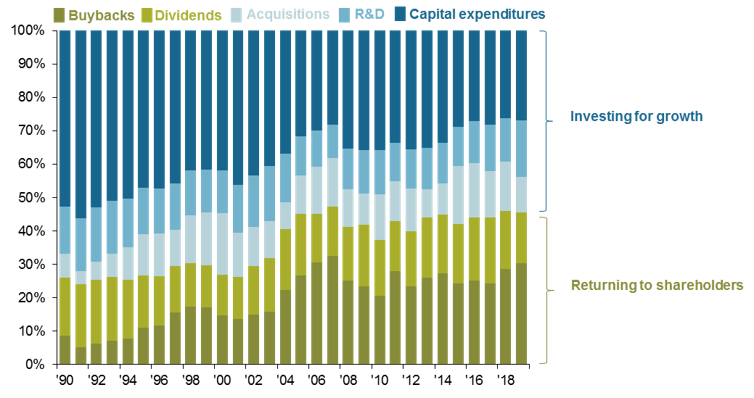
Historically, companies demonstrated a preference for investing back into the business in an effort to drive future growth. While this came at the expense of returning cash to shareholders through dividends and stock buybacks, as shown in Exhibit 1, this dynamic has begun to shift. At the current juncture, 45% of cash is being returned to shareholders through dividends and buybacks, compared to just 26% in 1990.

EXHIBIT 1: S&P 500 companies have seen a preference for shareholder return more recently

% of capital used for each outlay
Source: Compustat, FactSet, Standard & Poor’s, J.P. Morgan Asset Management.


 0903c02a8280a9f4

  • Equities
J.P. Morgan Asset Management

  • Investment stewardship
  • About us
  • Contact us
  • Privacy policy
  • Cookie policy
  • Sitemap
  • Accessibility
J.P. Morgan

  • J.P. Morgan
  • JPMorgan Chase
  • Chase

READ IMPORTANT LEGAL INFORMATION. Legal Disclaimer >

The value of investments may go down as well as up and investors may not get back the full amount invested.

Copyright 2025 JPMorgan Chase & Co. All rights reserved.