logo
  • My collections
    View saved content and presentation slides
  • Log out
  • Products

      Funds

      • Performance & Yields
      • Liquidity
      • Ultra-Short
      • Short Duration
      • European domiciled products

      Solutions

      • Cash Strategies
      • Cash Segmentation
      • Separately Managed Accounts
      • Managed Reserves Strategy

      Fund Information

      • Regulatory Updates
    • Insights

        Liquidity Insights

        • Liquidity Insights Overview
        • Global Liquidity Investment Outlook

          Global Liquidity Investment Outlook

        • Tokenization

          Explore the full whitepaper to learn how tokenized MMFs can transform your approach to cash management and position your organization at the forefront of digital finance.

        • Cash Cookbook

          The Cash Cookbook, your guide to cash and liquidity management success, helps you choose the right liquidity solution for your needs and risk tolerance.

        • Case Studies

          Read about companies with specific cash management challenges and the solutions when they worked with J.P. Morgan Asset Management.

        • Partnership with fintechs

          A focus on digital innovation and institutional liquidity solutions drive our dynamic partnership with fintech.

        • ESG Resources for Liquidity Investors

          We’ve created a clear, rigorous ESG process meets the many needs of liquidity investors.

        • Leveraging the Power of Cash Segmentation

          The most effective strategy incorporates a clear investment policy, well-defined goals and parameters for liquidity, quality and return.

        • Cash Investment Policy Statement

          How to write an investment policy statement for your organization

        Market Insights

        • Market Insights Overview
        • Eye on the Market

          Explore Eye on the Market, timely commentary that offers views on the economy, markets, and investment portfolios by Michael Cembalest.

        • Guide to the Markets

          The J.P. Morgan Guide to the Markets illustrates a comprehensive array of market and economic histories, trends and statistics through clear charts and graphs.

        • Market Updates

          Read our weekly commentaries to get market insights that may help inform your investment strategy.

        Portfolio Insights

        • Portfolio Insights Overview
        • Currency

          Our currency team provides solutions for clients, controlling risk using passive management strategies and generating returns by actively managing global currencies.

        • Fixed Income

          A complex mix of monetary, credit and fiscal forces is changing the bond landscape. Discover how flexible fixed income approaches can seek returns, income and resilience.

        • Long-Term Capital Market Assumptions

          Our Long-Term Capital Market Assumptions (LTCMAs) deliver forward-looking return, volatility and correlation estimates for 200+ asset and strategy classes in 20+ base currencies.

        • Sustainable investing

          We believe that ESG considerations can play a critical role in a long-term investment strategy.

        • Strategic Investment Advisory Group

          The Strategic Investment Advisory Group approaches today’s investment challenges with a global view across asset classes.

      • Resources
          • Overview
          • MORGAN MONEY
          • Account Management & Trading
          • Global Liquidity Investment Academy
          • Announcements
        • About us

            About us

            Backed by $4.6T in assets, we harness our active edge to deliver timely ideas and actionable insights that empower investors to achieve what matters most.

            • Overview
            • Diversity, Opportunity & Inclusion
            • Spectrum: Our Investment Platform
            • Our Leadership Team
            • Our Commitment to Research
          • Contact us
          • English
          • MORGAN MONEY LOGIN
            • My collections
              View saved content and presentation slides
            • Log out
          • Log in
          • MORGAN MONEY LOGIN
          Log in
          You are about to leave the site Close
          J.P. Morgan Asset Management’s website and/or mobile terms, privacy and security policies don't apply to the site or app you're about to visit. Please review its terms, privacy and security policies to see how they apply to you. J.P. Morgan Asset Management isn’t responsible for (and doesn't provide) any products, services or content at this third-party site or app, except for products and services that explicitly carry the J.P. Morgan Asset Management name.
          CONTINUE Go Back
          1. The PBoC – Rate Cuts and Policy Clarification

          • LinkedIn Twitter Facebook Line WhatsApp

          The PBoC - Rate Cuts and Policy Clarification

          09-04-2020

          Aidan Shevlin

          On Friday, 3 April 2020, the Peoples Bank of China (PBoC) announced its second targeted Reserve Requirement Rate (RRR) cut in less than three weeks, reducing the effective RRR for medium and smaller banks to record lows.  Arguably, what’s more important was the accompanying reduction in the interest rate on excess reserves (IOER), the first cut in over a decade; which will pave the way for additional rate cuts and further interest rate reforms.  Both actions also help the PBoC address concerns that its policy response was lagging the aggressive actions taken by other central banks.

          The PBoC’s RRR Hat-Trick:

          The 100bps RRR cut was widely expected following calls for additional monetary policy support at the State Council meetings three days earlier.  The third RRR cut in 2020 will release ~CNY400bn of liquidity, while reducing bank funding costs, alleviating pressure on their loan-to-deposit ratios and increasing their ability to lend to small and medium enterprise clients.

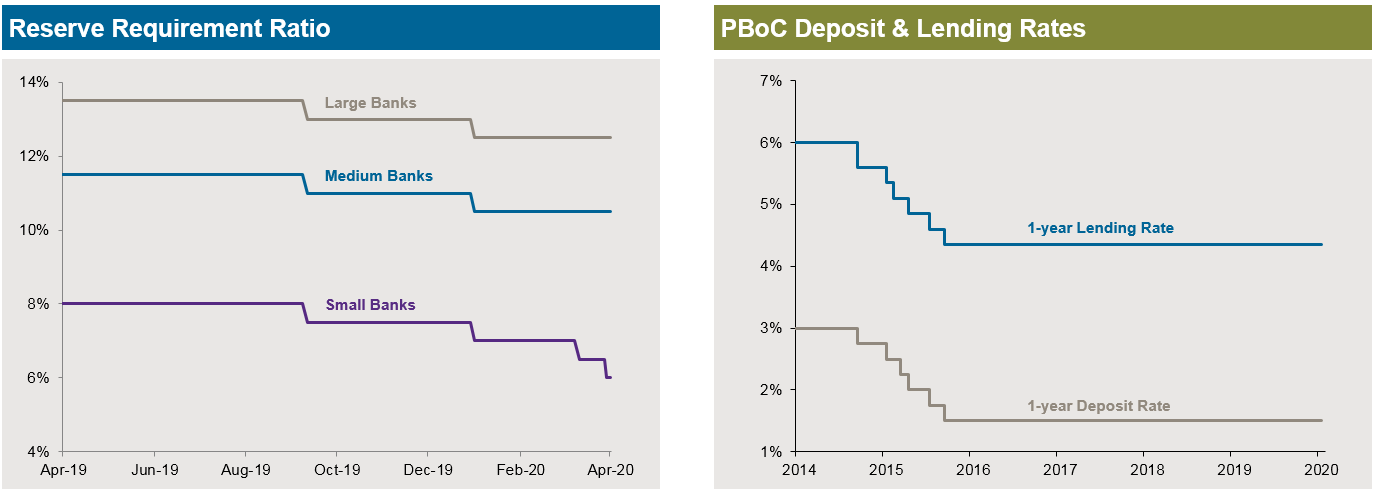
          Unlike open market operations, RRR represent permanent and free increases in commercial bank liquidity.  The previous 50bps targeted rate cut on 13 March released ~CNY550bn of liquidity, while the 2 January 50bps cut released ~CNY800bn of liquidity.  Following the cuts, the RRR for large banks is 12.5%, while it is 9-10.5% for medium banks and 6% for smaller banks.

          Fig 1: RRR rates for small and medium size banks are at record lows while benchmark interest rates remain unchanged
          Source: Bloomberg & J.P. Morgan Asset Management; data as at 5 Apr 2020

          The PBoC’s focus on RRR cuts has also clarified its policy stance and confirmed its hesitancy to change benchmark interest rates - reducing market expectations of a deposit or lending rate cut.  Since interest rates were liberalized in 2015, the central bank has de-emphasized benchmark rates and focused on using its growing arsenal of quasi-monetary policy tools to fine tune liquidity and interest rates.

          A benchmark lending rate cut would be an extremely strong signal of PBoC’s intentions and directly reduce funding costs for borrowers.  But it would also reduce commercial bank’s net interest rate margins unless accompanied by a benchmark deposit rate cut – which the PBoC appears reluctant to do – given the risk of penalizing small retail deposits, which still represent over 60% of commercial bank liabilities.

          IOER – Guiding rates lower:

          Excess reserves are the additional cash balances that commercial banks hold with the PBoC.  The 37bps IOER cut is the first time this rate has been reduced since November 2008.  At the end of 2019, excess cash balances represented 2.4% of total deposits; reducing the IOER will encourage commercial banks to invest their excess cash balances elsewhere – pushing interest rates on risky assets lower.

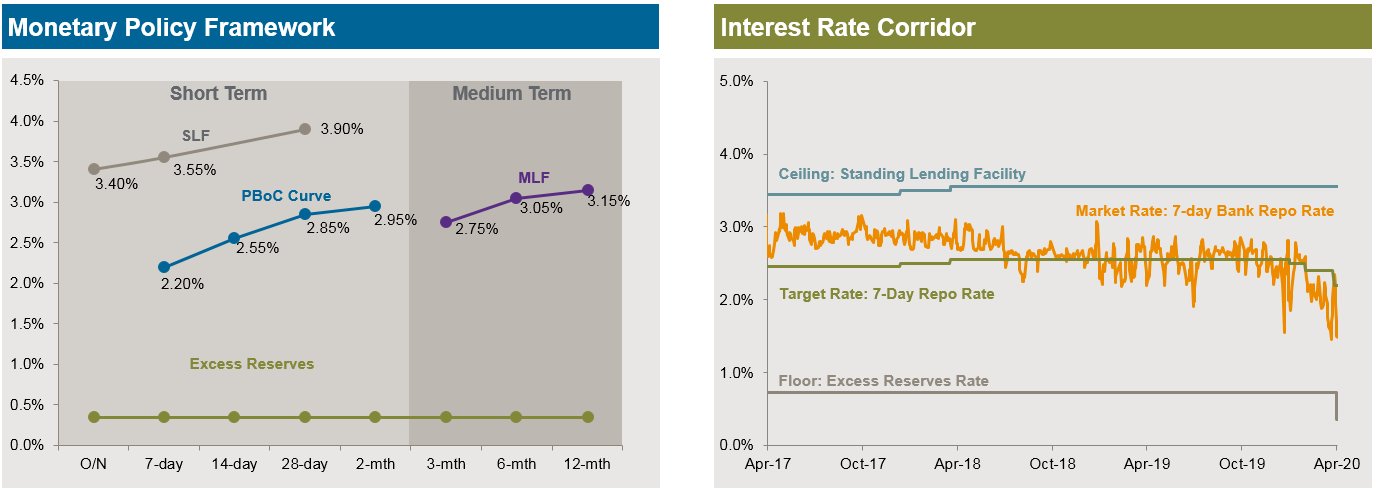
          Fig 2: China’s monetary policy framework is focused on controlling the 7-day reverse repo rate within an interest rate corridor.
          Source: Bloomberg & J.P. Morgan Asset Management: data as at 5 Apr 2020

          The IOER also forms the lower bound of the central banks interest rate corridor, while the 7-day reserve repo rate acts as the target rate and the standing lending facility (SLF) forms the upper bound. 

          Reducing the IOER paves the way for additional rate cuts and improves forward guidance. The PBoC has already cut the 7-day reverse repo rate three times this year - the latest 20bps reduction on the 30th of March to 2.20%.  A SLF cut is now likely as the central bank guides market driven interest rates even lower. 

          PBoC - Converging and clarifying:

          As the first country to be affected by the COVID-19 outbreak, the Chinese economy has witnessed significant economic disruption.  The government and PBoC reacted quickly to stabilize the economy, however, their subsequent fiscal and monetary policy response has been relatively muted by international standards.  While major central banks have slashed interest rates and introduced quantitative easing, the PBoC has relied on a series of mini-steps, including liquidity injections and modest quasi-monetary policy rate cuts to stabilize and support financial markets.

          While high frequency trackers signal a revival in domestic economic activity, the expanding global shutdown threatens to derail China’s prospects of a v-shaped recovery, prompted renewed dovish comments from the Politburo and Standing Committee - which triggered the latest PBoC actions. 

          Implications for RMB Money Markets:  

          The recent PBoC rate cuts will place additional downward pressure on market driven rates, Shibor rates have already trended lower while the yield curve has flattened.  Meanwhile, refinements to the central bank interest rate corridor will pave the way for more aggressive future monetary policy actions, but the PBoCs reluctance to cut benchmark interest rates will increase the divergence between policy and market driven rates – creating additional investment challenges for money market investors.


          • China
          • APAC

          RELATED ARTICLES

          China’s Interest Rate Pivot

          While China’s post-Covid-19 economic data is showing signs of normalization, the government’s focus on stability will have significant implications for monetary policy and interest rates

          Read more

          Singapore Dollar – no longer defying gravity

          The Singapore Dollar is no longer defying gravity – we discuss why and the implications for cash investors.

          Read more

          PBOC: small move, strong signal

          We look at why the People’s Bank of China’s (PBoC) made its recent and notable dovish pivot and its implications for investors

          Read more