logo
  • My collections
    View saved content and presentation slides
  • Log out
  • Products

      Funds

      • Performance & Yields
      • Liquidity
      • Ultra-Short
      • Short Duration
      • European domiciled products

      Solutions

      • Cash Strategies
      • Cash Segmentation
      • Separately Managed Accounts
      • Managed Reserves Strategy

      Fund Information

      • Regulatory Updates
    • Insights

        Liquidity Insights

        • Liquidity Insights Overview
        • Global Liquidity Investment Outlook

          Global Liquidity Investment Outlook

        • Tokenization

          Explore the full whitepaper to learn how tokenized MMFs can transform your approach to cash management and position your organization at the forefront of digital finance.

        • Cash Cookbook

          The Cash Cookbook, your guide to cash and liquidity management success, helps you choose the right liquidity solution for your needs and risk tolerance.

        • Case Studies

          Read about companies with specific cash management challenges and the solutions when they worked with J.P. Morgan Asset Management.

        • Partnership with fintechs

          A focus on digital innovation and institutional liquidity solutions drive our dynamic partnership with fintech.

        • ESG Resources for Liquidity Investors

          We’ve created a clear, rigorous ESG process meets the many needs of liquidity investors.

        • Leveraging the Power of Cash Segmentation

          The most effective strategy incorporates a clear investment policy, well-defined goals and parameters for liquidity, quality and return.

        • Cash Investment Policy Statement

          How to write an investment policy statement for your organization

        Market Insights

        • Market Insights Overview
        • Eye on the Market

          Explore Eye on the Market, timely commentary that offers views on the economy, markets, and investment portfolios by Michael Cembalest.

        • Guide to the Markets

          The J.P. Morgan Guide to the Markets illustrates a comprehensive array of market and economic histories, trends and statistics through clear charts and graphs.

        • Market Updates

          Read our weekly commentaries to get market insights that may help inform your investment strategy.

        Portfolio Insights

        • Portfolio Insights Overview
        • Currency

          Our currency team provides solutions for clients, controlling risk using passive management strategies and generating returns by actively managing global currencies.

        • Fixed Income

          A complex mix of monetary, credit and fiscal forces is changing the bond landscape. Discover how flexible fixed income approaches can seek returns, income and resilience.

        • Long-Term Capital Market Assumptions

          Our Long-Term Capital Market Assumptions (LTCMAs) deliver forward-looking return, volatility and correlation estimates for 200+ asset and strategy classes in 20+ base currencies.

        • Sustainable investing

          We believe that ESG considerations can play a critical role in a long-term investment strategy.

        • Strategic Investment Advisory Group

          The Strategic Investment Advisory Group approaches today’s investment challenges with a global view across asset classes.

      • Resources
          • Overview
          • MORGAN MONEY
          • Account Management & Trading
          • Global Liquidity Investment Academy
          • Announcements
        • About us

            About us

            Backed by $4.6T in assets, we harness our active edge to deliver timely ideas and actionable insights that empower investors to achieve what matters most.

            • Overview
            • Diversity, Opportunity & Inclusion
            • Spectrum: Our Investment Platform
            • Our Leadership Team
            • Our Commitment to Research
          • Contact us
          • English
          • MORGAN MONEY LOGIN
            • My collections
              View saved content and presentation slides
            • Log out
          • Log in
          • MORGAN MONEY LOGIN
          Log in
          You are about to leave the site Close
          J.P. Morgan Asset Management’s website and/or mobile terms, privacy and security policies don't apply to the site or app you're about to visit. Please review its terms, privacy and security policies to see how they apply to you. J.P. Morgan Asset Management isn’t responsible for (and doesn't provide) any products, services or content at this third-party site or app, except for products and services that explicitly carry the J.P. Morgan Asset Management name.
          CONTINUE Go Back
          1. China’s Interest Rate Pivot

          • LinkedIn Twitter Facebook Line WhatsApp

          China’s Interest Rate Pivot

          18-06-2020

          Aidan Shevlin

          Over the past few weeks, on-shore CNY interest rates have rebounded sharply higher from the cycle lows of early May.  SHIBOR, Treasury bond and financial policy bank bonds yields all jumped across the curve, while credit spreads surged upwards.  The combination of a central bank policy pivot, better economic data and market technical factors contrived to end China’s bond bull market – but is the upward momentum sustainable, and what are the implications for investors?

          Swift Intervention:

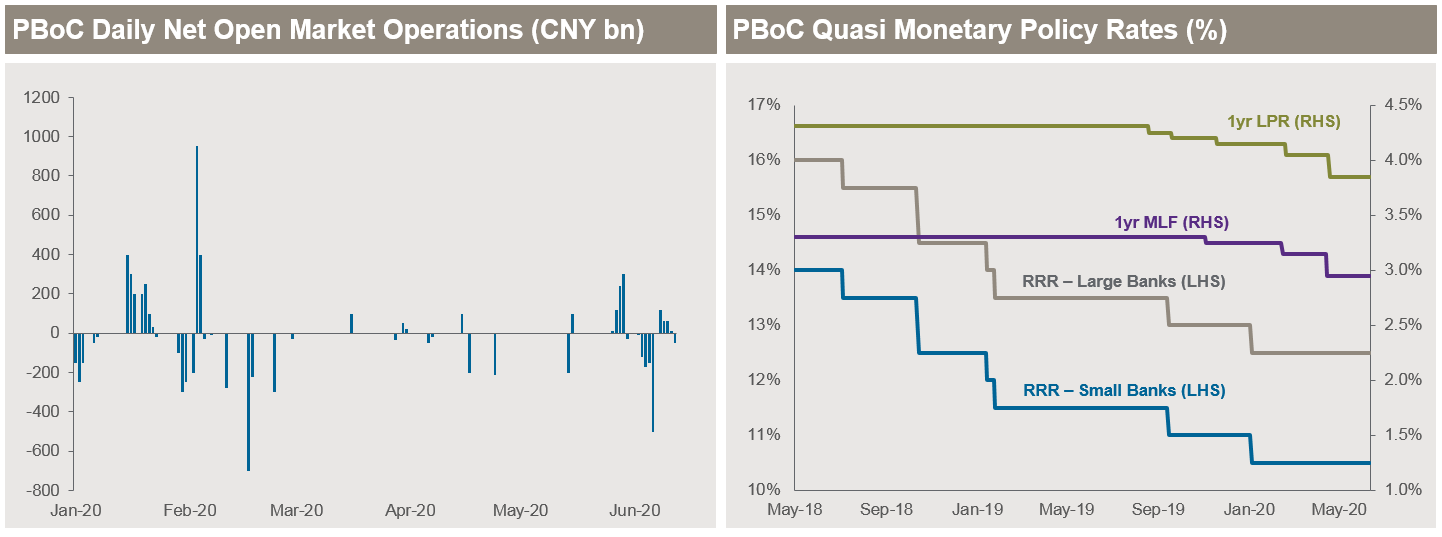
          As financial markets reopened following Chinese New Year holiday, the Peoples Bank of China (PBoC) focused on minimizing the economic fallout from the Covid-19 outbreak (Figure 1).  The central bank injected a record amount of liquidity via open market operations (OMO), cut the Reserve Requirement Ratio (RRR) and key quasi-monetary policy rates including the Medium Term Lending Facility (MLF) and the Loan Prime Rate (LPR).  

          Figure 1: The PBoC used monetary policy to support market stability
          Source: Bloomberg, as at 14th June 2020

          The PBoC also reduced the 7-day repo rate and trimmed the interest on excess reserves (IOER) for the first time since 2008.  All these actions plus the plunge in first quarter GDP by 9.8%q/q raised expectations of additional rate cuts – and by mid-April market driven interest rates hit new multi-year lows.

          The PBoC Pivot:

          However, China’s apparent success in containing the Covid-19 outbreak and restarting the economy was soon reflected in economic data, which showed signs of normalization as large parts of the economy emerged from quarantine.  Exports recovered faster than expected, policy driven sectors accelerated, and the PBoC’s new targeted lending tools supported a revival of small and medium enterprises.

          In his annual policy address at the delayed National People’s Congress (NPC), Premier Li mentioned stability over forty times, compared with zero mentions of growth. The economic uncertainties triggered by the pandemic have threatened the government’s “six guarantees” including employment and basic livelihood, forcing a reappraisal of growth and stimulus plans.  For the first time in over two decades, the authorities did not announce an official 2020 growth target.  This reduced pressure on the Ministry of Finance and the PBoC to deliver further fiscal and monetary policy stimulus.

          Instead, the Ministry of Finance made several formal announcements, encouraging market participants to focus on downside debt risks.  Meanwhile, the PBoC surprised the market by leaving the MLF and LPR rates unchanged in May and June, and dramatically scaled back OMO - reducing the amount of liquidity in the banking system from excessive to merely ample. 

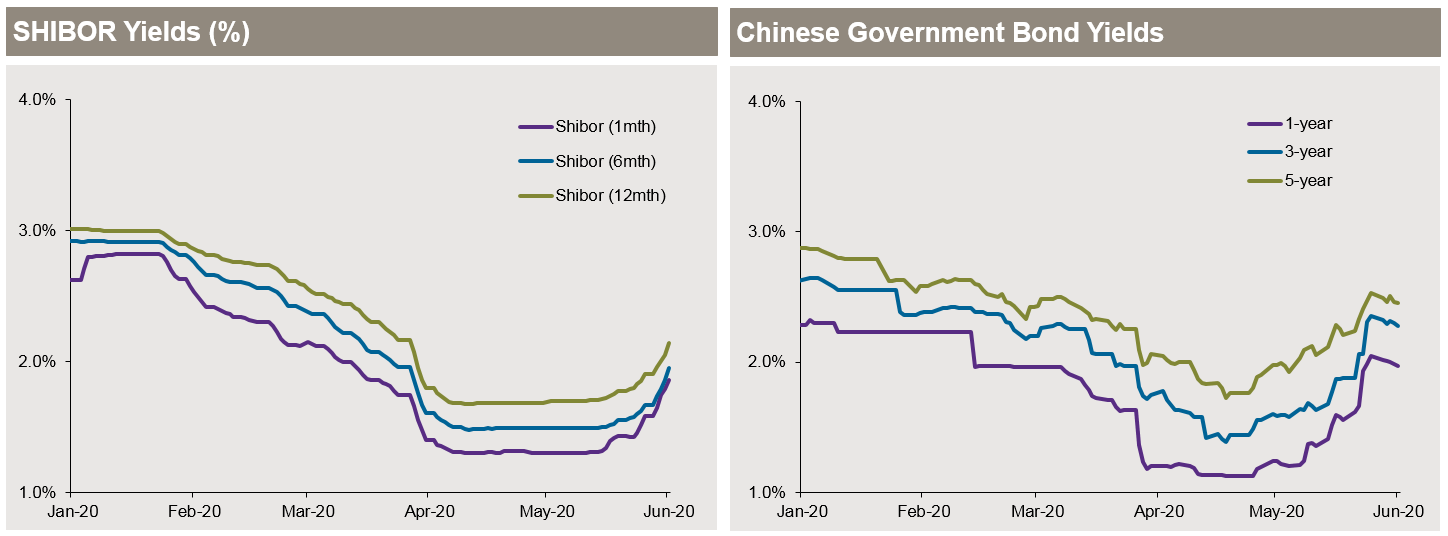
          These factors plus technical dynamics including tax payments and sizeable local government bond issuance helped push yields (Figure 2) to two-month highs, ending China’s bond bull market, as investors unwound expectations of further PBoC monetary policy easing.

          Figure 2: SHIBOR and government bond yields have rebounded sharply
          Source: Bloomberg, as at 14th June 2020

          The PBoC also hopes that standardizing the date for MLF (15th of each month) and LPR (20th of each month) combined with formalized notification of OMO (9-9.20am each day) will help reduce market volatility and improve forward guidance.

          Investor Implications:

          Rapidly declining yields in the first quarter triggered large flows into riskier investments including structured deposits, asset management products and short duration bond funds.  Subsequently, as expectations of further monetary policy stimulus faded, market yields have increased, generating capital losses, fears of a spike in bond defaults and an investment retrenchment.

          Despite the nascent recovery, economic activity remains well below potential and exposed to risks of a second Covid-19 wave – potentially necessitating additional central bank monetary easing.  A recent virus outbreak in Beijing has already prompted the State Council to reiterate the need to maintain ample liquidity (possibly signaling further RRR cuts) and encouraged the PBoC to ease its 14-day repo rate.   Fortunately, the PBoC still has capacity to cut rates further or inject additional liquidity if necessary – principally via quasi-monetary policy tools - but a significant policy reversal remains unlikely in the near term.

          • China
          • Liquidity
          • APAC

          RELATED ARTICLES

          IOER – does the latest fed move have any practical implications for cash investors?

          The Fed’s interest on excess reserves (IOER) shot to prominence following an unprecedented adjustment by the central bank. We explore its impact on investors.

          Read more

          The PBoC – Rate Cuts and Policy Clarification

          The Peoples Bank of China recent policy actions help address the concerns that its policy response was lagging the aggressive actions taken by other central banks.

          Read more

          Singapore Dollar – no longer defying gravity

          The Singapore Dollar is no longer defying gravity – we discuss why and the implications for cash investors.

          Read more