Executive Summary
The guide presents a practical retirement planning framework for those looking to retire in Singapore. It covers the current retirement landscape, savings discipline, spending needs and investment portfolio construction.
- Plan for a longer retirement, not just retirement day. A 65-year-old couple in Singapore has a 62% chance that at least one person lives to age 90, which means retirement savings may need to last for several decades.1
- Retirement planning cannot be left too late. Around 66% of participants overall, and about 75% of those aged 65 and above have not started retirement planning, highlighting a gap between retirement needs and preparedness.2
- Stay invested and match your money to your goals. The guide shows that missing just the 10 best S&P 500 market days would have reduced a USD 10,000 investment over 20 years from USD 80,619 to USD 35,866, highlighting the importance of discipline and a goals-based portfolio approach.3
Meeting the challenge of an ageing society
Singapore's population is ageing quickly. In 2015, about 1 in 10 Singaporeans were aged 65 years and older. In 2025, this proportion has increased to 1 in 5 and is expected to further increase to 1 in 4 by 2030.4 In addition, with more Singaporeans entering their retirement years than working ages, the number of working people able to support a senior person is expected to shrink.4
This, coupled with longer life expectancies, declining average size of households and shifting societal norms that increasingly stress individual responsibility on the part of older Singaporeans5, underscore the importance of taking steps to stay independent in your silver years, both financially and physically.
Taking care of your health is an important part of that equation, but so is growing your wealth to ensure that your financial resources can last over a longer period of time. This can also help improve access to a wider array of medical and care services which many may require in their old age.
The reality is, to retire confidently tomorrow requires a serious effort to grow one’s assets today.
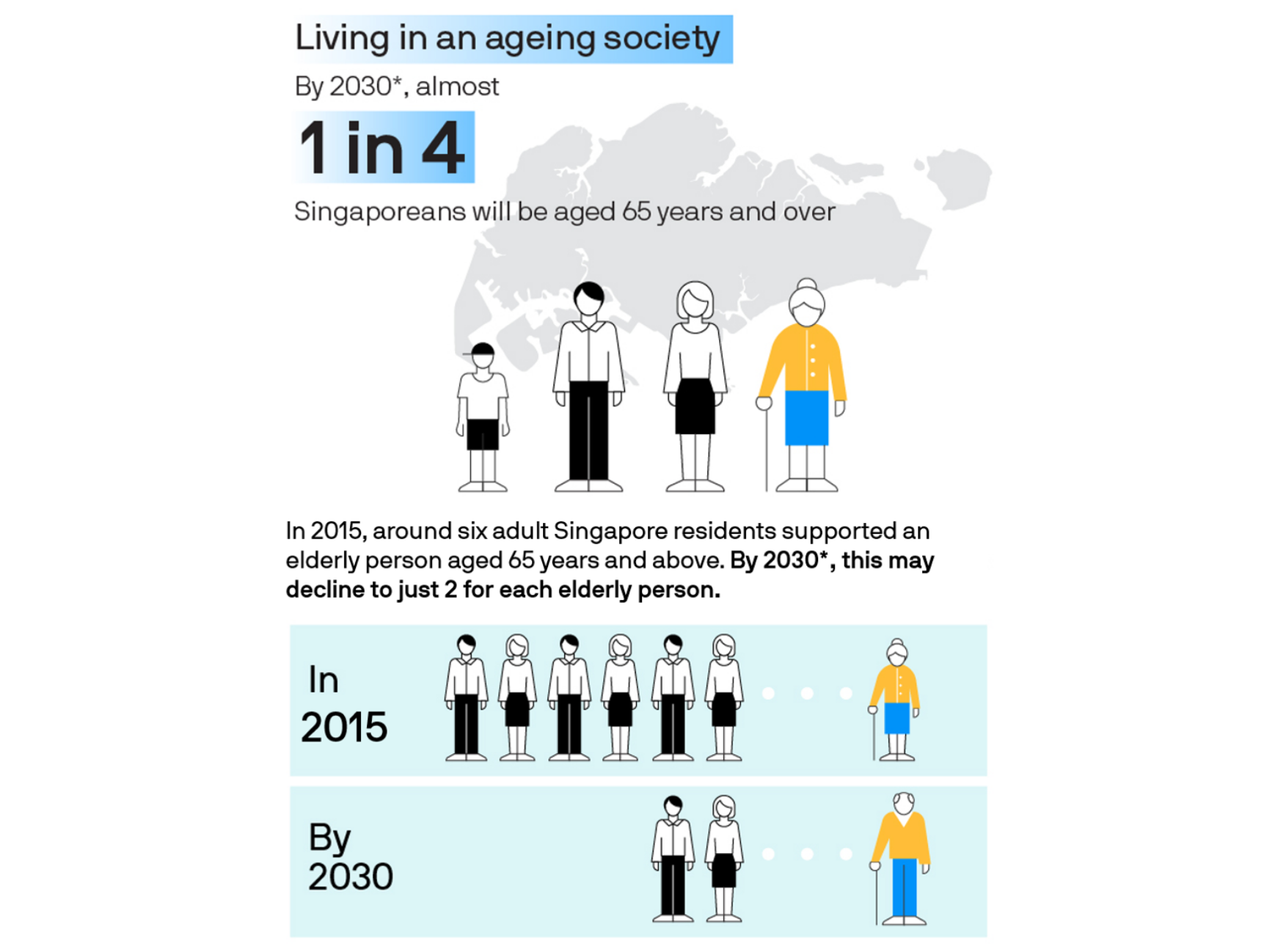
Source: J.P. Morgan Asset Management. Population in Brief (PIB) 2025. National Population and Talent Division; Strategy Group, Prime Minister’s Office; Singapore Department of Statistics; Ministry of Home Affairs; Immigration & Checkpoints Authority; Ministry of Manpower. September 2025. Forecasts, projections and other forward-looking statements are based upon current beliefs and expectations, they may or may not come to pass. *2030 numbers are Singapore Department of Statistics forecasts. The 2030 numbers illustrate the possible change in the population that could occur if certain demographic assumptions prevail over the stated period. These assumptions may or may not be realised. Projections have been updated from Population in Brief 2025.
Where are you on your retirement journey?
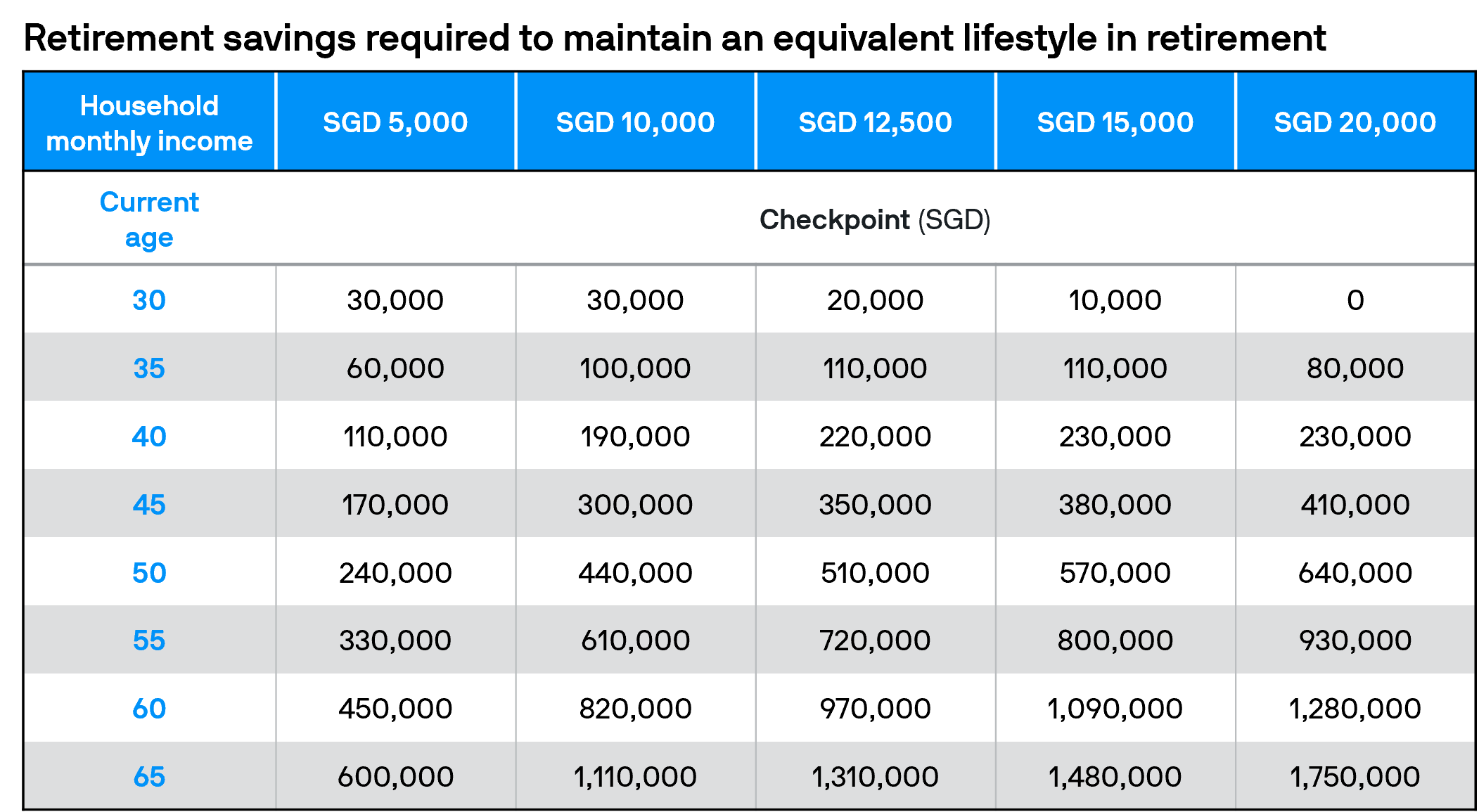
Model assumptions: (1) Annual contribution rate: 10%^ (2) Pre-retirement investment return: 6.5% (3) Post-retirement investment return: 5.5% (4) Inflation rate: 2% (5) Retirement age: 65 (6) Years in retirement: 30.
^10% annual contribution rate assumed for all income levels.
Source: Central Provident Fund Board, Inland Revenue Authority of Singapore, Singapore Department of Statistics, J.P. Morgan Asset Management (JPMAM). Analysis as of May 2026. J.P. Morgan’s model is based on pre-retirement portfolio of 22% Asia ex-Japan equities, 43% MSCI All Country World, 35% US Aggregate bonds (SGD) and post-retirement portfolio of 12% Asia ex-Japan equities, 23% MSCI All Country World, 65% US Aggregate bonds (SGD). This portfolio is customised by J.P. Morgan Asset Management Multi-Asset Solutions. Lower forward-looking returns may require higher savings going forward. This chart is for illustrative purposes only and must not be used, or relied upon, to make investment decisions. Allocations, assumptions and expected returns are not meant to represent J.P. Morgan Asset Management performance. Given the complex risk/reward trade-offs involved, we advise clients to rely on judgment as well as quantitative optimisation approaches in setting strategic allocations. References to future returns for either asset allocation strategies or asset classes are not promises or even estimates of actual returns a client portfolio may achieve. Investments involve risks. Not all investments, strategies or ideas are suitable for all investors. Investors should make their own evaluation or seek independent advice prior to making any investment. Currency in SGD. Opinions and statements based on current market conditions constitute our judgment and are subject to change without notice.
The cost of living in Singapore may be creeping up. Headline inflation (as of end-April 2026) stands at 1.8% year-on-year,6 with recent conflict in the Middle East affecting inflation in Singapore and already causing local hawkers to raise the prices of food by up to SGD 1.7 With cost of everyday goods increasing, many Singapore residents may be wondering if they have accumulated enough to meet the challenge of future inflation, especially those closer to retirement.
A retirement savings checkpoint or calculator can provide some useful insight into this question. The table below provides a rough gauge as to how much a household could already have invested to maintain their current lifestyle through 30 years of retirement.
How to use it?
- Go to the intersection of your current age and your closest current household gross monthly income.
- This is the amount an individual should have invested today, assuming he/she continues saving 10% for retirement going forward.
- For example, a 40-year-old with a monthly household income of SGD 10,000 should have SGD 190,000 invested for retirement today.
If you are below your checkpoint today, or you find that your personal circumstances have changed, work with an adviser to adjust your plan. After all, one’s retirement plan has to remain dynamic, to take into account evolving circumstances which include income, saving and spending habits, the number of years projected at work, the number of years expected in retirement, risk tolerance, the changing cost of a desired retirement lifestyle and so on. There are many variables to consider and these often change with time.
Ultimately, an optimal plan is one that is personalised and evolves as circumstances change.
Retirement capabilities honed over the decades
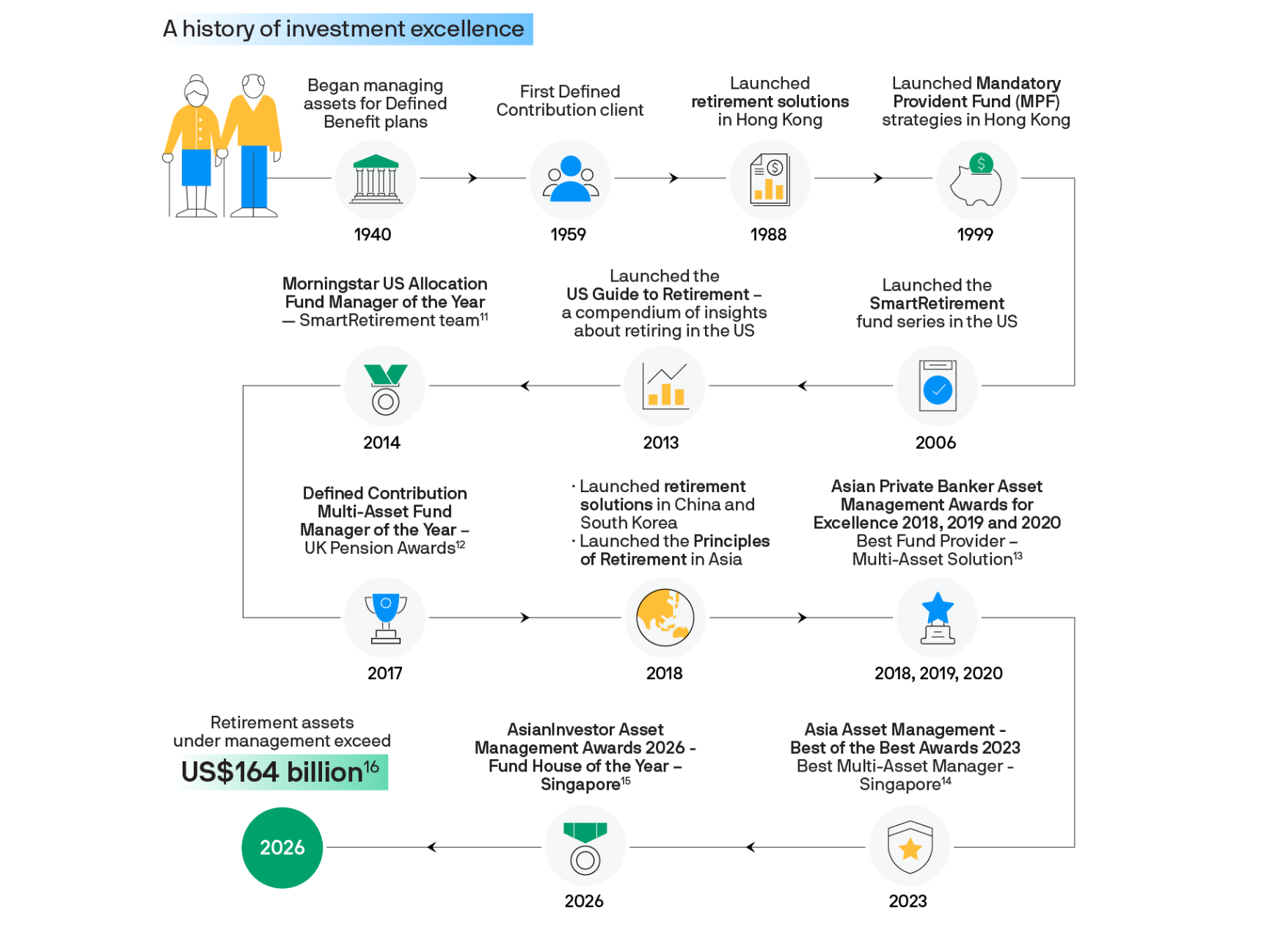
J.P. Morgan Asset Management has a long and proud history of helping clients achieve stronger outcomes for retirement through various investment strategies and comprehensive retirement insights.
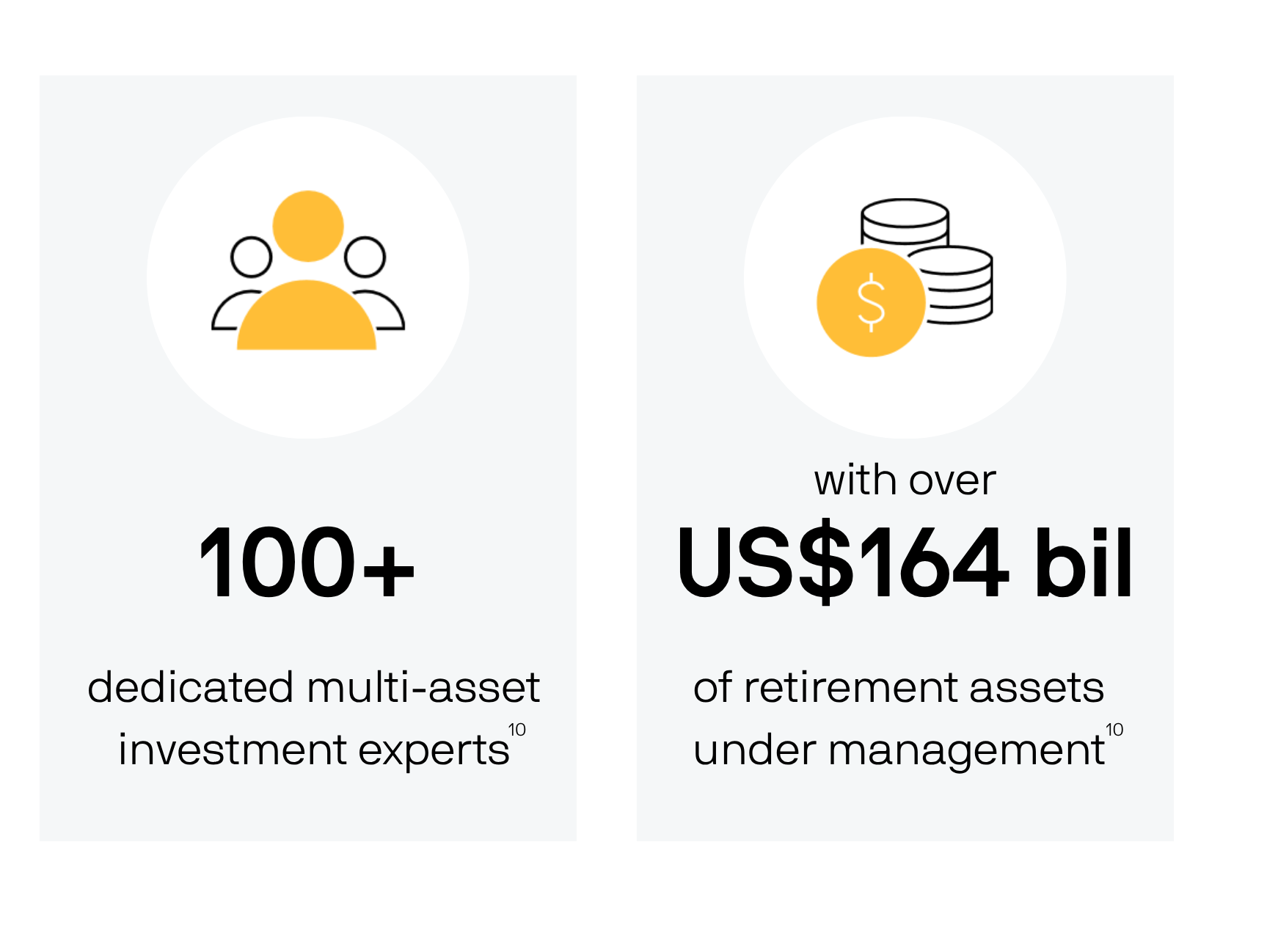
Led by our award-winning and well-resourced Multi Asset Investment team, our firm has over half a century of experience managing retirement assets on behalf of our clients, in the US, UK and Asia.
Key principles to grow your retirement nest egg
Here are six key principles to help you take positive steps towards a successful retirement.
Read our “Principles for Successful Long-term Investing” for important lessons in investing.
What if...
The rate of inflation, the mix of goods and services, the social safety net and life expectancy can vary widely across geographies. So, while certain principles of retirement planning are universal, the way we think about retirement is often highly local.
In the articles below, we delve deeper into a series of “what ifs” when thinking about retirement in Singapore.
Our growth solutions with CPF share classes
The following strategies have been included under the CPF Investment Scheme (for CPFIS List A category). These share classes are available on select investment platforms.
Our market insights

For Fund or Institutional enquiries, please call or email us. You can also contact your financial advisor or your J.P.Morgan Representative.