
logo
  • Funds
      Contact Us

      Fund Listing

      • Fund Explorer
      • Fund Managers
      • Fund Documents
      • How to Invest

      Capabilities

      • All Funds
      • Equities
      • Fixed Income
      • Multi-asset
      • ETF Investing
      • Investment Research

      Featured Funds

      • JPMorgan Singapore & Asia Equity Income Fund
      • JPMorgan Income Fund
      • Equity Funds
      • Equity Premium Income Active ETFs
      • JPMorgan Flexible Credit Fund
    • Insights
        Contact Us

        Market Insights

        • Market Insights Overview
        • Guide to the Markets

          The J.P. Morgan Guide to the Markets illustrates a comprehensive array of market and economic histories, trends and statistics through clear charts and graphs.

        • Weekly Market Recap

          Start to simplify the complex with our Weekly Market Recap – a timely summary of recent market movements, economic developments and a look at what's ahead.

        • On the Minds of Investors

          What investment questions are on the minds of investors? Explore the questions investors ask frequently and find answers at J.P. Morgan Asset Management.

        • Podcasts

          Insights from Tai Hui, Chief Market Strategist, Asia, on what is happening in financial markets, from our Asia Pacific headquarters in Hong Kong.

        • Mid-Year Outlook 2026

          Global uncertainties abound: the Middle East conflict, central banks' response to returning inflation, U.S. policy shifts and the fast-changing AI landscape.

        • Multimedia

          Interviews with Fund Managers and Investment Strategists bring you insights on global market trends and investment news.

        • Solving for Income

          Solving for Income uses slides from the Guide to the Markets – Asia to examine the role of income and why it should remain a key investment objective.

        • Solving for Fixed Income

          Slides from the Guide to the Markets – Asia examine the role of fixed income and why it should remain a key investment objective.

        • U.S. Policy Pulse Hub

          Insights to guide investors through the opportunities and risks arising from policy from the new administration.

        Portfolio Insights

        • Portfolio Insights Overview
        • Global Asset Allocation Views

          Amid resilient growth and a fading energy shock, we stay positive on risk assets, favoring U.S., Japan and EM equities and U.S. high yield.

        • Global Fixed Income Views

          Central bank credibility, solid profits, capex and resilient consumers lift expansion odds to 85%, outweighing inflation and AI headwinds.

        • Global Equity Views

          Massive AI spending is driving exceptional profit growth at reasonable valuations. We see long-term value in “AI losers” and defensive stocks.

        • Alternative Insights

          We bring you insights based on our nearly 50 years of experience investing in alternatives and more than 800 alternatives professionals around the globe.

        ETF Insights

        • ETF Insights overview
        • Guide to ETFs

          Explore J.P. Morgan Asset Management’s ETF investing guide with insights on ETF market trends and best investing practices for smarter portfolio decisions.

        Retirement Insights

        • Retirement Resources

          To achieve our desired retirement, it is important to anticipate the possible challenges that retirees could face and be better financially prepared.

        • Guide to Retirement

          Our Guide to Retirement, updated annually, provides an effective framework for retirement planning conversations with clients.

      • Investment Ideas
          Contact Us
          • What's new
          • Sustainable investing
          • ETF Knowledge
        • Resources
            Contact Us
            • All Resources
            • Announcements
            • Forms & Literature
            • About Mutual Funds
            • Investment Glossary
            • Insights App
          • About Us
              Contact Us

              About us

              We harness our active edge to deliver timely ideas and actionable insights that empower investors to achieve what matters most.

              • Overview
              • Awards
              • Diversity, Opportunity and Inclusion
              • Our Leadership Team
            • Contact Us
            You are about to leave the site Close
            J.P. Morgan Asset Management’s website and/or mobile terms, privacy and security policies don't apply to the site or app you're about to visit. Please review its terms, privacy and security policies to see how they apply to you. J.P. Morgan Asset Management isn’t responsible for (and doesn't provide) any products, services or content at this third-party site or app, except for products and services that explicitly carry the J.P. Morgan Asset Management name.
            CONTINUE Go Back
            On the Minds of Investors

            Central bankers are not rushing into things

            TH
            Tai Hui

            Chief Market Strategist, Asia Pacific

            Published: 24/06/2024

            Policy easing amid a soft landing backdrop should be positive for both equities and fixed income.

            In brief

            • Central bankers are adopting a cautious approach as they navigate the current economic landscape.
            • The U.S. Federal Reserve (Fed): 75 basis points (bps) of cut expected before year-end, with the first cut likely to happen in the June meeting.
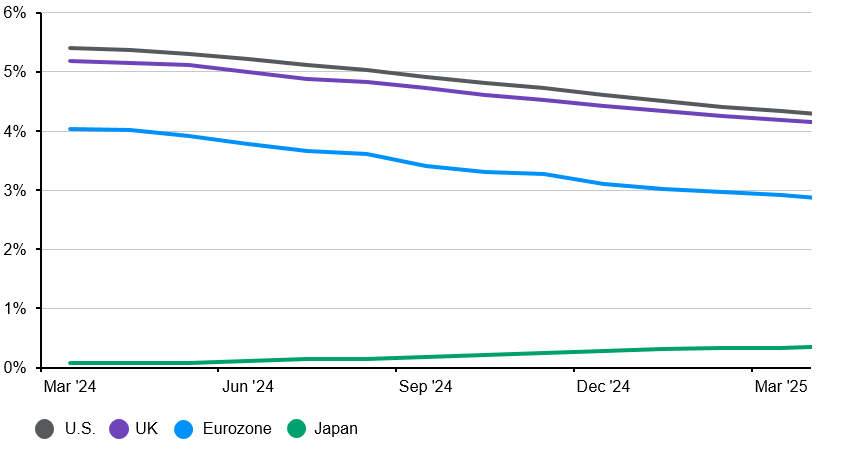
            • The Bank of Japan (BoJ) has dismantled the framework of ultra-loose monetary policy, but is yet to commit to a consistent program to bring policy rate to a higher level. The overnight index swap (OIS) market is only expecting the policy rate to rise to 27bps by the end of 2024.
            • June seems to be where several central banks could begin their rate cut cycles. This includes the U.S.,  UK and eurozone. We continue to argue that policy easing amid a soft-landing backdrop should be positive for both equities and fixed income.

            Central bankers are adopting a cautious approach as they navigate the current economic landscape. Recent monetary policy meetings held by key central banks, including the Fed, the Bank of England (BoE), and the Reserve Bank of Australia (RBA), have resulted in no major shifts in policy rates. However, there is an expectation of gradual easing in inflation later in the year, which may prompt more central banks to cut rates. Notably, the Swiss National Bank surprised the market with a 25bps rate cut, positioning itself as one of the first movers among developed market central banks.

            The BoJ introduced policy changes that signaled a departure from its ultra-loose monetary policy. Despite the perception of a radical shift away from negative rates and Yield Curve Control (YCC), the actual policy changes were relatively modest.

            Chair Powell & Co. sticking to the script

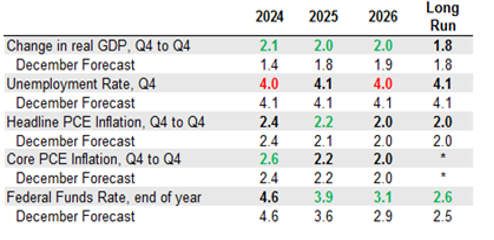
            Concerns were raised about the Summary of Economic Projections and the potential need to revise down rate cut forecasts for the year due to strong growth momentum and persistent inflation. However, the committee expressed increased confidence in economic growth, revising its growth forecasts for 2024, 2025, and 2026. While core personal consumption expenditure (PCE) inflation for the fourth quarter of 2024 was revised higher, and unemployment rate forecasts were lowered for 2024 and 2026, the median projection for the policy rate of the fourth quarter of 2024 remained unchanged at 4.6%.

            FOMC March 2024 Forecasts
            Percent
            Source: Federal Reserve, J.P. Morgan Asset Management. Forecasts of 19 FOMC participants, median estimate. Green denotes an adjustment higher, red denotes an adjustment lower. *Longer-run projection for core PCE inflation is not collected. Data are as of 26/03/24. 


            This suggests a total of 75bps cut before the year-end, with a reduction in the size of rate cuts from 100bps to 75bps for 2025. The market was relieved by these projections, as the Fed is keeping to cut rates this year. We see the first opportunity likely to arise during the June meeting, which is consistent with market expectations.

            Bank of Japan: Stepping away… very slowly

            The BoJ announced that it is ending negative interest rates, YCC on the Japanese Government Bond (JGB) market, and purchases of exchange traded funds (ETFs) and Japan real estate investment trusts. On paper, these are historical steps to end its ultra-loose monetary policy and quantitative easing. Yet, upon looking more closely, the actual changes are less dramatic. Negative interest rates only affected about 5% of banks’ balance with the central bank, as it was to penalize excess reserves parked with the BoJ. The remaining balance is paid 0%-0.1% interest. After the announcement, all balances with the central bank would be paid 0.1% interest.

            On YCC, while the program has officially ended, the BoJ is committed to continue to purchase JGBs at a similar amount as before, which has been around JPY 6trillion in recent months. This does give the BoJ more flexibility to operate. However, it would want to carefully manage the rise in JGB yields to prevent abrupt capital flow by Japanese financial institutions repatriating their overseas investment, as well as a rapid drop in JGB value that could undermine these institutions’ balance sheets. Moreover, given that Japan’s government debt-to-gross domestic product ratio is over 250%, the rise in borrowing cost would also add to the government’s interest payment burden. On ETF purchases, the BOJ’s ETF holdings at book value has been stable at around JPY 3.7trillion since mid-2022. Hence, this was a tool that has been effectively retired for some time. We also don’t think the BoJ will be in a hurry to reduce its ETF holdings, despite some substantial mark-to-market gains.

            In sum, the Bank of Japan has dismantled the framework of ultra-loose monetary policy, but it has yet to commit to a consistent program to bring policy rate to a higher level. The OIS market is only expecting the policy rate to rise to 27bps by the end of 2024. 

            Market expectations* for central bank policy rates
            Source: Bloomberg L.P., Bank of England, Bank of Japan, European Central Bank, U.S. Federal Reserve, J.P. Morgan Asset Management . *Expectations are based on OIS rates. Past performance is not a reliable indicator of current and future results. Guide to the Markets – Asia. Data reflect most recently available as of 26/03/24.

            Patience is a virtue

            Switzerland took the lead in cutting rates last week by 25bps to 1.5%. It was able to make the first move because inflation was never a significant problem. It peaked at 3.5% in August 2022, and has since fallen to 1.2% in February 2024. Other developed market central banks don’t have this luxury just yet, but they are patiently looking for signals.

            The RBA and the BoE both kept their policy rates unchanged in their March meetings. The RBA is still watchful over the tight labor market, which could lead to wage inflation. For the BoE, the voting pattern of the Monetary Policy Committee (MPC) members is telling. In the February meeting, two MPC members voted for higher policy rates, while one voted for a cut. In March, the vote was 8-1, with one member voting for a cut. The meeting minutes showed that there is still some divergence in view over the economic performance and inflation outlook.

            Investment Implications

            Overall, June seems to be when several central banks could begin their rate cut cycles. This includes the U.S., UK and eurozone. We continue to argue that policy easing amid a soft- landing backdrop should be positive for both equities and fixed income. Hence, we see an internationally diversified allocation to large cap, quality equities would fit into this scenario. On fixed income, the resilient economic backdrop in the U.S. allows high yield corporate bonds to outperform high quality fixed income, given higher all-in yields. Yet, we still see value in developed market government bonds and investment grade corporate debt to provide some cushion against downside surprises or unexpected financial stress. 


            09oc242603062711

            About the Author

            Latest from the Author

            Monthly Views and Perspectives: Reality bites for governments and AI investors
            November 01, 2026 Tai Hui
            Monthly Views and Perspectives: Higher rates and AI scrutiny calls for portfolio diversification
            October 01, 2026 Tai Hui
            The problems with doing too much, or too little
            September 02, 2026
            Implications of U.S.-Iran agreement to reopen the Strait of Hormuz
            June 15, 2026 Tai Hui
            Mid-term elections: How does a change in Congress change U.S. policies?
            June 11, 2026 Tai Hui
            • Economy
            • Equities
            • Fixed Income
            • Markets
            JPMorgan Asset Management

            • Terms of Use
            • Privacy Statement
            • Cookies Policy
            • Investment stewardship
            • Sitemap
            J.P. Morgan

            • J.P. Morgan
            • JPMorgan Chase
            • Chase

            The information contained herein is intended only for use by Singapore residents. By using this information, you are representing and warranting that you are either residing in Singapore or the applicable laws and regulations of your jurisdiction allow you to access the information, and you confirm that you accept the Terms of Use as set out in https://www.jpmorgan.com/sg/am/per/. Investment involves risk. Past performance is not indicative of future performance. In particular, funds which are invested in emerging markets and smaller companies may involve a higher degree of risk and are usually more sensitive to price movements. Investors should carefully read and consider the fund offering document(s), which contain details on investment objectives, risk factors, charges and expenses of the fund, before making any investment decisions. Information in this website does not constitute investment advice, or an offer to sell, or a solicitation of an offer to buy any security, investment product or service, nor a distribution of information for any such purpose. Informational sources are considered reliable but you should conduct your own verification of information contained herein. Issued by JPMorgan Asset Management (Singapore) Limited. This advertisement or publication has not been reviewed by the Monetary Authority of Singapore (“MAS”).


            JPMorgan Asset Management (Singapore) Ltd is regulated by the Monetary Authority of Singapore. (Co. Reg. No. 197601586K)