
logo
  • Funds
    Overview

    Fund Listing

    • Fund Explorer
    • Fund Managers
    • Fund Documents
    • How to Invest

    Capabilities

    • Equities
    • Fixed Income
    • Multi-asset
    • ETF Investing

    Featured Funds

    • Equity Funds
    • JPMorgan Global Income Fund
    • JPMorgan Income Fund
    • Equity Premium Income Active ETFs
  • Insights
    Overview

    Market Insights

    • Market Insights Overview
    • Guide to the Markets
    • Weekly Market Recap
    • On the Minds of Investors
    • Podcasts
    • Multimedia
    • Solving for Income
    • Solving for Fixed Income
    • U.S. Policy Pulse Hub

    Portfolio Insights

    • Portfolio Insights Overview
    • Global Asset Allocation Views
    • Global Fixed Income Views
    • Global Equity Views

    ETF Insights

    • ETF Insights overview
    • Guide to ETFs

    Retirement Insights

    • Guide to Retirement
  • Investment Ideas
    Overview
    • What's new
    • Navigating Volatility
    • Retirement resources
    • Sustainable investing
    • ETF Knowledge
  • Resources
    Overview
    • Announcements
    • Forms & Literature
    • About Mutual Funds
    • Investment Glossary
    • Insights App
  • About Us
    Overview
    • Awards
    • Diversity, Opportunity and Inclusion
    • Our Leadership Team
  • Contact Us
  • Role
  • Country
Search
Menu
Search
You are about to leave the site Close
J.P. Morgan Asset Management’s website and/or mobile terms, privacy and security policies don't apply to the site or app you're about to visit. Please review its terms, privacy and security policies to see how they apply to you. J.P. Morgan Asset Management isn’t responsible for (and doesn't provide) any products, services or content at this third-party site or app, except for products and services that explicitly carry the J.P. Morgan Asset Management name.
CONTINUE Go Back

The FOMC statement indicated a shift in sentiment regarding the outlook since January, noting that “uncertainty around the economic outlook has increased”.

The Federal Open Market Committee (FOMC) voted to maintain the Federal funds rate at a target range of 4.25%-4.50%. The statement indicated a shift in sentiment regarding the outlook since January, noting that “uncertainty around the economic outlook has increased”. Moreover, the committee removed the language that risk to its inflation and employment goals were “roughly in balance”, suggesting members may be more sensitive to slowing growth than price pressures.

Elsewhere, the committee announced it will slow the pace of balance sheet runoff, reducing the monthly redemption cap on Treasury securities from $25bn to $5bn, while maintaining the $35bn cap on agency mortgage-backed securities (MBS). The wind down of QT is likely in anticipation of potential liquidity risks around the debt ceiling “X-date”, estimated to be some time over the summer.

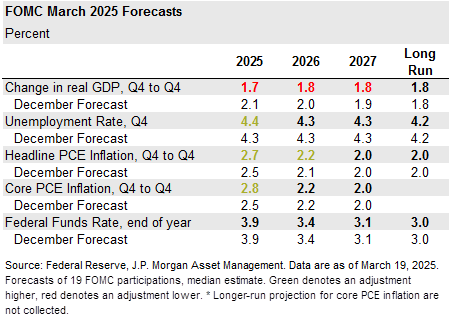
Updates to the Summary of Economic Projections (SEP) signal rising near term stagflation risks: 

  • Growth was downgraded from 2.1% to 1.7% this year and adjusted modestly lower in 2026 and 2027.
  • The unemployment rate was nudged higher by 0.1% to 4.4% in 2025.
  • Both headline and core PCE were raised by 0.2% and 0.3% to 2.7% and 2.8%, respectively, for 2025. Further out, forecasts were essentially unchanged suggesting tariff related policy implications on prices will be a transitory inflation shock.  
  • No changes were made to the median interest rate forecast.

During the press conference, Chairman Powell acknowledged the uncertainty in Washington and that tariffs—those implemented and proposed—are expected to contribute to upward pressure on near term inflation but took some solace in that longer run inflation expectations have remained well anchored. On recession risk, Powell mentioned that it’s not the committee’s base case, but the risk has risen albeit from a low level at the start of the year.

Both stocks and bonds rallied, likely reflecting the Fed’s consistent bias for rate cuts despite upside risks to inflation. For investors, the outlook for growth and inflation remains highly uncertain. Therefore, remaining well diversified across high quality bonds, reasonably priced stocks, international assets, and alternatives seems most appropriate.


09bu252003030725
  • Economy
  • Markets
JPMorgan Asset Management

  • Terms of Use
  • Privacy Statement
  • Cookies Policy
  • Investment stewardship
  • Sitemap
J.P. Morgan

  • J.P. Morgan
  • JPMorgan Chase
  • Chase

The information contained herein is intended only for use by Singapore residents. By using this information, you are representing and warranting that you are either residing in Singapore or the applicable laws and regulations of your jurisdiction allow you to access the information, and you confirm that you accept the Terms of Use as set out in https://www.jpmorgan.com/sg/am/per/. Investment involves risk. Past performance is not indicative of future performance. In particular, funds which are invested in emerging markets and smaller companies may involve a higher degree of risk and are usually more sensitive to price movements. Investors should carefully read and consider the fund offering document(s), which contain details on investment objectives, risk factors, charges and expenses of the fund, before making any investment decisions. Information in this website does not constitute investment advice, or an offer to sell, or a solicitation of an offer to buy any security, investment product or service, nor a distribution of information for any such purpose. Informational sources are considered reliable but you should conduct your own verification of information contained herein. Issued by JPMorgan Asset Management (Singapore) Limited. This advertisement or publication has not been reviewed by the Monetary Authority of Singapore (“MAS”).


JPMorgan Asset Management (Singapore) Ltd is regulated by the Monetary Authority of Singapore. (Co. Reg. No. 197601586K)