

Global Bond Monitor Q2 2026
Investors have typically looked to bonds for two outcomes:
1. A steady stream of income;
2. Diversification against riskier assets if the growth outlook deteriorates.
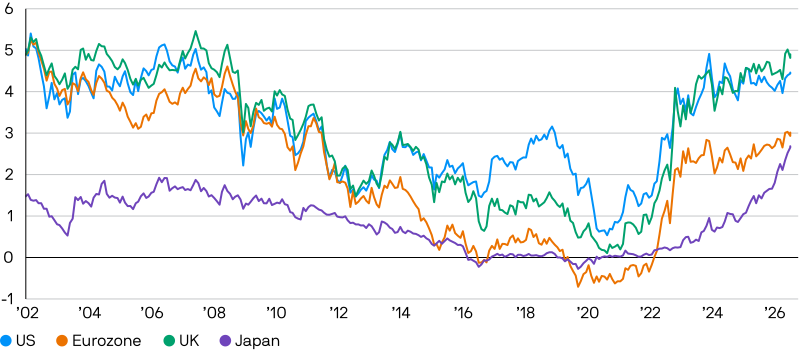
In the decade after the global financial crisis and the eurozone crisis, the ability of bonds to offer either of these elements steadily diminished as a long bull market compressed yields to record low levels. The subsequent reset after the energy shock in 2022 was deeply painful. As yields normalised, fixed income returns turned negative, with the global aggregate bond index falling by 16% – the worst annual decline since the index began in 1990. But the fixed income reset is now complete. Yields have established new trading ranges at higher levels, with 10-year government bond yields recently trading close to levels not seen since at least 2011. The role of bonds in a balanced portfolio has been restored.
Like other asset classes, expectations for fixed income have been adjusted this year to reflect geopolitical events, especially the war in the Middle East. Government bond markets are sending a clear signal: demand for borrowing is increasing, inflation risk is back in focus, and investors are once again being paid to provide financing. Despite ongoing volatility, it is clear that the income and diversification benefits that bonds have historically provided remain relevant, and that the bond market of today is not the same as the bond market of 2022. Therefore, with prudent risk management, fixed income still deserves its place in multi-asset portfolios.
-
Government bond yields have pushed higher
-
Central banks could be less hawkish than financial markets expect
-
Higher yields improve the diversification potential of fixed income
-
Emerging market debt offers higher real yields vs. developed markets
-
Tight corporate credit spreads supported by high all-in yields
Government bond yields normalised after the 2022 energy shock, ending the prolonged period of low interest rates that followed the global financial crisis and the eurozone crisis. The war in the Middle East that started at the end of February has led to a further increase in yields. Besides bringing inflation risks more to the fore, recent events have further increased the sense of urgency for governments to invest in strategically important sectors such as energy, defence and technology. Similarly, corporates are investing to expand capacity in these strategic sectors and to enhance supply-chain robustness. This higher demand for borrowing is driving up nominal yields, offering a more attractive entry point to fixed income markets. While the opportunity set to deploy capital is expanding, investors need to be discerning about which investments add value and which do not, supporting the case for active management within the fixed income universe.
Nominal 10 year government bond yields
% yield
At the start of the year, central banks in the US and the UK appeared to be able to cut policy rates further in 2026, following the European Central Bank’s earlier moves. While geopolitical developments have led the markets to revise those expectations, economies may now be better positioned compared with the 2022 energy shock. Not only is inflation starting from lower levels, but also labour-market vacancies have declined, fiscal responses are more restrained and policy rates are already higher. With these factors lowering the risk of second-round wage effects taking hold, central banks could therefore be less hawkish than current market pricing implies.
Market expectations for cumulative interest rate changes in 2026
Basis points
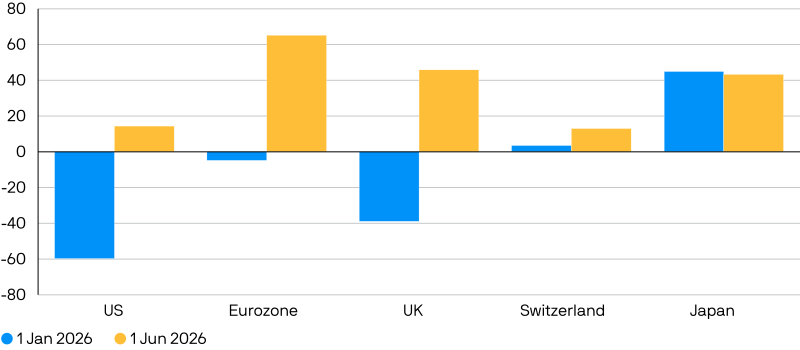
Source: Bloomberg, J.P. Morgan Asset Management. Interest rate expectations are calculated using OIS forwards. Past performance is not a reliable indicator of current and future results. Guide to the Markets - EMEA. Data as of 1 June 2026.
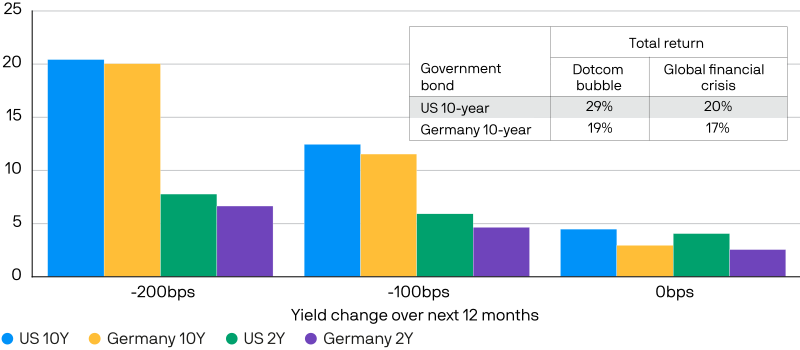
If the energy shock proves more persistent than markets currently expect, the result would ultimately be a larger drag on growth and a deteriorating economic outlook. In this scenario, bond yields still have significant room to fall from current levels. For example, in the event that 10-year government bond yields fall by 100 basis points over the next 12 months, investors could expect a return of more than 10%. This return of government bonds would provide meaningful diversification against equity losses, adding value in a balanced portfolio. The diversification potential of fixed income has improved compared to the ultra-low yield environment that existed in the period following the global financial crisis.
Government bond return scenarios
%, total return over 12 months
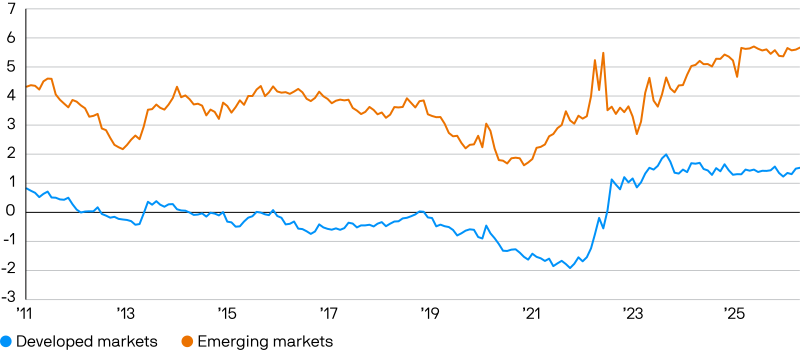
Emerging markets had to grapple with the same issues as developed markets in 2022. Emerging market central banks and sovereigns showed discipline by generally preserving fundamentals across debt ratios, current accounts, fiscal balances, real policy rates and currency reserves. As a result, local-currency emerging market debt currently offers attractive real yields relative to developed market bonds. If a reopening of the Strait of Hormuz causes energy markets to normalise, the US dollar may well lose some of its recent relative advantage. A weaker US dollar is traditionally a tailwind for emerging market assets.
Real global government bond yields
% yield
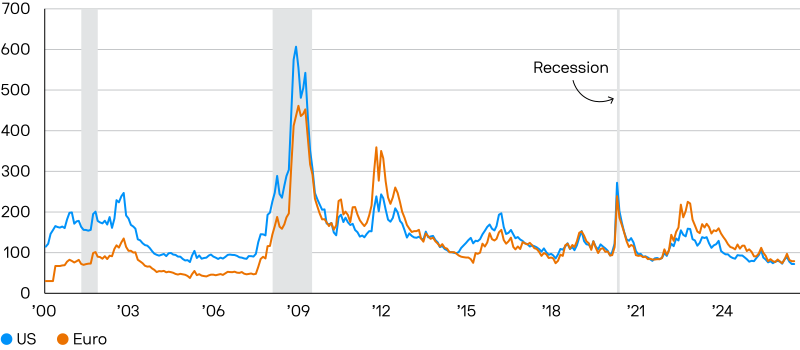
Corporate credit spreads are tight across both investment grade and high yield markets. However, spreads can remain tight for extended periods of time and only materially widen when corporate earnings come under pressure. Currently, rich valuations are supported by strong fundamentals, with corporate earnings growth looking solid and margins holding up well. Higher all-in yields – the risk-free government bond rate plus a spread – continue to attract demand from investors for corporate credit, despite tight spreads. The strength of this demand is reflected in oversubscribed new issuance books and favourable pricing for corporates when issuing new debt. Tight spreads do mean that the bulk of credit returns should come from income rather than further spread tightening.
Investment grade spreads
Basis points, option-adjusted spread
Conclusion
The opportunities available in fixed income remain attractive as the reset higher in yields offers a better entry point for investors and income over the medium term. Absent a shock to growth, solid corporate fundamentals should mean that credit spreads remain contained, allowing investors to position their portfolios to capture the income on offer. However, if the growth outlook does deteriorate, the rise in yields means that government bonds once again offer diversification benefits in a balanced portfolio against losses in riskier asset classes.