logo
  • My Collections
    View saved content and presentation slides
  • Log out
  • Insights

      Liquidity Insights

      • Liquidity Insights Overview
      • Global Liquidity Investment Outlook

        Global Liquidity Investment Outlook

      • Tokenization

        Explore the full whitepaper to learn how tokenized MMFs can transform your approach to cash management and position your organization at the forefront of digital finance.

      • Case Studies

        Read about companies with specific cash management challenges and the solutions when they worked with J.P. Morgan Asset Management.

      • Institutional liquidity made closer

        Bringing our worldwide money market capabilities to Hong Kong institutions —now with online access to our HKD money market fund.

      • Partnership with fintechs

        A focus on digital innovation and institutional liquidity solutions drive our dynamic partnership with fintech.

      • ESG Resources for Liquidity Investors

        We’ve created a clear, rigorous ESG process meets the many needs of liquidity investors.

      • Leveraging the Power of Cash Segmentation

        The most effective strategy incorporates a clear investment policy, well-defined goals and parameters for liquidity, quality and return.

      • Cash Investment Policy Statement

        How to write an investment policy statement for your organization

      Market Insights

      • Market Insights Overview
      • Eye on the Market

        Explore Eye on the Market, timely commentary that offers views on the economy, markets, and investment portfolios by Michael Cembalest.

      • Guide to the Markets

        The J.P. Morgan Guide to the Markets illustrates a comprehensive array of market and economic histories, trends and statistics through clear charts and graphs.

      • Market Updates

        Read our weekly commentaries to get market insights that may help inform your investment strategy.

      • Podcasts

        Insights from Tai Hui, Chief Market Strategist, Asia, on what is happening in financial markets, from our Asia Pacific headquarters in Hong Kong.

      • Guide to Investing in Asia

        The Guide to Investing in Asia explores the diverse economies, markets and investment trends across Asia, including Japan, India, China and Southeast Asia.

      Portfolio Insights

      • Portfolio Insights Overview
      • Currency

        Our currency team provides solutions for clients, controlling risk using passive management strategies and generating returns by actively managing global currencies.

      • Fixed Income

        We highlight themes and implications from various fixed income teams to help guide your portfolio decisions.

      • Long-Term Capital Market Assumptions

        Our Long-Term Capital Market Assumptions (LTCMAs) deliver forward-looking return, volatility and correlation estimates for 200+ asset and strategy classes in 20+ base currencies.

      • Sustainable investing

        Sustainable Insights

      • Strategic Investment Advisory Group

        The Strategic Investment Advisory Group approaches today’s investment challenges with a global view across asset classes.

    • Resources
        • All Resources
        • MORGAN MONEY
        • Account Management & Trading
        • Global Liquidity Investment Academy
        • Announcements
      • About us

          About us

          Backed by $4.6T in assets, we harness our active edge to deliver timely ideas and actionable insights that empower investors to achieve what matters most.

          • About us
          • Spectrum: Our Investment Platform
          • Our Leadership Team
          • Diversity, Opportunity & Inclusion
        • Contact us
        • English
        • MORGAN MONEY LOGIN
          • My Collections
            View saved content and presentation slides
          • Log out
        • Log in
        • MORGAN MONEY LOGIN
        Log in
        You are about to leave the site Close
        J.P. Morgan Asset Management’s website and/or mobile terms, privacy and security policies don't apply to the site or app you're about to visit. Please review its terms, privacy and security policies to see how they apply to you. J.P. Morgan Asset Management isn’t responsible for (and doesn't provide) any products, services or content at this third-party site or app, except for products and services that explicitly carry the J.P. Morgan Asset Management name.
        CONTINUE Go Back
        1. Monetary financing – crossing the line?

        • LinkedIn Twitter Facebook Line WhatsApp

        Monetary financing – crossing the line?

        30/04/2020

        Seamus Mac Gorain

        The COVID-19 crisis has seen the fastest deterioration in the economic outlook in living memory, and an equally rapid policy response, led by enormous fiscal stimulus and facilitated by unprecedented monetary easing. Central banks have bought bonds at a $1tr per month pace, with the US Federal Reserve in the vanguard. Many central banks have embraced QE for the first time, including Canada, Australia and several emerging economies. The Bank of Japan’s experiment in “yield curve control” has spread to Australia, and may well spread further. And central banks have extended further into private sector assets, with the Fed again leading the way by including sub-investment grade bonds in their corporate purchases. 

        G4 central bank bond purchases
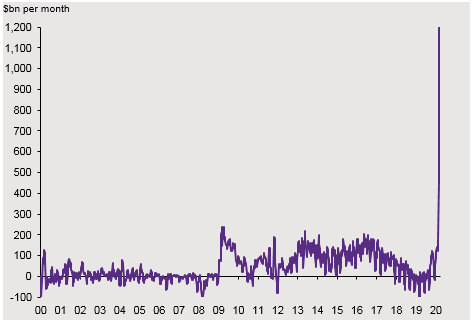
        Source: Bloomberg as of 4/22/2020

        With the close coordination between fiscal and monetary easing, we think it is fairly clear that central banks are monetising the huge fiscal deficits necessitated by the crisis, even as they mostly will not describe their policies in this way. We also expect much of the monetary expansion used to fund these deficits will be very long-lived, if not permanent. The experience of previous large monetary expansions is that the ratio of central bank assets to GDP tends to normalise through rising GDP rather than falling central bank assets. Indeed, after the last recession, only the Fed made a serious attempt to reduce its crisis-era bond holdings, and even that “Quantitative Tightening” was a disruptive process which was halted sooner than expected.

        All that said, we think fears that “helicopter money” will lead to a surge in inflation are overblown for now. Central banks typically have an inflation target, coupled with a requirement to support growth or employment. The real concern about monetary financing comes when the central bank’s objectives are subjugated to the government’s. Especially, when rising growth and inflation would call for a tightening of monetary policy, but the government would not be able to cope with higher funding costs. These are the circumstances that can lead to a spiral of ever-rising inflation.

        The present situation is very different. Unemployment is set to increase to levels unseen in modern times. This will bear down on inflation, which was in any case quite subdued before the onset of the crisis. The collapse in oil prices will do the same. There are clear risks of long-lasting damage from the recession through corporate bankruptcies and labour market hysteresis. Along with the healthcare response, aggressive fiscal easing to support private sector incomes during the lockdown is the main tool to prevent this damage. It is hard to see how central banks could hope to meet their inflation and growth objectives without facilitating this government spending. Far from being in conflict, the central bank and government objectives are one and the same at this point.

        As is often the case, Japan provides a useful example here. The Bank of Japan has been hoovering up Japanese government bonds for years, taking its balance sheet as a share of GDP to levels previously seen only in war time. Yet it is difficult to argue that monetary policy has been too loose in Japan, when inflation is still hovering barely above zero. With nominal demand so subdued, there has been no conflict between keeping government financing costs low, and the Bank of Japan’s inflation target. 

        Central bank balance sheets
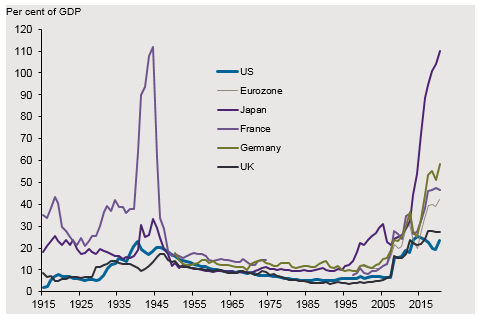
        Source: Bloomberg, Major Central Banks as of 4/22/2020

        The more interesting questions about monetary financing will come once the crisis has passed, and huge government deficits are no longer needed. It is very difficult to bring down government deficits from very high levels. In the aggregate, advanced economy fiscal deficits have never returned to the levels prevailing before the 2008 financial crisis, and even the journey back to current levels was very painful for many countries. The principle that governments can support private sector incomes with central banks buying the resulting debt has been established. While entirely appropriate to this crisis, it may prove quite inflationary in a milder downturn. But these are concerns for another day – for now, we expect bond markets to remain quite sanguine about the shift to monetary financing, until there are signs that the economy is emerging from the downturn.


        • Central Banks
        • Market Views
        • COVID-19
        • Monetary Policy
        • Economic Outlook

        RELATED ARTICLES

        Affordability Series: Tax Reform in the Municipal Market

        As affordability takes center stage, tax reform proposals—from property tax relief to billionaire levies—are reshaping municipal credit risks and state budgets.

        Read more

        But what about the deficit?

        On the heels of Moody’s rating downgrade of US Treasuries and continuing budget negotiations in the US Congress, higher uncertainty has resulted in a re-pricing of term premium in the bond market.

        Read more

        The Case for the Big Apple

        As investors turn their attention to Election Day and Zohran Mamdani tops the polls, we continue to field questions about what a democratic socialist mayor might mean for the future of New York City. We discussed in a previous post, but expand on some of the City’s core strengths and take a closer look at Mamdani’s platform.

        Read more
        J.P. Morgan Asset Management

        • Investment stewardship
        • About us
        • Contact us
        • Privacy policy
        • Cookie policy
        • Complaint Resolution
        • Sitemap
        J.P. Morgan

        • J.P. Morgan
        • JPMorgan Chase
        • Chase

        READ IMPORTANT LEGAL INFORMATION. CLICK HERE >

        The value of investments may go down as well as up and investors may not get back the full amount invested.

        Copyright 2026 JPMorgan Chase & Co. All rights reserved.