logo
  • My Collections
    View saved content and presentation slides
  • Log out
  • Insights

      Liquidity Insights

      • Liquidity Insights Overview
      • Global Liquidity Investment Outlook

        Global Liquidity Investment Outlook

      • Tokenization

        Explore the full whitepaper to learn how tokenized MMFs can transform your approach to cash management and position your organization at the forefront of digital finance.

      • Case Studies

        Read about companies with specific cash management challenges and the solutions when they worked with J.P. Morgan Asset Management.

      • Institutional liquidity made closer

        Bringing our worldwide money market capabilities to Hong Kong institutions —now with online access to our HKD money market fund.

      • Partnership with fintechs

        A focus on digital innovation and institutional liquidity solutions drive our dynamic partnership with fintech.

      • ESG Resources for Liquidity Investors

        We’ve created a clear, rigorous ESG process meets the many needs of liquidity investors.

      • Leveraging the Power of Cash Segmentation

        The most effective strategy incorporates a clear investment policy, well-defined goals and parameters for liquidity, quality and return.

      • Cash Investment Policy Statement

        How to write an investment policy statement for your organization

      Market Insights

      • Market Insights Overview
      • Eye on the Market

        Explore Eye on the Market, timely commentary that offers views on the economy, markets, and investment portfolios by Michael Cembalest.

      • Guide to the Markets

        The J.P. Morgan Guide to the Markets illustrates a comprehensive array of market and economic histories, trends and statistics through clear charts and graphs.

      • Market Updates

        Read our weekly commentaries to get market insights that may help inform your investment strategy.

      • Podcasts

        Insights from Tai Hui, Chief Market Strategist, Asia, on what is happening in financial markets, from our Asia Pacific headquarters in Hong Kong.

      • Guide to Investing in Asia

        The Guide to Investing in Asia explores the diverse economies, markets and investment trends across Asia, including Japan, India, China and Southeast Asia.

      Portfolio Insights

      • Portfolio Insights Overview
      • Currency

        Our currency team provides solutions for clients, controlling risk using passive management strategies and generating returns by actively managing global currencies.

      • Fixed Income

        We highlight themes and implications from various fixed income teams to help guide your portfolio decisions.

      • Long-Term Capital Market Assumptions

        Our Long-Term Capital Market Assumptions (LTCMAs) deliver forward-looking return, volatility and correlation estimates for 200+ asset and strategy classes in 20+ base currencies.

      • Sustainable investing

        Sustainable Insights

      • Strategic Investment Advisory Group

        The Strategic Investment Advisory Group approaches today’s investment challenges with a global view across asset classes.

    • Resources
        • All Resources
        • MORGAN MONEY
        • Account Management & Trading
        • Global Liquidity Investment Academy
        • Announcements
      • About us

          About us

          We harness our active edge to deliver timely ideas and actionable insights that empower investors to achieve what matters most.

          • About us
          • Global Liquidity Capabilities
          • Spectrum: Our Investment Platform
          • Our Leadership Team
          • Diversity, Opportunity & Inclusion
          • Careers
        • Contact us
        • English
        • MORGAN MONEY LOGIN
          • My Collections
            View saved content and presentation slides
          • Log out
        • Log in
        • MORGAN MONEY LOGIN
        Log in
        You are about to leave the site Close
        J.P. Morgan Asset Management’s website and/or mobile terms, privacy and security policies don't apply to the site or app you're about to visit. Please review its terms, privacy and security policies to see how they apply to you. J.P. Morgan Asset Management isn’t responsible for (and doesn't provide) any products, services or content at this third-party site or app, except for products and services that explicitly carry the J.P. Morgan Asset Management name.
        CONTINUE Go Back
        1. CLOs: not the CDOs of yore

        • LinkedIn Twitter Facebook Line WhatsApp

        CLOs: not the CDOs of yore

        25/06/2020

        Sameer Riaz

        The leveraged loan and CLO (Collateralized Loan Obligations) markets have grown in recent years. The amount of CLOs outstanding reaching USD 700 billion, up from USD 300 billion at the beginning of 2010. The leveraged loan market has increased from approximately USD 520 billion to approximately USD 1.2 trillion over the same time period.  Along with this growth, the number of headlines predicting the emergence of the next crisis and comparison to subprime mortgages and Collateralized Debt Obligations (CDOs) of the Great Financial Crisis (GFC) have also increased.  The focus of these articles has been on the weakening of loan underwriting standards, the complexity of securitized finance, and the impact of rising defaults on investors with regulatory constraints; one recent article even argues that bank holdings of senior CLOs could be impaired and lead to a crisis. 

        Real risks do exist to the CLO market – looser covenants, higher leverage, and the increase in loan-only structures can lead to quicker downgrades and higher losses upon defaults for the underlying loans.  Credit selection, analysis of CLO manager performance, and understanding the nuances of the structure are key to investing in CLOs. 

        While acknowledging the risks, we believe that many of the comparisons to subprime CDOs are overly exaggerated, and that the rising credit risks in CLOs are well recognized by investors. 

        1.     The CLO market is currently much smaller than the subprime mortgage market was in 2009, even before accounting for the growth of the U.S. economy and change in bank capital regimes.  At the end of 2009, non-agency RMBS outstanding was north of USD 1.6 trillion, not including Home Equity Line of Credit Asset Backed Securities (HELOC ABS), which would only increase the total amount.  The subprime mortgage market also had both synthetic derivatives and CDO squared structures, which would allow a single default to be felt many times over, exacerbating losses in the system.  U.S. CLOs outstanding are USD 700 billion and have no comparable synthetic or CLO squared structures, limiting the extent of losses.

        2.     Compared to pre-2007 issuance, CLO debt tranches issued from 2011 on have increased credit enhancement (see Chart 1).  

        Chart 1: CLO Credit Enhancement has Evolved Over Time
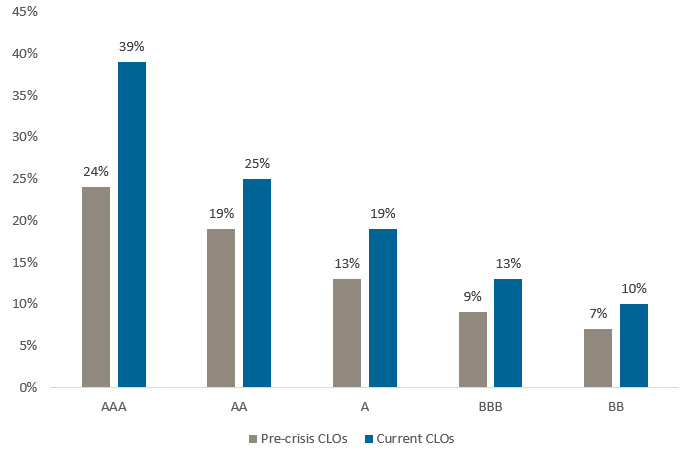
        Source: Citi, J.P. Morgan as of June 2020

        Per Moody’s, no CLOs rated single A or higher have taken a loss since 1993 (a time period that includes the dot-com bubble bursting and the GFC).  CLOs also have specific structural differences compared to other securitized products – as losses begin to impact CLO deals, the structure can divert cashflow from equity and lower-rated debt noteholders to pay down AAA tranches.  This cashflow diversion acts to protect senior noteholders in adverse scenarios.  In addition, CLOs have both industry and issuer concentration limits, among other tests and triggers.

        3.     Default rates in the Great Depression peaked at 15.7% in 1933, while defaults during the Great Financial Crisis peaked at 12.1% in 2009.  For a CLO AAA to lose principal, assuming a 50% recovery rate, annual default rates would have to exceed 33% for more than 2 years (see Chart 2), which would be more than double the highest rate seen since 1920.

        Chart 2
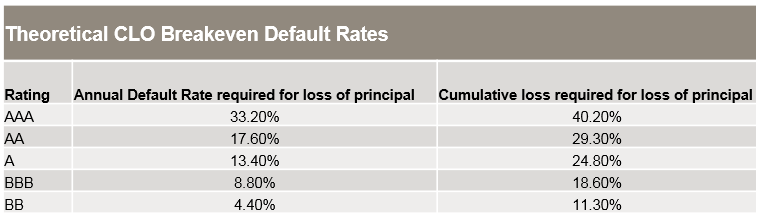
        Source: llustrative modeling assumptions from Intex as of June 2020; assumptions include 5% CPR, 50% severity upon default, and no reinvestment.  Senior AAA shown.

        CLOs are also actively managed, and data over the last few years show that CLOs have experienced less defaults than the overall loan market (see Chart 3).

        Chart 3: CLOs have held less defaults than the broader market rate
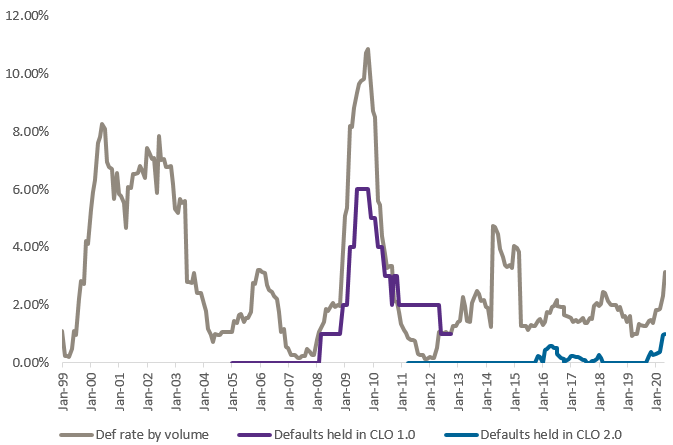
        Source: Deutsche Bank, Moody's, S&P as May 2020

        4.     Subprime mortgages were primarily an “originate to distribute model”, while leveraged loans are syndicated to a broad investor base, with institutional investors such as insurance companies and money managers involved in the loan market along with CLOs.  Investors have access to financial information and the ability to perform credit underwriting on a name by name basis.  Market estimates suggest that over 60% of CLO equity was placed with managers in 2018 and 2019, highlighting the alignment of incentives in the post-crisis market that did not exist before 2009.

        5.     Loans are an important source of capital to US companies, providing financing to smaller issuers, as well as more common names such as T-Mobile, Delta, and PetSmart.  The Federal Reserve recently set up the Main Street Lending Program, which provides access to lower rate financing to eligible companies.  While we believe the program primarily serves as a backstop, the establishment of it serves as a signal of the importance of the loan market as a conduit for capital to US businesses.

        Risks exist in both the CLO and loan markets – however, CLOs are a much smaller outstanding universe now than non-agency mortgages were in 2009, no derivative or CLO squared market exists to exacerbate potential losses, and the structure is designed to protect senior noteholders.  To envision AAA CLOs taking principal impairments requires scenarios far worse than what we have seen since 1920, in a time of unprecedented fiscal and monetary action.  While investing in CLOs does require deep credit and structural analysis, senior CLOs are built to withstand dire corporate default scenarios  While comparisons between the pre-crisis subprime mortgage market and the CLOs of today are overdone, we have been focused on up-in-quality in our CLO investments, focusing on security selection in the light of increasing defaults and potential economic uncertainty.

        • Economic Outlook
        • Market Views

        RELATED ARTICLES

        'Blue ripple' and the USD outlook

        The ‘Blue wave’ the market had prepared for now appears to be more of a ‘Blue ripple’ and currency markets are adjusting to a different political outlook.

        Read more

        Multiple reasons for multi-family

        The agency CMBS market offers an attractive way for fixed income investors to access one of the more resilient sectors of the commercial real estate market.

        Read more

        FOMC statement & potential impact on fixed income

        Following the Fed's announcement, find our latest market views from the Global Fixed Income, Currency & Commodities Team (GFICC).

        Read more
        J.P. Morgan Asset Management

        • Investment stewardship
        • About us
        • Contact us
        • Privacy policy
        • Cookie policy
        • Complaint Resolution
        • Sitemap
        J.P. Morgan

        • J.P. Morgan
        • JPMorgan Chase
        • Chase

        READ IMPORTANT LEGAL INFORMATION. CLICK HERE >

        The value of investments may go down as well as up and investors may not get back the full amount invested.

        Copyright 2026 JPMorgan Chase & Co. All rights reserved.