Marketing Communication
JPMorgan Emerging Markets Growth and Income1 (JMGI) is well-positioned to benefit from such resurgence, looking to build on its strong long-term performance track record2.
For the trust’s co-Portfolio Manager, Austin Forey, emerging markets remains as attractive as ever. They offer investors exposure to long-term structural trends such as the rise of the middle class, urbanisation and digitalisation that will drive growth, and equity market returns, over the next decade and beyond. Many of these drivers are unique to emerging markets and thus give investors valuable diversification benefits and upside potential at times when developed markets are under pressure. Furthermore, the two largest emerging markets, China and India, now number among the world’s five largest economies, and arguably command a place in all well-balanced investment portfolios.
Several factors are supporting emerging market equities…
Like their developed market counterparts, emerging markets fell sharply in March and April 2025 due to the uncertainties generated by US trade policy. But since then, they have seen gains of c 25%3, outpacing most other markets. Forey cites several factors underpinning this recovery, all of which look set to provide ongoing support. Key among these is recent US dollar weakness, which is viewed as positive for emerging markets as it reduces the cost of dollar-denominated debt and increases the local currency value of exports. Dollar weakness has been driven by concerns about US trade policy and associated fears of slower US growth and higher inflation. In response, global investors are rotating away from the US, into other areas, including emerging markets4, compounding dollar weakness in the process.
Another important driver of recent emerging market gains is the rapid spread of artificial intelligence (AI). The AI revolution is only just getting started and emerging market tech companies are in the vanguard, integral to the global AI supply chain. Taiwan and Korea are home to leading suppliers of semiconductor chips, memory chips, data servers and other components essential for the global AI build-out.
Emerging markets have also benefited from an improvement in China’s economic prospects. Investors across the region have welcomed the Chinese authorities’ efforts to boost consumer confidence and support the country’s ailing property sector through lower interest rates and a series of domestic stimulus initiatives. In addition, US trade policy has prompted a wave of Chinese domestic investment as local manufacturers try to meet demand for tech components and other inputs previously sourced in the US.
...and tariffs may do less harm than some fear
Forey is not overly concerned about the impact of US tariffs on Chinese and other emerging market exporters. In his view, exporters will not move production to the US, as President Trump wants. US labour costs are simply too high to make American production commercially viable, even after allowing for the impact of tariffs. Instead, the manager expects emerging market manufacturers to protect margins by reducing exports to the US and seeking alternative markets in Europe, the UK, Asia and the global south.
JMGI: Well-positioned to capture emerging market upsurge
JMGI may be a good choice for those seeking exposure to the recovery in emerging markets. With £1.4bn in assets under management5, it is the second largest trust among its emerging market peers, with the lowest ongoing charge6. Furthermore, the trust is run by a very experienced team. Forey has been investing in emerging markets for over 35 years and he, and co-Portfolio Manager John Citron, are supported by JPMorgan’s extensive research resources, including analysts based on the ground in Shanghai, Seoul and Singapore - ideally located to identity investment opportunities as they emerge.
Forey is confident in the team’s long-term, bottom-up investment approach. He and the team avoid the pitfalls of trying to predict macroeconomic and geopolitical events, and focus instead on industry structures, comparative advantages, and other factors which provide insights into a business’s growth prospects. Forey places particular emphasis on the management of portfolio companies because in his view, the calibre of a company’s management team is often the decisive determinant of long-term performance.
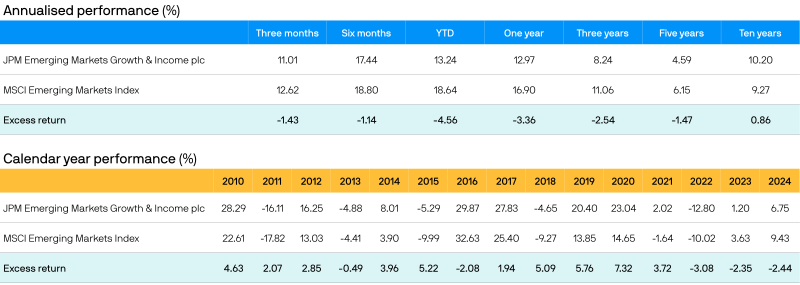
JMGI’s recent performance has lagged the benchmark due to its bias towards high quality growth stocks, which have underperformed lower-quality cyclical names since China’s economic outlook began to improve. However, the trust has a strong long-term performance track record. Over the 10 years to 31 August 2025, it delivered average annualised returns of 9.5% in net asset value terms, comfortably above the average benchmark return of 8.3%2.
Following recent shareholder approval, the trust now also offers investors an enhanced dividend, equivalent to 4% of Net Asset Value (NAV) as at the end of the preceding financial year, paid in four equal quarterly instalments. If required, any shortfall in the annual dividend income received from the portfolio’s underlying investments will be paid out of realised capital reserves. The enhanced dividend policy takes advantage of the trust’s closed-ended structure to deliver the reliable and predictable income that many retail investors seek.
With recent developments pointing to a sustained resurgence in emerging markets, Forey believes the trust is well-positioned to extend this track record – aiming to give shareholders absolute gains and outperformance, while also providing them with an attractive, steady dividend, and exposure to the structural growth trends driving some of the world’s most vibrant, rapidly growing and innovative economies.

The risk indicator assumes you keep the product for 5 year(s). The risk of the product may be significantly higher if held for less than the recommended holding period.
Investment Objective: This Company aims to maximise total returns from Emerging Markets and provides investors with a diversified portfolio of shares in companies which the Manager believe offer the most attractive opportunities for growth. The Company can hold up to 10% cash or utilise gearing of up to 20% of net assets where appropriate.
Risk Profile:
- Exchange rate changes may cause the value of underlying overseas investments to go down as well as up.
- Investments in emerging markets may involve a higher element of risk due to political and economic instability and underdeveloped markets and systems. Shares may also be traded less frequently than those on established markets. This means that there may be difficulty in both buying and selling shares and individual share prices may be subject to short-term price fluctuations.
- Where permitted, a Company may invest in other investment funds that utilise gearing (borrowing) which will exaggerate market movements both up and down.
- External factors may cause an entire asset class to decline in value. Prices and values of all shares or all bonds and income could decline at the same time, or fluctuate in response to the performance of individual companies and general market conditions.
- This Company may utilise gearing (borrowing) which will exaggerate market movements both up and down.
- This Company may also invest in smaller companies which may increase its risk profile.
- The share price may trade at a discount to the Net Asset Value of the Company.
- The Company may invest in China A-Shares through the Shanghai-Hong Kong Stock Connect program which is subject to regulatory change, quota limitations and also operational constraints which may result in increased counterparty risk.