logo
  • My collections
    View saved content and presentation slides
  • Log out
  • Insights

      Liquidity Insights

      • Liquidity Insights Overview
      • Global Liquidity Investment Outlook

        Global Liquidity Investment Outlook

      • Tokenization

        Explore the full whitepaper to learn how tokenized MMFs can transform your approach to cash management and position your organization at the forefront of digital finance.

      • Case Studies

        Read about companies with specific cash management challenges and the solutions when they worked with J.P. Morgan Asset Management.

      • Partnership with fintechs

        A focus on digital innovation and institutional liquidity solutions drive our dynamic partnership with fintech.

      • ESG Resources for Liquidity Investors

        We’ve created a clear, rigorous ESG process meets the many needs of liquidity investors.

      • Leveraging the Power of Cash Segmentation

        The most effective strategy incorporates a clear investment policy, well-defined goals and parameters for liquidity, quality and return.

      • Cash Investment Policy Statement

        How to write an investment policy statement for your organization

      Market Insights

      • Market Insights Overview
      • Eye on the Market

        Explore Eye on the Market, timely commentary that offers views on the economy, markets, and investment portfolios by Michael Cembalest.

      • Guide to the Markets

        The J.P. Morgan Guide to the Markets illustrates a comprehensive array of market and economic histories, trends and statistics through clear charts and graphs.

      • Market Updates

        Read our weekly commentaries to get market insights that may help inform your investment strategy.

      • Podcasts

        Insights from Tai Hui, Chief Market Strategist, Asia, on what is happening in financial markets, from our Asia Pacific headquarters in Hong Kong.

      • Guide to Investing in Asia

        The Guide to Investing in Asia explores the diverse economies, markets and investment trends across Asia, including Japan, India, China and Southeast Asia.

      Portfolio Insights

      • Portfolio Insights Overview
      • Currency

        Our currency team provides solutions for clients, controlling risk using passive management strategies and generating returns by actively managing global currencies.

      • Fixed Income

        We highlight themes and implications from various fixed income teams to help guide your portfolio decisions.

      • Long-Term Capital Market Assumptions

        Our Long-Term Capital Market Assumptions (LTCMAs) deliver forward-looking return, volatility and correlation estimates for 200+ asset and strategy classes in 20+ base currencies.

      • Sustainable investing

        Sustainable Insights

      • Strategic Investment Advisory Group

        The Strategic Investment Advisory Group approaches today’s investment challenges with a global view across asset classes.

    • Resources
        • All Resources
        • MORGAN MONEY
        • Account Management & Trading
        • Global Liquidity Investment Academy
        • Announcements
      • About us

          About us

          Backed by $4.6T in assets, we harness our active edge to deliver timely ideas and actionable insights that empower investors to achieve what matters most.

          • Overview
          • Spectrum: Our Investment Platform
          • Our Leadership Team
          • Diversity, Opportunity & Inclusion
        • Contact us
        • English
        • MORGAN MONEY LOGIN
          • My collections
            View saved content and presentation slides
          • Log out
        • Log in
        • MORGAN MONEY LOGIN
        Log in
        You are about to leave the site Close
        J.P. Morgan Asset Management’s website and/or mobile terms, privacy and security policies don't apply to the site or app you're about to visit. Please review its terms, privacy and security policies to see how they apply to you. J.P. Morgan Asset Management isn’t responsible for (and doesn't provide) any products, services or content at this third-party site or app, except for products and services that explicitly carry the J.P. Morgan Asset Management name.
        CONTINUE Go Back
        1. Chinese property - a paradigm shift

        • LinkedIn Twitter Facebook WhatsApp

        Chinese property - a paradigm shift

        19/11/2019

        Sunny Tam, CFA

        Over the past decade, Chinese property and related industries contributed ~15-20% of China’s GDP. Over the same period, the market value of the housing stock ballooned from 92% of GDP in 2009 to 178% of GDP in 2019. The Chinese government appears to be very determined to prevent further rapid growth in property prices and has further tightened credit availability to the sector this year. The operating environment could likely get more challenging in 2020, and we expect more divergence in developers’ performance going forward. Chinese property is one of the largest sectors in the Asia high yield bond universe, and is often considered as one of the “safer” sectors by investors, given limited default cases so far (only two defaults in the USD bond space in the past 10 years) and generally good asset coverage for most companies; however, the perception could change if defaults start to pick up. Some issuers may grow stronger as they consolidate the market, while the weaker ones get eliminated.

        Policies now targeting demand side and financing side

        Historically we have gone through many policy cycles for the Chinese property sector, but we think the key difference this time is that the government clearly stated that they will no longer use the property sector as a short term economic tool; and credit tightening is across the board, from construction loans, to bond issuance, and even mortgage loans. It is less likely that we would see policy easing anytime soon, and new regulations are virtually capping the total debt available to the sector. The operating environment has changed materially. Overall property sales appears to have reached its peak and is plateauing, if not gradually declining (volume growth is flat, price growth is being curbed).

        Operational performance would likely diverge going forward

        When markets perform well, developers can use higher growth to offset impacts of higher leverage or higher funding costs. As long as property sales do well, a lot of the weaker/smaller companies can still survive. However with the tighter mortgage loan availability, cash collection rate from property sales will likely be lower than before. As a result, the construction loans required to support the same scale will be higher yet at the same time construction loans are now harder to get. Also, with more stringent rules on bond issuances (basically only refinancing is allowed), developers would have less cash available to buy land too. Some developers may start to focus more on margins, and gradually deleverage during this period, yet others may struggle to survive. Current land bank quality and execution capability of management are also important factors determining how they would perform in the coming years, and this is not always fully captured in credit ratings.

        Bond market gradually pricing in the diverging operating performances – more adjustments to come

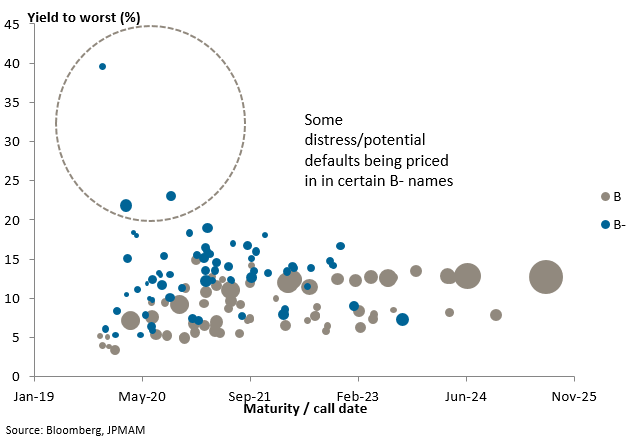
        The bond market is already starting to price-in more differentiation between issuers, but this is possibly just the beginning. Some names are already trading at relatively distressed levels, yet if some of them actually default, it could still affect the overall sentiment towards the sector.

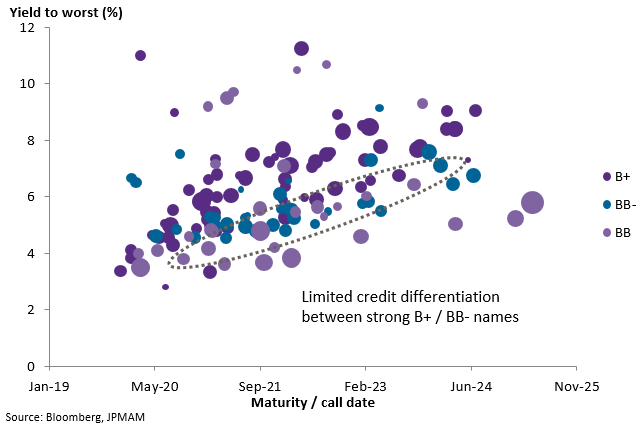
        On the other hand there seems to be relatively less differentiation between some stronger B+ names vs BB- names, possibly due to the expectation that they would eventually improve their credit metrics and later get upgraded to BB-, yet it could also be due to complacency of investors on certain names, and valuations could adjust materially if their performances do not meet expectations.

        All in all, there are still good investment opportunities within the sector; but we need to be vigilant in monitoring the company’s operational performances and make suitable credit rotations along the way, given that the competitive landscape is constantly evolving. The ability of issuers in adapting to the industry changes should play a much bigger role in credit selection going forward.

        Yield charts for various issuers with different ratings
        • APAC

        RELATED ARTICLES

        China’s Interest Rate Pivot

        While China’s post-Covid-19 economic data is showing signs of normalization, the government’s focus on stability will have significant implications for monetary policy and interest rates

        Read more

        The PBoC – Rate Cuts and Policy Clarification

        The Peoples Bank of China recent policy actions help address the concerns that its policy response was lagging the aggressive actions taken by other central banks.

        Read more

        Singapore Dollar – no longer defying gravity

        The Singapore Dollar is no longer defying gravity – we discuss why and the implications for cash investors.

        Read more
        J.P. Morgan Asset Management

        • Investment stewardship
        • About us
        • Contact us
        • Privacy policy
        • Cookie policy
        • Complaint Resolution
        • Sitemap
        J.P. Morgan

        • J.P. Morgan
        • JPMorgan Chase
        • Chase

        READ IMPORTANT LEGAL INFORMATION. CLICK HERE >

        The value of investments may go down as well as up and investors may not get back the full amount invested.

        Copyright 2026 JPMorgan Chase & Co. All rights reserved.