logo
  • My collections
    View saved content and presentation slides
  • Log out
  • Insights

      Liquidity Insights

      • Liquidity Insights Overview
      • Global Liquidity Investment Outlook

        Global Liquidity Investment Outlook

      • Tokenization

        Explore the full whitepaper to learn how tokenized MMFs can transform your approach to cash management and position your organization at the forefront of digital finance.

      • Case Studies

        Read about companies with specific cash management challenges and the solutions when they worked with J.P. Morgan Asset Management.

      • Partnership with fintechs

        A focus on digital innovation and institutional liquidity solutions drive our dynamic partnership with fintech.

      • ESG Resources for Liquidity Investors

        We’ve created a clear, rigorous ESG process meets the many needs of liquidity investors.

      • Leveraging the Power of Cash Segmentation

        The most effective strategy incorporates a clear investment policy, well-defined goals and parameters for liquidity, quality and return.

      • Cash Investment Policy Statement

        How to write an investment policy statement for your organization

      Market Insights

      • Market Insights Overview
      • Eye on the Market

        Explore Eye on the Market, timely commentary that offers views on the economy, markets, and investment portfolios by Michael Cembalest.

      • Guide to the Markets

        The J.P. Morgan Guide to the Markets illustrates a comprehensive array of market and economic histories, trends and statistics through clear charts and graphs.

      • Market Updates

        Read our weekly commentaries to get market insights that may help inform your investment strategy.

      • Podcasts

        Insights from Tai Hui, Chief Market Strategist, Asia, on what is happening in financial markets, from our Asia Pacific headquarters in Hong Kong.

      • Guide to Investing in Asia

        The Guide to Investing in Asia explores the diverse economies, markets and investment trends across Asia, including Japan, India, China and Southeast Asia.

      Portfolio Insights

      • Portfolio Insights Overview
      • Currency

        Our currency team provides solutions for clients, controlling risk using passive management strategies and generating returns by actively managing global currencies.

      • Fixed Income

        We highlight themes and implications from various fixed income teams to help guide your portfolio decisions.

      • Long-Term Capital Market Assumptions

        Our Long-Term Capital Market Assumptions (LTCMAs) deliver forward-looking return, volatility and correlation estimates for 200+ asset and strategy classes in 20+ base currencies.

      • Sustainable investing

        Sustainable Insights

      • Strategic Investment Advisory Group

        The Strategic Investment Advisory Group approaches today’s investment challenges with a global view across asset classes.

    • Resources
        • All Resources
        • MORGAN MONEY
        • Account Management & Trading
        • Global Liquidity Investment Academy
        • Announcements
      • About us

          About us

          Backed by $4.6T in assets, we harness our active edge to deliver timely ideas and actionable insights that empower investors to achieve what matters most.

          • Overview
          • Spectrum: Our Investment Platform
          • Our Leadership Team
          • Diversity, Opportunity & Inclusion
        • Contact us
        • English
        • MORGAN MONEY LOGIN
          • My collections
            View saved content and presentation slides
          • Log out
        • Log in
        • MORGAN MONEY LOGIN
        Log in
        You are about to leave the site Close
        J.P. Morgan Asset Management’s website and/or mobile terms, privacy and security policies don't apply to the site or app you're about to visit. Please review its terms, privacy and security policies to see how they apply to you. J.P. Morgan Asset Management isn’t responsible for (and doesn't provide) any products, services or content at this third-party site or app, except for products and services that explicitly carry the J.P. Morgan Asset Management name.
        CONTINUE Go Back
        1. Singapore Dollar – no longer defying gravity

        • LinkedIn Twitter Facebook Line WhatsApp

        Singapore Dollar – no longer defying gravity

        20/02/2020

        Aidan Shevlin

        Weak growth, elevated currency

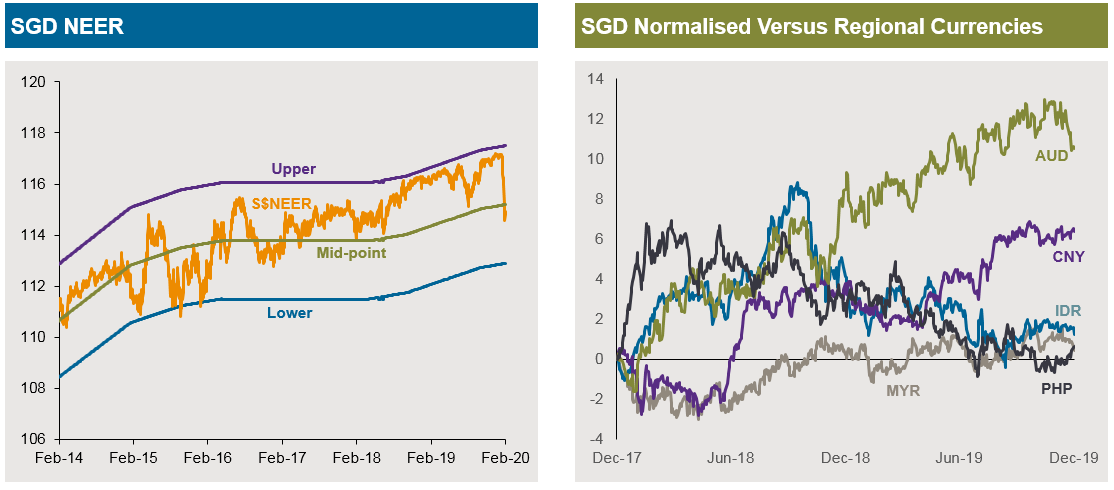
        For the majority of 2019, the Singapore nominal effective exchange rate (S$NEER) defied economic gravity, tightly adhering to the top end of its trading range (Fig 1a), while the SGD outperformed many regional currencies (Fig 1b). 

        However, the potentially large negative impact of the of the Covid-19 virus has prompted a reappraisal of weaker economic data and muted inflation – triggering a notable dovish shift by the Monetary Authority of Singapore (MAS) with significant implications for the SGD and short term interest rates.

        Fig 1: The MAS controls the S$NEER; SGD has outperformed regional peers in 2018 & 2019
        Source: Citibank, Bloomberg & J.P. Morgan Asset Management.  Data as at 12th February 2020

        Trade tensions encourage a MAS pivot

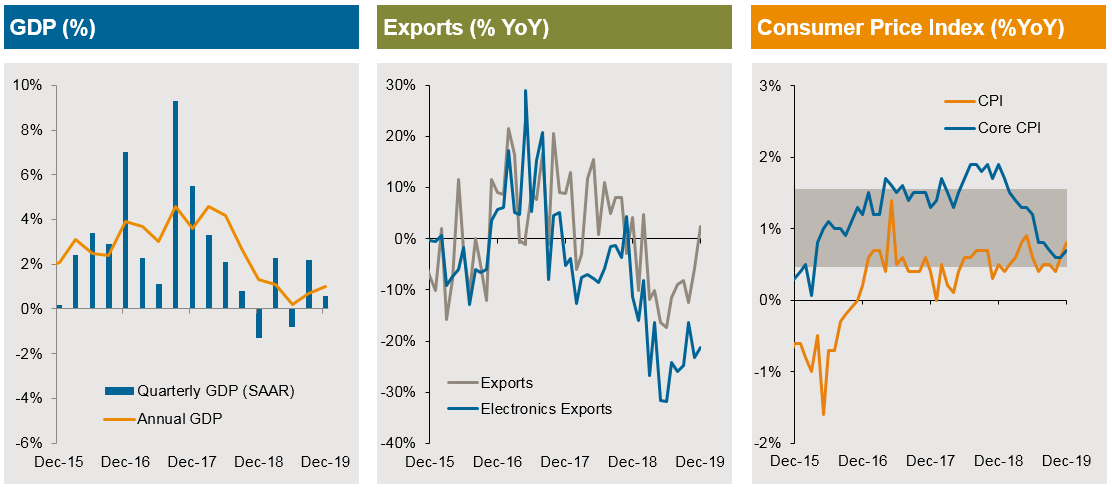
        The Singapore economy faced multiple headwinds in 2019 from weaker domestic growth, anemic price pressures and a heightened exposure to global trade tensions (Fig 2).  At its April 2019 monetary policy meeting the MAS ended its hawkish hiking cycle, leaving rates unchanged and downgrading its GDP and core inflation targets.  Subsequently, weaker than expected growth and further downward revisions to its key targets nudged the central bank to cut the slope of its S$NEER at its October policy meeting, the first easing in over 3.5 years.

        The MAS’s modest monetary policy adjustments stood in stark contrast with more aggressive rate cuts by global and regional peers – leaving the S$NEER at the top of its trading range and SGD stronger relative to other Asia-Pacific currencies

        Fig 2: Singapore monetary policy depends on trade and inflation
        Source: Bloomberg & J.P. Morgan Asset Management.  Data as at 15th February 2020

        SAAR = seasonally adjusted annualized rate

        Despite the policy pivot, Singapore’s economic growth hit a decade low of 1.0%y/y in 2019 as escalating global trade tensions weighted on the Lion city’s open, export dependent economy.  Fortunately, lower global interest rates and record tourist arrivals and spending supported a moderate stabilization while the phase 1 US/China trade truce in early January raised the potential of an economic recovery in 2020.

        Evolving uncertainty

        The unexpected Covid-19 outbreak, with its negative implications for international trade, domestic productivity and tourism has triggered significant uncertainty and concern - especially after Singapore raised its disease outbreak response condition level.

        The imposition of travel restrictions on Chinese visitors – the largest source of spending in 2019 - has already dramatically impacted tourism, with significant ramifications for the aviation, hospitality and consumption sectors.  In addition, the delayed return of many Chinese workers will impact the construction sector, while manufacturing and export sectors will be negatively affected by China’s delayed re-opening following Chinese New Year holidays. Acknowledging the downside risks, the government downgraded its 2020 growth forecast by 1% to a range of -0.5% to 1.5%.[1]

        Rapid fiscal and monetary support

        Responding to media queries, on 4th February 2020, the MAS commented[2] that “there is sufficient room within the policy band to accommodate an easing of the S$NEER in line with the weakening of economic conditions as a result of the 2019-nCov”.  Such inter-meeting statements are rare and highlight the central banks concern.  The de-facto easing triggered an instant market response, with the S$NEER declining sharply below the mid-point of its trading range for the first time since 2017 while the SGD weakened considerably versus the USD.

        The MAS confirmed its next policy meeting would occur on schedule in April – allaying concerns of an inter-meeting cut.  Given the S$NEER band still has a mild appreciation bias, most economists expect the central bank to either flatten the S$NEER slope or lower the S$NEER trading band.

        Implications for cash investors

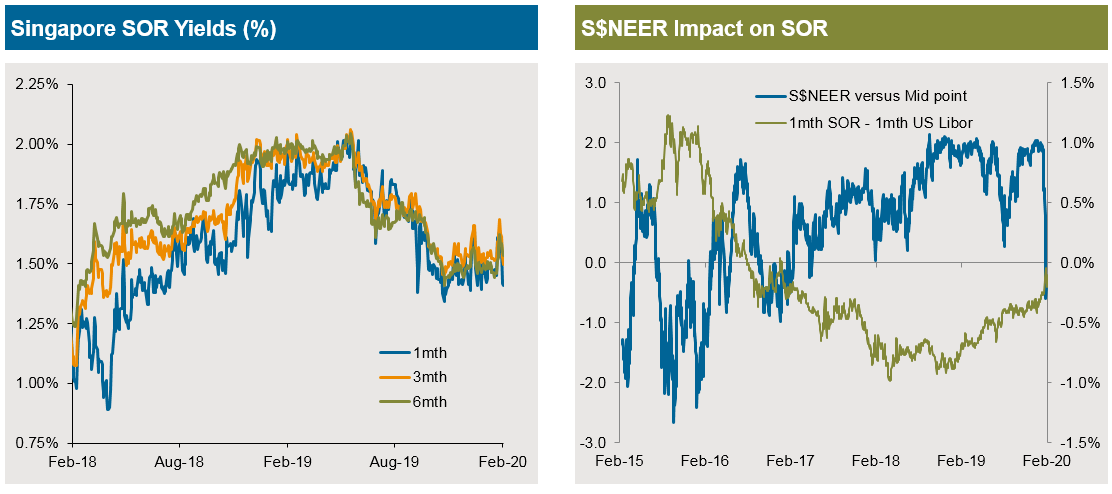
        In 2019, Singapore Swap Offer rate (SOR) yields declined (Fig 3a) as the US Federal Reserve (Fed) switched to a dovish policy stance with three rate cuts.  However, even as yield curves flattened, SOR yields outperformed their US Libor equivalents, with the spread between the two short term interest rates contracting to a 3.5-year point tight.

        Fig 3: Singapore SOR yields are impacted by movements in S$NEER
        Source: Citibank, Bloomberg & JPMorgan Asset Management as at 12th February 2020

        Historically, SOR yields tend to increase when the S$NEER weakens – especially as it declines below the mid-point of its trading range (Fig 3b).  With the Fed on-hold for the foreseeable future and the MAS expected to ease S$NEER policy at its April meeting, it is likely SOR yields could climb further, creating attractive investment opportunities for cash investors who are able to lock in longer tenor securities.

        [1] https://www.mti.gov.sg/Newsroom/Press-Releases/2020/02/MTI-Downgrades-2020-GDP-Growth-Forecast-to--0_5-to-1_5-Per-Cent

        [2] https://www.mas.gov.sg/news/media-releases/2020/comments-by-mas-on-the-monetary-policy-stance

        • Liquidity
        • APAC

        RELATED ARTICLES

        IOER – does the latest fed move have any practical implications for cash investors?

        The Fed’s interest on excess reserves (IOER) shot to prominence following an unprecedented adjustment by the central bank. We explore its impact on investors.

        Read more

        China’s Interest Rate Pivot

        While China’s post-Covid-19 economic data is showing signs of normalization, the government’s focus on stability will have significant implications for monetary policy and interest rates

        Read more

        The PBoC – Rate Cuts and Policy Clarification

        The Peoples Bank of China recent policy actions help address the concerns that its policy response was lagging the aggressive actions taken by other central banks.

        Read more
        J.P. Morgan Asset Management

        • Investment stewardship
        • About us
        • Contact us
        • Privacy policy
        • Cookie policy
        • Complaint Resolution
        • Sitemap
        J.P. Morgan

        • J.P. Morgan
        • JPMorgan Chase
        • Chase

        READ IMPORTANT LEGAL INFORMATION. CLICK HERE >

        The value of investments may go down as well as up and investors may not get back the full amount invested.

        Copyright 2026 JPMorgan Chase & Co. All rights reserved.