logo
  • Log in
  • My collections
    View saved content and presentation slides
  • Log out
  • Products

      Funds

      • Performance & Yields
      • Liquidity
      • Ultra-Short
      • Short Duration
      • European domiciled products

      Solutions

      • Cash Strategies
      • Cash Segmentation
      • Separately Managed Accounts
      • Managed Reserves Strategy

      Fund Information

      • Regulatory Updates
    • Insights

        Liquidity Insights

        • Liquidity Insights Overview
        • Global Liquidity Investment Outlook

          Global Liquidity Investment Outlook

        • Tokenization

          Explore the full whitepaper to learn how tokenized MMFs can transform your approach to cash management and position your organization at the forefront of digital finance.

        • Cash Cookbook

          The Cash Cookbook, your guide to cash and liquidity management success, helps you choose the right liquidity solution for your needs and risk tolerance.

        • Case Studies

          Read about companies with specific cash management challenges and the solutions when they worked with J.P. Morgan Asset Management.

        • Partnership with fintechs

          A focus on digital innovation and institutional liquidity solutions drive our dynamic partnership with fintech.

        • ESG Resources for Liquidity Investors

          We’ve created a clear, rigorous ESG process meets the many needs of liquidity investors.

        • Leveraging the Power of Cash Segmentation

          The most effective strategy incorporates a clear investment policy, well-defined goals and parameters for liquidity, quality and return.

        • Cash Investment Policy Statement

          How to write an investment policy statement for your organization

        Market Insights

        • Market Insights Overview
        • Eye on the Market

          Explore Eye on the Market, timely commentary that offers views on the economy, markets, and investment portfolios by Michael Cembalest.

        • Guide to the Markets

          The J.P. Morgan Guide to the Markets illustrates a comprehensive array of market and economic histories, trends and statistics through clear charts and graphs.

        • Market Updates

          Read our weekly commentaries to get market insights that may help inform your investment strategy.

        Portfolio Insights

        • Portfolio Insights Overview
        • Currency

          Our currency team provides solutions for clients, controlling risk using passive management strategies and generating returns by actively managing global currencies.

        • Fixed Income

          A complex mix of monetary, credit and fiscal forces is changing the bond landscape. Discover how flexible fixed income approaches can seek returns, income and resilience.

        • Long-Term Capital Market Assumptions

          Our Long-Term Capital Market Assumptions (LTCMAs) deliver forward-looking return, volatility and correlation estimates for 200+ asset and strategy classes in 20+ base currencies.

        • Sustainable investing

          We believe that ESG considerations can play a critical role in a long-term investment strategy.

        • Strategic Investment Advisory Group

          The Strategic Investment Advisory Group approaches today’s investment challenges with a global view across asset classes.

      • Resources
          • Overview
          • MORGAN MONEY
          • Account Management & Trading
          • Global Liquidity Investment Academy
          • Announcements
        • About us

            About us

            Backed by $4.6T in assets, we harness our active edge to deliver timely ideas and actionable insights that empower investors to achieve what matters most.

            • Overview
            • Diversity, Opportunity & Inclusion
            • Our Leadership Team
            • Our Commitment to Research
          • Contact us
          • English
          • MORGAN MONEY LOGIN
            • Log in
            • My collections
              View saved content and presentation slides
            • Log out
          • Log in
          • MORGAN MONEY LOGIN
          You are about to leave the site Close
          J.P. Morgan Asset Management’s website and/or mobile terms, privacy and security policies don't apply to the site or app you're about to visit. Please review its terms, privacy and security policies to see how they apply to you. J.P. Morgan Asset Management isn’t responsible for (and doesn't provide) any products, services or content at this third-party site or app, except for products and services that explicitly carry the J.P. Morgan Asset Management name.
          CONTINUE Go Back
          1. EM central banks – the case for an asymmetrical beta to the fed

          • LinkedIn Twitter Facebook WhatsApp

          EM central banks – the case for an asymmetrical beta to the fed

          01-08-2019

          Julien Allard

          Since its first hike in December 2015 the Federal Reserve has delivered a 225bps hiking cycle. Over the same period the main Central Banks in Emerging Markets have hiked only 50bps on average, or they actually cut policy rate by -33bps when removing Turkey. We could infer from these numbers that EM CB don’t really include the Fed policy in their reaction function – or in other words that they exhibit a low beta to the Fed policy rates. We think that this would be incorrect and here is why.

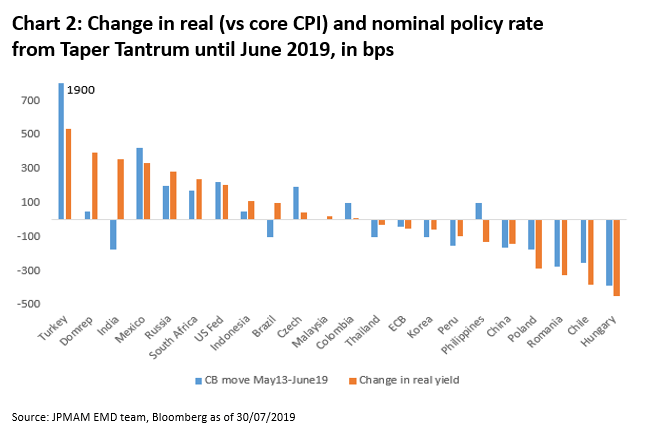
          First, the above period of reference is misleading. The real turning point in the Fed tightening cycle is better captured by Taper Tantrum (May-June 2013) than by the first Fed hike (December 2015). The sharp rise in US real yield which occurred in the second half of 2013 led to tighter financial conditions across the board especially for at the time the so-called “fragile five” economies –Turkey, Brazil, South Africa, India, Indonesia – which shared the common feature of being particularly externally exposed. Between Taper Tantrum and the first Fed hike (December 2015) the Central Banks in the fragile five countries hiked between 75bps (Reserve Bank of India) and 675 bps (Bank Central of Brazil) in an effort to protect their currencies.
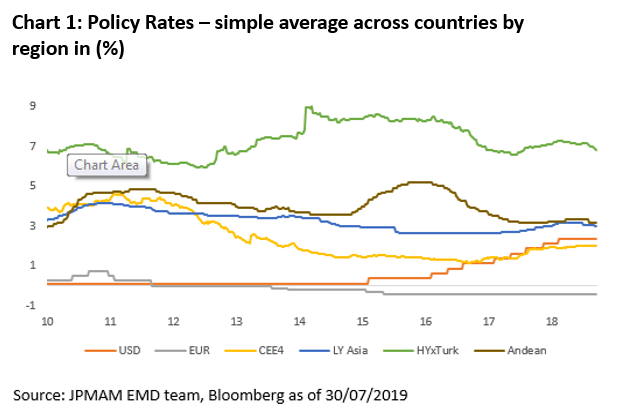
          Second, disinflation in emerging markets has been an offset to the Fed hiking rates. With the exception of some idiosyncratic crises which led to currency depreciation and an inflation spike – such as in Turkey in the summer of 2019 or in Russia in 2015 – inflation has been moderating across most regions. Latin America and Asia overall have seen a very clear downward trend in YOY inflation prints driven by core and non core items. Central and Eastern Europe has been an exception to the rest of EM as the only region which has seen higher core inflation pressure fuelled by tight labour markets and strong wage growth. Emerging markets have been able to maintain elevated real yields relative to developed market not by hiking aggressively but by better anchoring inflation.

          Third, looking at the average across the whole period masks a succession of three distinct regimes. The first period started from the Taper Tantrum and continued until 2016. In this period EM Central Banks had to adapt to the switch in the Fed stance and the more externally vulnerable countries were forced into hiking as mentioned above. During the second period – from 2016 to 2017 – the Fed hiked in a well telegraphed manner which did not destabilize the emerging market complex. Central Banks in a number of Emerging Markets were able to engage in deep cutting cycles for example Banrep (Colombia), BCB (Brazil) or NBR (Russia).The third period (2018) saw a resumption of hikes which were driven by a mix of better growth and the necessity for some EM Central Banks to compete with Libor in the 2-2.5% context. In 2018, we saw a number Central Banks hiking rates across the whole low yield-high yield spectrum and in particular Banxico (Mexico), BI (Indonesia), SARB (South Africa), CBRT (Turkey), BCCh (Chile) and CNB (Czech Republic).

          Fourth, the sensitivity of EM Central Banks to the Fed varies highly across countries. Banxico stands out as one of the most sensitive Central Banks to the Fed policy as it targets a yield pick up over the Fed rates to compensate for political risk and attract investors. It hiked 425bps since Taper Tantrum. In general the most externally dependent tends to be more exposed to the Fed policy rate (CBRT, BI, RBI, SARB, Banrep) while the Central European Central Banks are less exposed to the Fed as the ECB dominates as a reference point. Mid yielder Central Banks – think BCR (Peru), BOT (Thailand), BNM (Malaysia)- fall somewhere in the middle.

          In sum, EM Central Banks have in fact a relatively high beta to Fed policy rates. Going forward we therefore believe that EM Central Banks will deliver a significant cutting cycle across most countries and that they will at least match the Fed cutting cycle, which implies a beta of one or potentially even higher. In a number of countries, real policy rates have increased considerably over the last 5 years and there is room for cutting as activity is slowing down. In the last 13 weeks, 53% of the EM Central Banks have already delivered cuts. After the Fed cut we expect that close to 75% will have joined the party.
          • Emerging Markets
          • Central Banks
          • Inflation

          RELATED ARTICLES

          Add extra guacamole for a dollar!

          Emerging Markets Local Currency debt emerged as one of our best ideas at our most recent investment quarterly meeting. This isn't just about the US Dollar; we like what we see in local EM.

          Read more

          Emerging Markets: Don’t Fight the Central Banks

          The opportunity cost of not investing in EM debt remains very high. Most importantly the same applies for the rest of fixed income: don’t fight the central banks.

          Read more

          A new era for alpha generation in local emerging markets?

          The global savings glut has been driving asset price valuations for the last decade or so. Emerging Markets and investors need to prepare for a potential new world.

          Read more