Investment themes for emerging market debt – Q4 2026
- Emerging markets stand out amid developed-market challenges
- Sovereign and corporate fundamentals remain strong
- Inflation and monetary policy: calibrations, not cycles
- Emerging market debt continues to improve in quality
- Carry, emerging market foreign exchange (EMFX) and selective credit remain central to returns
-
Emerging markets stand out amid developed-market challenges
-
Sovereign and corporate fundamentals remain strong
-
Inflation and monetary policy: calibrations, not cycles
-
Emerging market debt continues to improve in quality
-
Carry, EMFX and selective credit remain central to returns
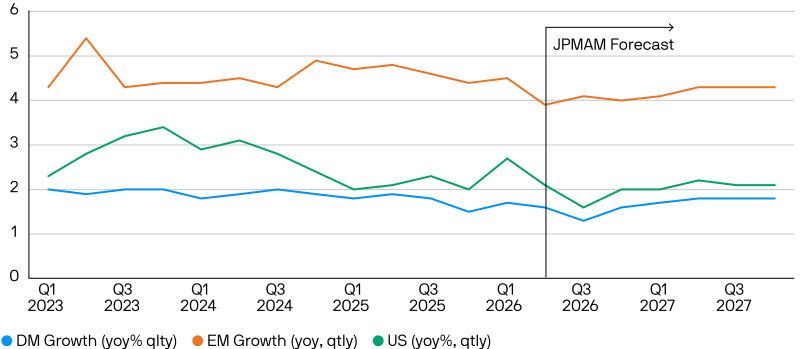
Emerging market debt (EMD) enters the final quarter of 2026 with a supportive backdrop. Growth remains resilient, inflation is stabilising and market performance is increasingly reflecting stronger emerging market (EM) fundamentals. The key macro message is that emerging markets stand out while developed market (DM) economies face greater policy uncertainty, heavier bond-supply pressure and more visible political challenges. EM growth is expected to remain constructive at 4.1% in 2026 and rise to 4.3% in 2027, while China remains an important anchor, with 2026 GDP growth expected to hold at 4.6%.
This resilience has also been reflected in market returns. In a volatile year, EM corporate high-yield and EM sovereign high-yield bonds have led fixed income returns, returning close to 5%, while EM local currency debt is up almost 3%; meanwhile, US Treasuries and eurozone government bonds have posted negative returns. This performance illustrates the significant opportunity for growth within a USD 50 trillion asset class. EMD is a core allocation that can offer higher income, broaden diversification and provide access to attractive return drivers beyond developed markets.
Bond returns since the start of 2026 (% year-to-date)
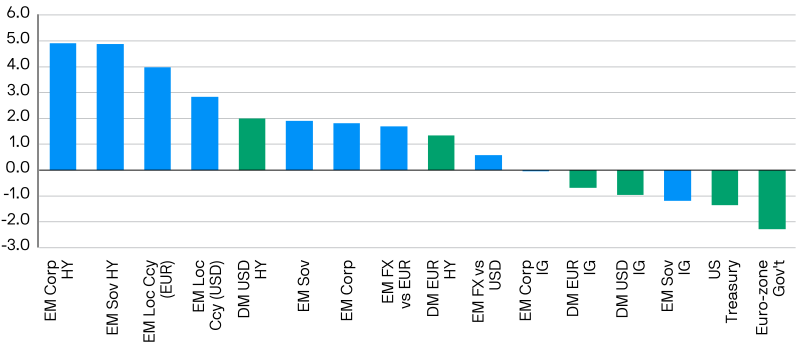
Source: J.P. Morgan, J.P. Morgan Asset Management; data as of 11 September 2026. Returns in USD unless otherwise noted. Past performance is not a reliable indicator of current or future returns. Indices do not include fees or operating expenses. Indices: JPM GBI-EM Global Diversified (EM Local, EMF X), JPM EMBI Global Diversified (EM Sovereign), JPM CEMBI Broad Diversified (EM Corporate), US Treasury and Eurozone Government (JPM GBI), US HG (JPM GCI USD DM IG), EUR HG (JPM GCI EUR DM IG). Corp = corporate; Ccy = currency; FX = foreign exchange; Govt = government; HY = high yield; IG = investment grade; Loc = local; Sov = sovereign.
EM growth has remained resilient relative to developed markets, with the EM-DM growth alpha remaining stable near pre-pandemic levels and the EM ex-China alpha versus the US expected to rise in coming quarters. Regionally, Latin America and Asia are expected to remain steady, while Europe, the Middle East and Africa (EMEA) are expected to recover, reinforcing the breadth of the EM opportunity set.
This growth backdrop is also supporting EM corporates. Earnings before interest, taxes, depreciation and amortisation (EBITDA) growth is expected to accelerate to 8.3% in 2026 from 2.6% in 2025, while margins remain around their 10-year average. Commodity sectors are expected to lead the improvement, with EBITDA growth forecast at 29.9% in 2026 versus 8.3% for the broader EM corporate universe.
The improvement in earnings should also support balance sheets. EM corporate net leverage is expected to fall to 2.3x in 2026 from 2.5x in 2025, while capital expenditure (capex) as a share of revenue is expected to rise to 11.6%, suggesting companies are still investing despite a more uncertain global backdrop. Bank capital buffers also appear sufficient to absorb potential asset-quality shocks, adding another layer of support to the corporate credit outlook.
Artificial Intelligence (AI) is becoming an increasingly important theme for EM investors. While capex remains largely led by developed markets, data-centre investment is expanding across China, broader Asia, Mexico, India and the Middle East. EM commodity exporters may also benefit from AI-related demand, given that EM economies account for 62% of critical mineral supply. In addition, lower-cost AI models could support productivity gains over time.
Growth is resilient relative to developed markets
Quarterly, Year over year rate
Inflation remains a risk, but this is not a repeat of 2022. EM inflation is stabilising after the second-quarter shock, with remaining upside risks concentrated in non-core factors such as El Niño and second-round effects. Crucially, inflation expectations remain broadly anchored, and there is little evidence of a broad demand-side impulse.
As a result, EM central banks are more likely to calibrate policy than launch full hiking cycles. Policy paths should continue to diverge across regions and countries, with policy rates in Latin America remaining higher, those in EMEA gradually easing and those in Asia at lower absolute levels. For investors, this dispersion creates relative-value opportunities: duration can be added where central banks have room to ease, while a more tactical approach is warranted where fiscal, political or inflation risks are more prominent.
EM real rates remain attractive relative to the US on a forward-looking basis. Brazil and Colombia stand out, with forward-looking real policy rates of 9.4% and 6.7%, respectively, followed by South Africa at 3.8%, Mexico at 3.0% and Hungary at 2.6%; the US stands at 1.8%. Ex post real rates show a similar pattern, with Brazil at 9.6%, Colombia at 6.0% and Hungary at 4.3%, highlighting the degree of real-rate cushion still available in parts of emerging markets.
Brazil and Colombia stand out on a forward-looking basis)
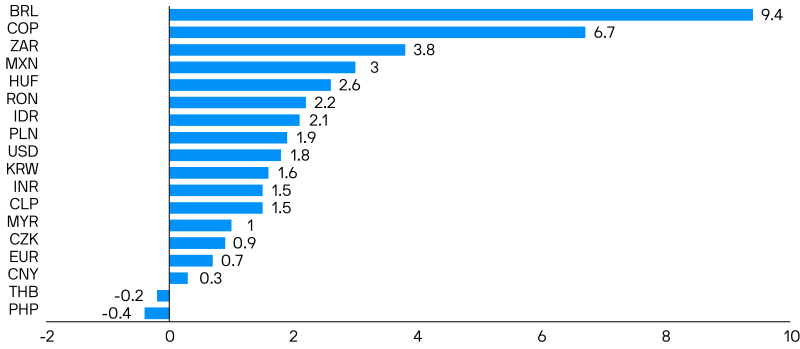
Source: J.P. Morgan Asset Management, Bloomberg, International Monetary Fund (IMF). Ex post reflects the latest headline consumer price index (CPI) year-over-year print. Ex ante reflects one-year-ahead inflation expectations based on surveys or Bloomberg forecasts. One-year-ahead market pricing reflects monetary policy priced into local swap curves. Data as of 4 September 2026. Currency codes: BRL = Brazilian real; COP = Colombian peso; ZAR = South African rand; MXN = Mexican peso; HUF = Hungarian forint; RON = Romanian leu; IDR = Indonesian rupiah; PLN = Polish zloty; USD = US dollar; KRW = South Korean won; INR = Indian rupee; CLP = Chilean peso; MYR = Malaysian ringgit; CZK = Czech koruna; EUR = euro; CNY = Chinese yuan (renminbi); THB = Thai baht; PHP = Philippine peso.
The quality of the EMD universe continues to improve. Compared with 2022, EM fiscal deficits are narrower, debt levels are lower, inflation is more contained, real policy yields are higher and current-account positions are stronger. Reserve coverage among B-rated sovereigns has also doubled, providing a larger cushion against external shocks. By contrast, fiscal deficits remain wider and debt burdens heavier across developed markets.
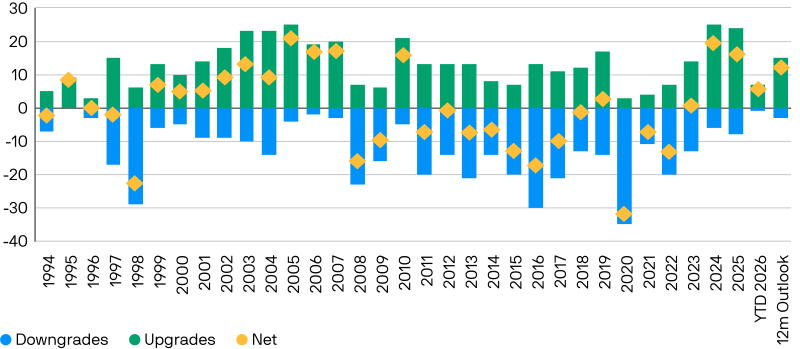
Ratings momentum reinforces this quality improvement. Upgrades continued to exceed downgrades in 2026, with recent upgrades across a range of sovereigns and further upgrades expected in countries including India, Morocco, Turkey, Uzbekistan and Zambia. Expected downgrades remain more limited.
Default risk also remains contained. There were no defaults in 2024 or 2025, and the 12-month forecast default rate is very low and largely idiosyncratic rather than systemic. External balances add to this resilience: current accounts are stronger or less fragile, capital flows are improving, reserves are high among formerly vulnerable credits and sovereign net borrowing requirements are declining in emerging markets relative to developed markets.
Political risks remain worth monitoring, particularly as the calendar becomes more active. Elections to watch include Brazil and Israel in 2026, and Nigeria, Kenya, Angola and Argentina in 2027. This suggests that country selection will remain important even though aggregate EM fundamentals remain supportive.
Upgrades continue to exceed downgrades in 2026
EM sovereigns rating changes (middle M/S/F)
Valuations remain attractive even after strong performance. Benchmark yields are still elevated, with EM sovereigns (6.8%), EM corporates (6.5%) and EM local currency debt (6.4%) all offering a yield premium versus DM government and aggregate bond markets.
Long-term capital market assumptions also remain supportive, with EM local currency, sovereign and corporate debt expected to deliver superior returns relative to other fixedincome sectors.
EMFX remains a key part of the opportunity set. EM currencies continue to offer higher carry than the US dollar and benefit from stronger external balances, while valuations remain cheap despite recent appreciation. This supports a constructive stance on local markets, where carry, improving growth and external resilience can combine to provide a differentiated source of return.
Credit selection remains important. Spreads are near long-term lows, but EM credit continues to offer a yield pickup compared to DM credit. Within EM credit, relative value remains important: spreads by rating have compressed, but EM corporate and sovereign comparisons still show opportunities across investment grade and high yield. Sovereign technicals remain broadly supportive, while another year of negative net issuance by corporates acts as a tailwind, reinforcing the need to focus on issuers where carry is supported by fundamentals.
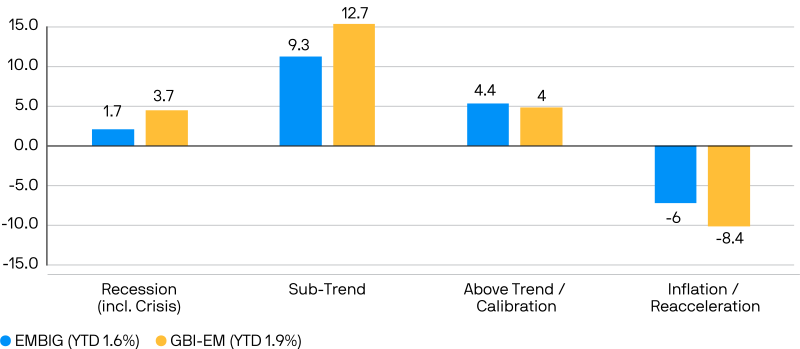
Scenario analysis points to positive probability-weighted returns, with carry continuing to deliver in the base case. The main downside is an inflationary or growth-reacceleration regime that pushes US Treasury yields higher and strengthens the US dollar.
Overall, we remain constructive on EMD into the final quarter of 2026. Local markets are supported by favourable EMFX fundamentals, strong external balances and improving EM growth; sovereigns remain attractive through select high-yield exposure and duration opportunities; and corporates offer selective carry, particularly in credits rated BB and higher quality B, supported by fundamentals and technicals. As in prior quarters, the opportunity is not just about yield: it is about using EM debt as a diversified allocation across currencies, rates and credit stories that remain less tied to the developed-market cycle.
2026 EMD alternative scenarios