


Productivity Returns: An investment surge lifts growth … and volatility
A USD 15 trillion global capex supernova fuels higher growth and strong asset returns over the next 10 to 15 years. Productivity gains mitigate rising inflation risks and an aging workforce. Despite the tail risks, a resilient economy drives resilient markets.
Three forces shape the future and drive returns
Economic nationalism boosts domestic investment but risks a crosscurrent of inflation volatility. Technology adoption is the fair wind filling the global economy’s sails. Rising domestic investment drives capital rewiring, resulting in shifts in public and private capital flows.
The best developed world growth outlook in 15 years
A global investment surge, centered on AI and extending to 2040, boosts total factor productivity by 50%, to 120bps, pushing our U.S. real GDP growth forecast up to 2.1% and developed world nominal growth up to 4.2%. The mix of GDP-to-inflation is the most favorable since the pandemic.
U.S. equity upgrades, a global bond renewal and a first look at bitcoin
Profit margins of over 15% push our U.S. large cap equity forecast up 80bps, to 7.5%, leading to our developed market equity forecasts overtaking our emerging market equity forecasts. Higher real yields drive global aggregate bond forecasts from a low of 2.1% in 2021 to 5.3% today – the highest in two decades. And for the first time, we put a range on bitcoin returns, though we do not yet include bitcoin in our main covariance matrices.
Alternatives for return enhancement, diversification and inflation resilience
We upgrade diversified hedge funds by 140bps on sustained alpha trends and higher rates – with alpha to play for, manager selection is vital. Real asset returns are resilient in the face of persistent inflation volatility, with global transportation returning 8.1%, global core real estate 7.9% and global infrastructure 7.1%.
Greater opportunities to diversify, greater rewards for doing so
A balanced global stock-bond portfolio rises 60bps, to 7.0%, but higher stock-bond correlation demands further diversification. Alternatives can boost risk-adjusted returns: Allocating 30% to diversified alternatives can push returns up to 7.5% and boost Sharpe ratios by 21% compared with a simple balanced portfolio. Diversifying relative to themes as well as across assets can further strengthen portfolio resilience.
Source: J.P. Morgan Asset Management; data as of September 2026
Topics
Matrices
Our expectations for returns, volatilities and correlations. Use our interactive version to download the excel in your chosen currency.
The assumptions are not designed to inform short term tactical allocation decisions. Our assumptions process is carefully calibrated and constructed to aid investors with strategic asset allocation or policy-level decisions over a 10- to 15-year investment horizon.
Download Excel and PDF matrices by currency
Assumptions
Examine our return projections by major asset class and the thinking behind the numbers.
Long-Term Capital Market Assumptions: Methodology Handbook
A companion volume to dive deeper into our LTCMAs’ building blocks
Macroeconomic Assumptions
AI leaders pull ahead, and inflation paths diverge
The scale of AI’s boost to total factor productivity varies widely
AI contribution to TFP
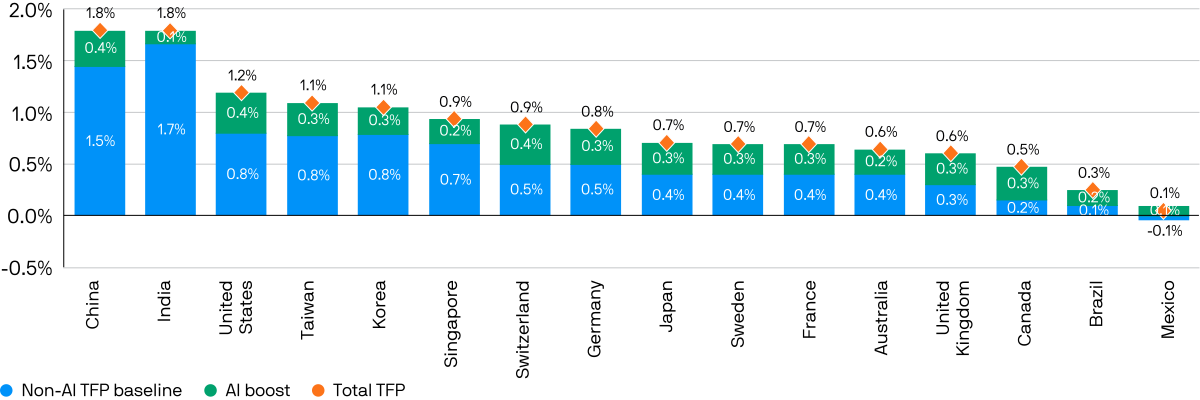
Source: J.P. Morgan Asset Management; data as of September 30, 2026. The non-AI TFP baseline is each economy’s assumed trend productivity growth before any AI contribution.
Public markets assumptions
Strong but uneven returns in a changing world
A balanced portfolio earns a respectable return over the next 10 to 15 years
Public market return assumption changes vs. prior edition of LTCMA
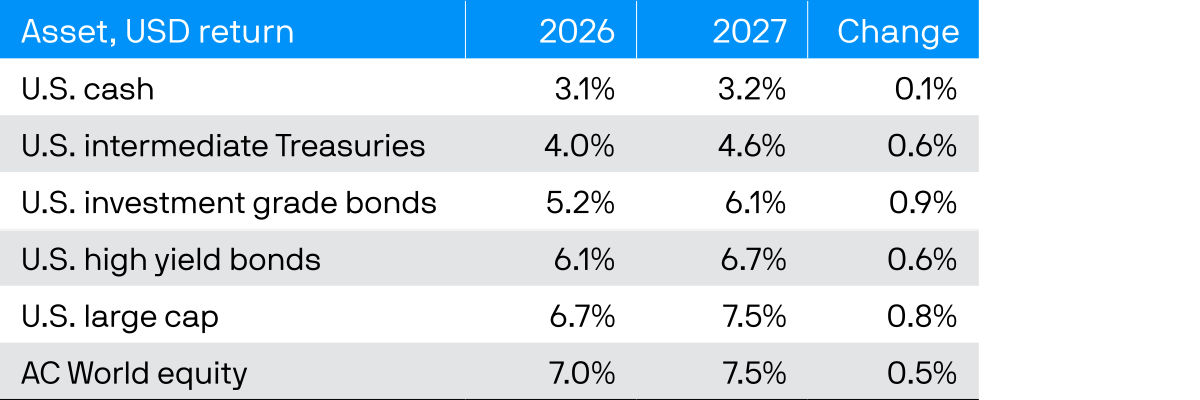
Source: J.P. Morgan Asset Management; data as of September 30, 2026.
Private markets and alternative asset assumptions
New forces lift private markets; greater dispersion offers alpha
Rising alpha estimates across financial alternatives will be matched by an increase in performance dispersion
Financial alternatives’ expected returns and drivers
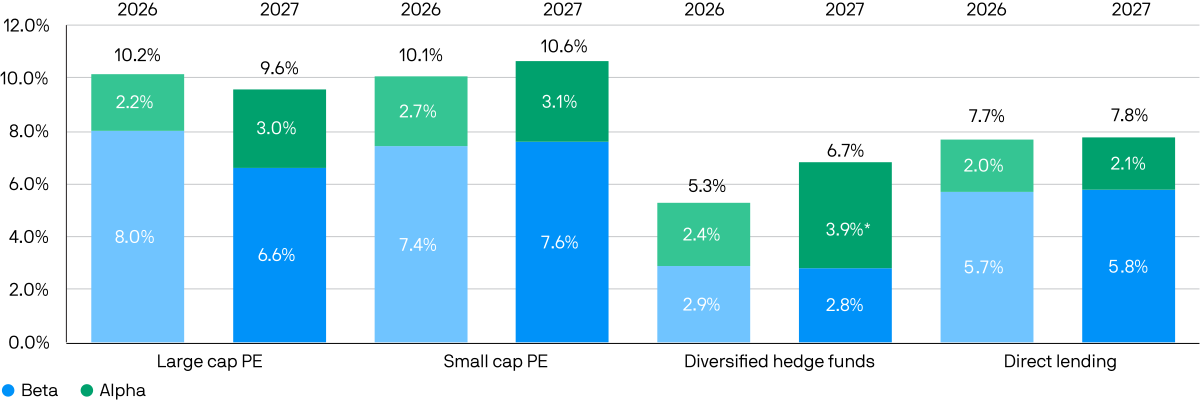
Source: J.P. Morgan Asset Management; data as of September 30, 2026. Alpha is defined as the intercept (or, in the case of private equity, the sum of the intercepts), except for direct lending, where alpha is defined as the excess return over the expected leveraged loan spread.
* The alpha boost seen in hedge fund returns comes in part from methodology enhancements this year.
Portfolio Implications Assumptions
How intentional thematic exposure can build portfolio resilience
Relative winners and losers vary across themes
Asset market impacts of themes
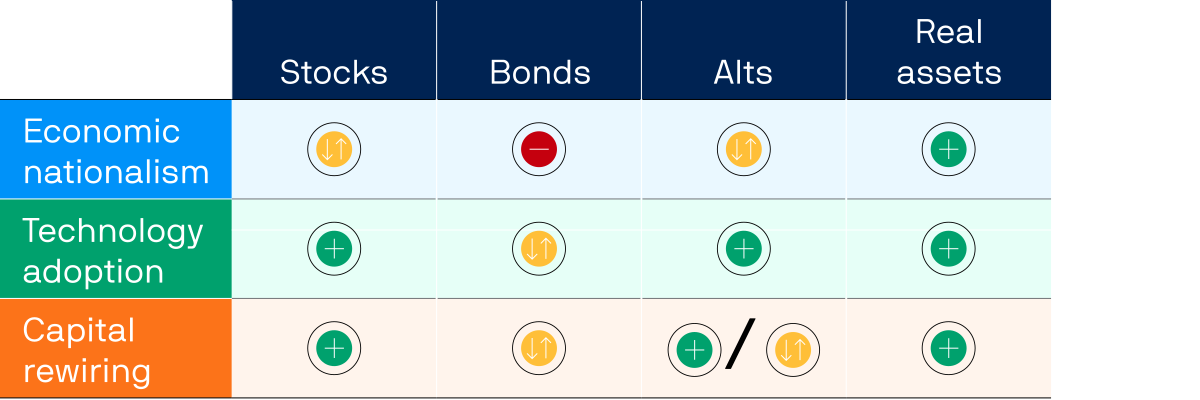
Source: J.P. Morgan Asset Management; data as of September 30, 2026.
Download this year's Long Term Capital Market Assumptions report

Frequently asked questions
J.P. Morgan Asset Management’s annual LTCMAs provide return, risk and correlation forecasts for more than 200 major asset classes in 20-plus base currencies, over a 10- to 15-year horizon. Our LTCMAs represent the work of more than 90 of our researchers, portfolio managers and economists worldwide, using a process refined over 31 years. A publication expands on the data, analyzing trends and themes.
Designed to help pave the way to stronger portfolios, these forecasts drive J.P. Morgan Asset Management’s strategic asset allocations and power the tools we use to advise clients. They help asset allocators, financial advisors and others build portfolios, evaluate trade-offs and stress-test performance against objectives, in pursuit of their long-term goals.
We center the 2027 edition on three forces with durable implications: Economic nationalism (governments’ more domestically oriented posture); faster diffusion of technological innovation (tech adoption) and the reconfiguration of how and where public and private funds are deployed (capital rewiring). These reshape returns’ level and dispersion across regions, sectors and asset classes. With a global capex boom, they support higher growth while creating more inflation volatility.
Resilient economies support resilient markets, but with wider outcomes – raising the rewards for thoughtful diversification.
We forecast a rise in long-term returns from a balanced-plus portfolio – including alternative assets. We expect faster economic growth to boost profits and yields, lifting a balanced portfolio’s long-run returns from last year’s forecast. In equities, U.S. profit margins are more resilient than emerging markets’. In fixed income, higher real yields improve the case for government bonds, while an “up in quality” mindset and tighter spread assumptions improve our corporate credit forecast.
Higher inflation volatility, ongoing risk of currency debasement and growing opportunities to capture active alpha reinforce alternatives as essential diversifiers and potential return drivers.
We believe AI will drive a meaningful, durable uplift to productivity over 10 to 15 years. Improved productivity is the main force returning U.S. GDP growth to a faster pace over a decade. AI diffusion and the resulting productivity boost will likely be gradual, most significant in the 2030s and beyond. This is vital to our 2027 forecast. Steady uptake should limit rapid, economy-wide job displacement while giving supply chains time to adapt.
For more than three decades, we’ve gathered 90-plus industry-leading portfolio managers, economists and research analysts on three continents, led by John Bilton, Global Head of Strategic Research, Multi-Asset Solutions. Authors and leadership team members include Dr. David Kelly, Chief Global Strategist; Karen Ward, Chief Market Strategist in EMEA; Tai Hui, Chief Market Strategist in Asia; Gabriela Santos, Chief Market Strategist for the Americas, Pulkit Sharma, Head of Alternatives Investment Strategy & Solutions and David Lebovitz, Head of Alternatives Research and Strategy.
58fa1f96-c36b-11f1-a9f3-d1e9c787777c