logo
  • My collections
    View saved content and presentation slides
  • Logout
  • Products

      Funds

      • Performance & Yields
      • Liquidity
      • Ultra-Short
      • Short Duration
      • European domiciled products

      Solutions

      • Cash Strategies
      • Cash Segmentation
      • Separately Managed Accounts
      • Managed Reserves Strategy

      Fund Information

      • Regulatory Updates
    • Insights

        Liquidity Insights

        • Liquidity Insights Overview
        • Global Liquidity Investment Outlook

          Global Liquidity Investment Outlook

        • Tokenization

          Explore the full whitepaper to learn how tokenized MMFs can transform your approach to cash management and position your organization at the forefront of digital finance.

        • Cash Cookbook

          The Cash Cookbook, your guide to cash and liquidity management success, helps you choose the right liquidity solution for your needs and risk tolerance.

        • Case Studies

          Read about companies with specific cash management challenges and the solutions when they worked with J.P. Morgan Asset Management.

        • Partnership with fintechs

          A focus on digital innovation and institutional liquidity solutions drive our dynamic partnership with fintech.

        • ESG Resources for Liquidity Investors

          We’ve created a clear, rigorous ESG process meets the many needs of liquidity investors.

        • Leveraging the Power of Cash Segmentation

          The most effective strategy incorporates a clear investment policy, well-defined goals and parameters for liquidity, quality and return.

        • Cash Investment Policy Statement

          How to write an investment policy statement for your organization

        Market Insights

        • Market Insights Overview
        • Eye on the Market

          Explore Eye on the Market, timely commentary that offers views on the economy, markets, and investment portfolios by Michael Cembalest.

        • Guide to the Markets

          The J.P. Morgan Guide to the Markets illustrates a comprehensive array of market and economic histories, trends and statistics through clear charts and graphs.

        • Market Updates

          Read our weekly commentaries to get market insights that may help inform your investment strategy.

        Portfolio Insights

        • Portfolio Insights Overview
        • Currency

          Our currency team provides solutions for clients, controlling risk using passive management strategies and generating returns by actively managing global currencies.

        • Fixed Income

          A complex mix of monetary, credit and fiscal forces is changing the bond landscape. Discover how flexible fixed income approaches can seek returns, income and resilience.

        • Long-Term Capital Market Assumptions

          Our Long-Term Capital Market Assumptions (LTCMAs) deliver forward-looking return, volatility and correlation estimates for 200+ asset and strategy classes in 20+ base currencies.

        • Sustainable investing

          We believe that ESG considerations can play a critical role in a long-term investment strategy.

        • Strategic Investment Advisory Group

          The Strategic Investment Advisory Group approaches today’s investment challenges with a global view across asset classes.

      • Resources
          • Overview
          • MORGAN MONEY
          • Account Management & Trading
          • Global Liquidity Investment Academy
          • Announcements
        • About us

            About us

            Backed by $4.6T in assets, we harness our active edge to deliver timely ideas and actionable insights that empower investors to achieve what matters most.

            • Overview
            • Diversity, Opportunity & Inclusion
            • Spectrum: Our Investment Platform
            • Our Leadership Team
            • Our Commitment to Research
          • Contact us
          • English
          • MORGAN MONEY LOGIN
            • My collections
              View saved content and presentation slides
            • Logout
          • Log in
          • MORGAN MONEY LOGIN
          Log in
          You are about to leave the site Close
          J.P. Morgan Asset Management’s website and/or mobile terms, privacy and security policies don't apply to the site or app you're about to visit. Please review its terms, privacy and security policies to see how they apply to you. J.P. Morgan Asset Management isn’t responsible for (and doesn't provide) any products, services or content at this third-party site or app, except for products and services that explicitly carry the J.P. Morgan Asset Management name.
          CONTINUE Go Back
          1. The epicenter of optimism

          • LinkedIn Twitter Facebook WhatsApp

          The epicenter of optimism

          23-03-2017

          Andrew Norelli

          Today I’m sharing just a short note to highlight one fascinating chart that in my view encapsulates the macro narrative thematically all by itself. Credit to my colleague David Tan for featuring it amongst the hundred or so charts we studied during last week’s GFICC Investment Quarterly (IQ) meeting.

          Broadly speaking, we know the so-called “soft” data is looking up – that is, surveys of sentiment, business conditions, outlook, and measures of intent are all showing very encouraging positive readings. And we also know the “hard” data – that is, live measures of output, spending, and investment, have yet to definitely turn higher. If anything, Q1 2017 GDP in the U.S. is likely to read optically quite low (sub-2%) for a variety of arcane reasons. And yet, equities are at all-time highs, credit spreads are close to multi-year tights, and the interest rate market is signaling green shoots of “normalization” for the first time since the old normal. It feels like all of this is built on a big stack of optimism, and as long as we’re waiting for policy changes to arrive, there is no more to the foundation than hope. Notwithstanding our view that real policy changes are coming on taxes, regulation, and fiscal stimulus, it is also our view that the optimism itself is significant enough to materially improve the near-term prospects for growth.
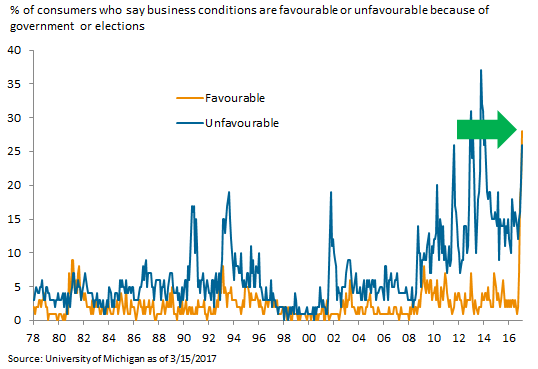
          The illustrated chart depicts a subset of the University of Michigan Consumer survey, where respondents cite “government” or “elections” as justification for their opinions on business conditions. This is the essence of soft data; it’s a survey, and it’s qualitative. But to say it’s turning up is an understatement. There has been a once-in-a-generation shift in the perceived relationship between government and business. Perhaps it’s obvious, but this is the sentiment shift which is driving all other sentiment shifts.

          It’s well understood that small businesses and startups are a potentially significant driver of job creation and incremental growth in the U.S.[1] , and that entrepreneurship cratered during the financial crisis. It has not bounced back. And yet, this chart depicts something extraordinary. For the first time in the 40-year history of the time series, a meaningful percentage of consumers feel that business conditions are favorable because of the government. Sure, there has been a spike in those viewing conditions unfavorably, but that statistic is no worse than it was during the Obama administration, and some level of pessimism seems rather typical. What’s atypical is government-derived optimism. The magnitude of the consumer optimism exceeds the next closest period by a factor of three. To boot, the participants in this survey are typical U.S. consumers, the same pool of people the economy draws upon for small business and startup entrepreneurship.

          This extraordinary shift in the outlook encapsulates the significance of the 2016 election for the U.S. economy. The economy, after all, is made up of individuals, and the risk tolerance of a large constituency is almost certainly improving with this shift view of the government. By extension, so too is the likelihood they will form businesses that create jobs, and add new value to our economy. Growth derived from the grassroots level, as opposed to the corporate behemoth level, is not dependent on closing the yawning manufacturing competitiveness gap nor is it dependent on reversing the trend toward automation. On the contrary, diverse entrepreneurship can exploit these realities as strengths.

          [1] https://www.washingtonpost.com/news/on-small-business/wp/2015/02/12/the-decline-of-american-entrepreneurship-in-five-charts/?utm_term=.876b355a2d7e

          • Market Views
          • Economic Outlook

          RELATED ARTICLES

          FOMC statement & potential impact on fixed income

          Following the Fed's announcement, find our latest market views from the Global Fixed Income, Currency & Commodities Team (GFICC).

          Read more

          FOMC statement & potential impact on fixed income

          Following the Fed's announcement, find our latest market views from the Global Fixed Income, Currency & Commodities Team (GFICC).

          Read more

          FOMC statement & potential impact on fixed income

          Following the Fed's announcement, find our latest market views from the Global Fixed Income, Currency & Commodities Team (GFICC).

          Read more