


J.P. Morgan active fixed income ETFs
Gain diversified fixed income access with one of the world’s leading active fixed income ETF managers and choose from a broad range of active strategies covering government bond, credit and emerging market debt.
This vastness brings complexity. Bond markets are fragmented, opaque, and dominated by benchmarks that leave out large parts of the investable universe. Navigating them requires research, skill and flexibility – all reasons why active management has long been the preferred approach for fixed income investors.
Today, active management has a dynamic new home in the ETF wrapper, where professional insight combines with structural efficiency to make active fixed income investing more flexible, transparent and cost-effective than ever before.*
Here are six reasons why fixed income works harder with active ETFs.
Freedom to go beyond benchmarks
Fair costs for all
Keep more of what you earn
Liquidity when it matters most
Price discovery in real time
Know what you own
Active ETFs: Fixed income at its fullest
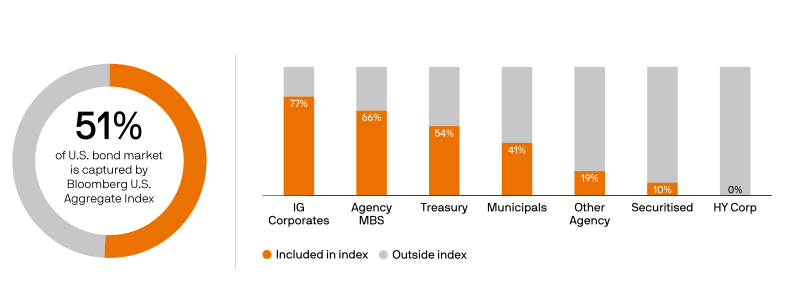
Bond indices can be blunt instruments: useful for broader exposure, but limiting when sharper tools are required. The Bloomberg US Aggregate Index, for example, excludes 49% of the $57.5 trillion US bond market, omitting areas such as non-agency mortgagebacked securities, high yield bonds, and leveraged loans. That leaves close to $28 trillion of assets outside the benchmark – markets where investment opportunities can be found.
Even within the index, rules-based construction has drawbacks. Market-value weighting means the most indebted issuers dominate portfolio allocations, regardless of credit quality. Passive ETFs tied to these benchmarks can therefore become concentrated in riskier borrowers and miss out on diversification. Active fixed income ETFs have the freedom to offer greater flexibility. Managers can rotate across sectors, adjust duration and credit risk as conditions change, and target spread opportunities in overlooked segments.
Active fixed income ETFs let managers reach well beyond the constraints of a benchmark. The ETF wrapper makes that flexibility easy for investors to access in a single, efficient trade.
Source: Bank of America, Bloomberg, SIFMA, J.P. Morgan Asset Management. The investable universe for Treasuries, municipals and other agency securities are sourced from SIFMA and reflect par value outstanding. The investable universe for agency MBS, CMBS, CMOs, CLOs, CDOs, ABS, investment grade corporates and high yield corporates are sourced from Bank of America and reflect market value outstanding. Treasuries include outstanding bills, bonds and notes. Agency MBS includes MBS, CMBS, and CMOs. Securitized includes ABS, CLOs, CDOs, non-agency CMBS and non-agency RMBS. Sector classifications for constituents in the Bloomberg U.S. Aggregate are based on classifications provided by Bloomberg. *Due to the exclusion of tax-free municipals from the Bloomberg U.S. Aggregate, municipals index representation is based on the Bloomberg Municipal Bond Index. U.S. Data are as of June 30, 2025.
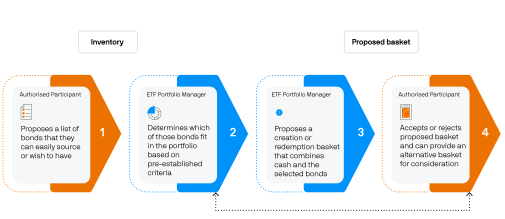
ETFs are designed so that the costs associated with trading are borne only by the investor who is buying or selling those ETF shares. If new ETF shares are created, this can happen “in-kind”, which means a basket of underlying securities, such as bonds, is delivered directly to the ETF by an authorised participant (AP), in return for new ETF shares. Similarly, when ETF shares are redeemed, the AP delivers ETF shares to the ETF in return for a basket of securities. If cash is delivered instead of securities, a fee is applied by the ETF to the AP, who in turn passes it on to the investor to cover the cost of purchasing new securities, or for selling the necessary securities.
This open-ended structure means that the ETF’s manager doesn’t have to trade securities to meet underlying demand for shares, and the ETF’s net asset value (NAV) is not diluted by trading activity. Instead, the costs of entering or exiting an ETF are paid solely by the investor transacting, rather than being shared across all shareholders.
Active ETF managers can also use the in-kind creation and redemption process to manage portfolio turnover strategically, allowing them to add or subtract securities to an ETF only when it aligns with the manager’s strategy, and without incurring trading costs in the open market. The performance of active fixed income ETFs will therefore reflect the active decisions of the ETF’s portfolio manager, rather than being diluted by the cash flows of other shareholders.
ETFs can reduce the total cost of owning fixed income exposure, starting with execution. Trading individual bonds can be operationally expensive and inefficient, with wide bid–ask spreads and limited price transparency. By pooling demand on exchange, ETFs often trade at much tighter spreads, helping active fixed income managers implement their investment strategy at lower cost.
The structural costs of ETF ownership are also typically low. ETFs generally carry low expense ratios, meaning less of a portfolio’s income is paid away in fees. Over time, even small differences in annual charges compound, leaving a larger share of returns in the hands of investors.
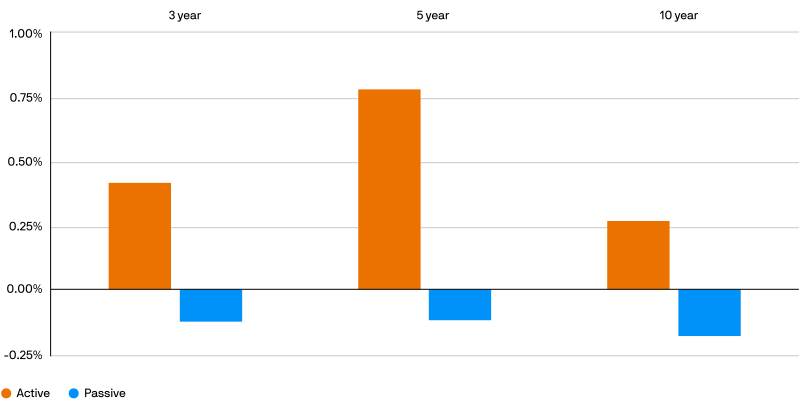
ETF investors retain more of the return generated by the portfolio, while active managers can focus on delivering excess return without costs diminishing the benefit of their positioning. The results are clear: looking at global aggregate bond ETFs, we can see that active managers have produced consistent average excess annualised returns compared to the Bloomberg Global Aggregate Index, and have significantly outperformed their passive peers over time, net of fees.
Average excess annualized returns over the Bloomberg Global Aggregate Bond Index
Source: Morningstar, J.P. Morgan Asset Management. Past performance is not a reliable indicator of current and future results. This information is for illustrative purposes only, does not reflect actual investment results, is not a guarantee of future results and is not a recommendation to buy or sell. The chart above reflects performance of all funds managed against Bloomberg Global Aggregate Index (LEGATRUU/LEGATRUH). Data as of 30 September 2025. The Bloomberg Global Aggregate Index is a flagship measure of global investment grade debt from a multitude local currency markets. This multi-currency benchmark includes treasury, government-related, corporate and securitized fixed-rate bonds from both developed and emerging markets issuers.
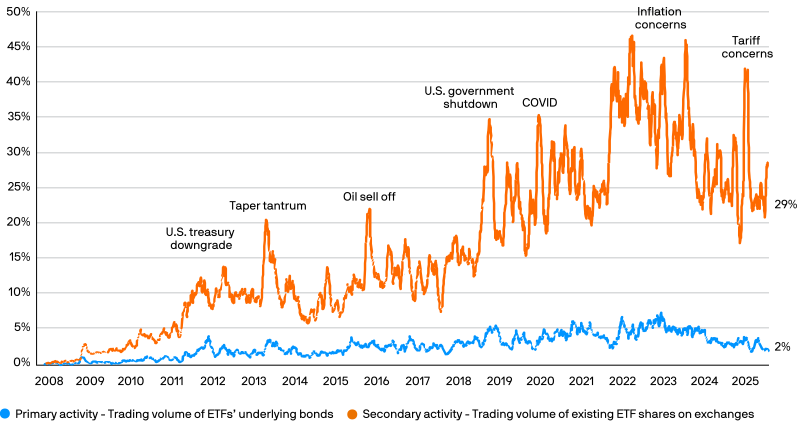
Liquidity in bond markets can weaken significantly in periods of market stress. Active fixed income ETFs mitigate this issue by providing two important additional layers of liquidity. In the secondary market, where most trades occur, investors can trade ETF shares throughout the day at live, transparent prices. In the primary market, authorised participants can create or redeem shares to meet demand, adding another layer of liquidity.
This structure has repeatedly proved its worth in recent years. During the inflation-driven bond market volatility of 2022 and 2023, for example, high-yield ETFs accounted for less than 10% of the bond market’s assets, yet their secondary market trading made up nearly half of all trading in the US high-yield bond market.
In other words, investors often chose the ETF as the easier and more efficient wrapper for high yield bond transactions than the bonds themselves.
Fixed income ETFs can concentrate and release liquidity at times when the bond market itself is harder to access. Because ETF portfolios can be adjusted by accessing the secondary market, an active ETF manager doesn’t need to buy or sell underlying bonds in the primary market. Active ETF managers can therefore avoid unnecessary turnover in the primary market and benefit from resilient trading of ETF shares, even during times of elevated market stress.
Share (%) of 20-day rolling average trading volume of overall high yield bond market
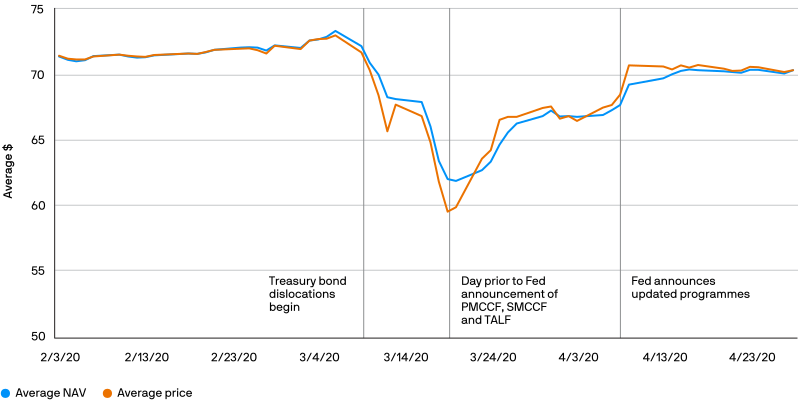
Because ETFs trade continuously throughout the trading day, their market prices serve as a live signal of where bonds are valued. This real-time price discovery can be a valuable input for navigating volatility and identifying opportunities, and provides greater clarity in assessing live market conditions, particularly in less liquid sectors.
During the COVID-19 turmoil, for example, a Bank for International Settlements study found that ETF prices responded more quickly and precisely to new information than NAVs. Market pricing is often the most accurate reflection of value, even if an ETF’s price appears as a premium or discount, typically because the NAV is stale or lagging.
The ability to observe real-time prices gives investors a timelier, more accurate read on bond values. For active managers, it provides clearer signals of when and where to act.
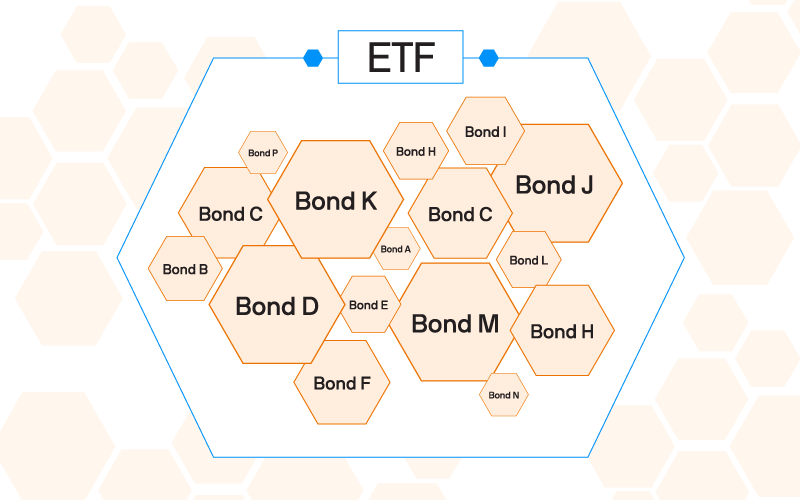
Transparency and accessibility are two of the clearest benefits of the ETF wrapper. As most ETFs publish their portfolios daily, investors can see exactly what they own, understand which positions are driving returns, and gain confidence in how their money is being managed. It also makes performance attribution easier, helping clients connect outcomes to portfolio decisions in real time.
Accessibility is just as important. With no high minimum investments – just a brokerage account and the price of a single share – ETFs open professionally managed active fixed income strategies to a far wider audience. A single ETF share provides exposure to a portfolio run by experienced bond managers.
ETF investors gain visibility and access to markets that were once reserved for institutions, while active managers demonstrate accountability every day through their positioning and results.
After one of the sharpest tightening cycles in decades, interest rates are stabilising. But the path ahead is uncertain. Yield curves are distorted, credit risks are diverging, and liquidity conditions can quickly shift.
This is exactly when active bond managers can add value: adjusting exposures, seeking overlooked opportunities, and managing risks with greater flexibility than passive vehicles. The ETF wrapper amplifies those active advantages by allocating costs fairly, reducing expenses, providing resilient liquidity, and by delivering real-time price signals and daily transparency.
Active fixed income ETFs package up active judgement in a highly efficient, transparent way, helping investors go beyond benchmarks, preserve more return, and position portfolios for whatever comes next.
The message is clear: fixed income works harder with active ETFs.
J.P. Morgan active fixed income ETFs
Gain diversified fixed income access with one of the world’s leading active fixed income ETF managers and choose from a broad range of active strategies covering government bond, credit and emerging market debt.

For Professional Clients / Qualified Investors only – not for Retail use or distribution.
The products mentioned in this document have been registered for public distribution in certain jurisdictions, which may include EEA countries, Switzerland and the UK. Certain share classes may not be authorised or their offering may be restricted in your jurisdiction. It is each investor's responsibility to ensure compliance with local laws and regulations. Please contact your J.P. Morgan Asset Management representative or refer to the latest available Prospectus, the Key Information Document (KID) and any applicable local offering document for further information. Prior to investing in a product, investors are advised to take all necessary legal, regulatory and tax advice on the consequences of an investment in the products. Shares or other interests may not be offered to or purchased directly or indirectly by US persons. All transactions should be based on the latest available Prospectus, KID and any applicable local offering document. These documents together with the annual report, semi-annual report, instrument of incorporation and sustainability-related disclosures, are available in English from JPMorgan Asset Management (Europe) S.à r.l., 6 route de Trèves, L-2633 Senningerberg, Grand Duchy of Luxembourg, your financial adviser or your J.P. Morgan Asset Management regional contact or at www.jpmorganassetmanagement.ie. A summary of investor rights is available in English at https://am.jpmorgan.com/lu/investor-rights. J.P. Morgan Asset Management may decide to terminate the arrangements made for the marketing of its collective investment undertakings. Units in Undertakings for Collective Investment in Transferable Securities (“UCITS”) Exchange Traded Funds (“ETF”) purchased on the secondary market cannot usually be sold directly back to UCITS ETF. Investors must buy and sell units on a secondary market with the assistance of an intermediary (e.g. a stockbroker) and may incur fees for doing so. In addition, investors may pay more than the current net asset value when buying units and may receive less than the current net asset value when selling them. This is a marketing communication and as such the views contained herein do not form part of an offer, nor are they to be taken as advice or a recommendation, to buy or sell any investment or interest thereto. Reliance upon information in this material is at the sole discretion of the reader. Any research in this document has been obtained and may have been acted upon by J.P. Morgan Asset Management for its own purpose. The results of such research are being made available as additional information and do not necessarily reflect the views of J.P. Morgan Asset Management. Any forecasts, figures, opinions, statements of financial market trends or investment techniques and strategies expressed are, unless otherwise stated, J.P. Morgan Asset Management’s own at the date of this document. They may not necessarily be all-inclusive and may be subject to change without reference or notification to you. The value of investments and the income from them may fluctuate in accordance with market conditions and taxation agreements and investors may not get back the full amount invested. Changes in exchange rates may have an adverse effect on the value, price or income of the products or underlying overseas investments. Past performance and yield are not a reliable indicator of current and future results. There is no guarantee that any forecast made will come to pass. Furthermore, there can be no assurance that the investment objectives of the investment products will be met. J.P. Morgan Asset Management is the brand name for the asset management business of JPMorgan Chase & Co. and its affiliates worldwide. To the extent permitted by applicable law, we may record telephone calls and monitor electronic communications to comply with our legal and regulatory obligations and internal policies. Personal data will be collected, stored and processed by J.P. Morgan Asset Management in accordance with our EMEA Privacy Policy www.jpmorgan.com/emea-privacy-policy. In Switzerland, JPMorgan Asset Management Switzerland LLC (JPMAMS), Dreikönigstrasse 37, 8002 Zurich, acts as Swiss representative of the funds and J.P. Morgan (Suisse) SA, Rue du Rhône 35, 1204 Geneva, as paying agent. With respect to its distribution activities in and from Switzerland, JPMAMS receives remuneration which is paid out of the management fee as defined in the respective fund documentation. Further information regarding this remuneration, including its calculation method, may be obtained upon written request from JPMAMS. This communication is issued in Europe (excluding UK) by JPMorgan Asset Management (Europe) S.à r.l., 6 route de Trèves, L-2633 Senningerberg, Grand Duchy of Luxembourg, R.C.S. Luxembourg B27900, corporate capital EUR 10.000.000. This communication is issued in the UK by JPMorgan Asset Management (UK) Limited, which is authorised and regulated by the Financial Conduct Authority. Registered in England No. 01161446. Registered address: 25 Bank Street, Canary Wharf, London E14 5JP. For UK only: Sustainability-related terms in this communication follow J.P Morgan Asset Management’s methodologies and application of the EU Sustainable Finance Disclosure Regulation, not the UK Sustainability Disclosure Requirements and investment labels regime. The product is authorised overseas, but not in the UK. The UK Financial Ombudsman Service is unlikely to be able to consider any related complaints and any claims for losses are unlikely to be covered under the UK compensation scheme.
*Source: Bloomberg. Data as of 31 October 2025.
80667493-a5e4-11f0-b24e-21e58b19ac4f