

logo
  • My collections
    View saved content and presentation slides
  • Log out
  • Products

      Funds

      • Performance & Yields
      • Liquidity
      • Ultra-Short
      • Short Duration
      • European domiciled products

      Solutions

      • Cash Strategies
      • Cash Segmentation
      • Separately Managed Accounts
      • Managed Reserves Strategy

      Fund Information

      • Regulatory Updates
    • Insights

        Liquidity Insights

        • Liquidity Insights Overview
        • Global Liquidity Investment Outlook

          Global Liquidity Investment Outlook

        • Tokenization

          Explore the full whitepaper to learn how tokenized MMFs can transform your approach to cash management and position your organization at the forefront of digital finance.

        • Cash Cookbook

          The Cash Cookbook, your guide to cash and liquidity management success, helps you choose the right liquidity solution for your needs and risk tolerance.

        • Case Studies

          Read about companies with specific cash management challenges and the solutions when they worked with J.P. Morgan Asset Management.

        • Partnership with fintechs

          A focus on digital innovation and institutional liquidity solutions drive our dynamic partnership with fintech.

        • ESG Resources for Liquidity Investors

          We’ve created a clear, rigorous ESG process meets the many needs of liquidity investors.

        • Leveraging the Power of Cash Segmentation

          The most effective strategy incorporates a clear investment policy, well-defined goals and parameters for liquidity, quality and return.

        • Cash Investment Policy Statement

          How to write an investment policy statement for your organization

        Market Insights

        • Market Insights Overview
        • Eye on the Market

          Explore Eye on the Market, timely commentary that offers views on the economy, markets, and investment portfolios by Michael Cembalest.

        • Guide to the Markets

          The J.P. Morgan Guide to the Markets illustrates a comprehensive array of market and economic histories, trends and statistics through clear charts and graphs.

        • Market Updates

          Read our weekly commentaries to get market insights that may help inform your investment strategy.

        • Podcast: Markets Explained

          Signal or noise? In this weekly podcast, Karen and Hugh digest the newsflow in an increasingly tumultuous world and work out what it means for global investors.

        Portfolio Insights

        • Portfolio Insights Overview
        • Currency

          Our currency team provides solutions for clients, controlling risk using passive management strategies and generating returns by actively managing global currencies.

        • Fixed Income

          A complex mix of monetary, credit and fiscal forces is changing the bond landscape. Discover how flexible fixed income approaches can seek returns, income and resilience.

        • Long-Term Capital Market Assumptions

          Our Long-Term Capital Market Assumptions (LTCMAs) deliver forward-looking return, volatility and correlation estimates for 200+ asset and strategy classes in 20+ base currencies.

        • Sustainable investing

          We believe that ESG considerations can play a critical role in a long-term investment strategy.

        • Strategic Investment Advisory Group

          The Strategic Investment Advisory Group approaches today’s investment challenges with a global view across asset classes.

      • Resources
          • Overview
          • MORGAN MONEY
          • Account Management & Trading
          • Global Liquidity Investment Academy
          • Announcements
        • About us

            About us

            Backed by $4.6T in assets, we harness our active edge to deliver timely ideas and actionable insights that empower investors to achieve what matters most.

            • Overview
            • Diversity, Opportunity & Inclusion
            • Spectrum: Our Investment Platform
            • Our Leadership Team
            • Our Commitment to Research
          • Contact us
          • English
          • MORGAN MONEY LOGIN
            • My collections
              View saved content and presentation slides
            • Log out
          • Log in
          • MORGAN MONEY LOGIN
          Log in
          You are about to leave the site Close
          J.P. Morgan Asset Management’s website and/or mobile terms, privacy and security policies don't apply to the site or app you're about to visit. Please review its terms, privacy and security policies to see how they apply to you. J.P. Morgan Asset Management isn’t responsible for (and doesn't provide) any products, services or content at this third-party site or app, except for products and services that explicitly carry the J.P. Morgan Asset Management name.
          CONTINUE Go Back
          Liquidity Insights

          Persistent Inflation Drives RBA Pivot

          AS
          Aidan Shevlin

          Head of International Liquidity Fund Management

          Published: 04-02-2026

          In brief

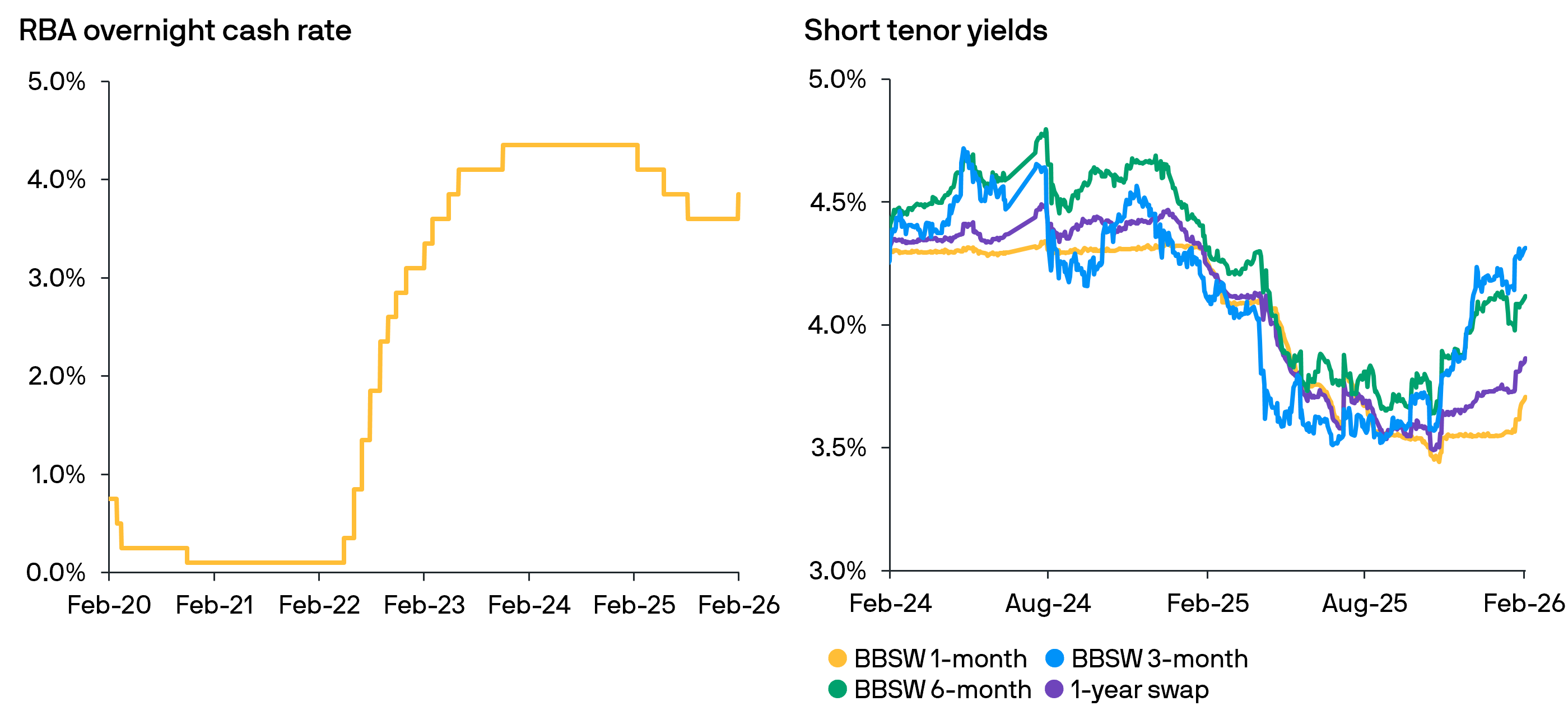
          • At its first policy meeting of 2026, the RBA ended its rate pause and raised the cash rate by 25bps to 3.85%, due to persistent and broad-based inflation pressures.
          • Stronger-than-expected private demand and a tight labour market triggered the hawkish pivot, signalling mounting capacity constraints.
          • The RBA reiterated its data-dependent stance and indicated that further tightening was possible if inflation remains above target.
          • Renewed rate hikes are positive for cash investors, presenting higher yields and a steeper yield curve, with ongoing uncertainty reinforcing the importance for diversification.


          RBA Hikes Rates as Inflation Proves Persistent 

          At its first meeting of 2026, the Reserve Bank of Australia (RBA) ended its policy pause, hiking the cash rate target by 25bps to 3.85%. This move marks the bank’s first rate hike just six months after it finished its shallow rate-cutting cycle in August 2025. The widely expected decision highlights the RBA’s growing unease about persistent inflation pressures. There is also concern that capacity constraints in the economy could keep price growth “above its 2-3% target range for some time”.

          The accompanying statement bluntly confirmed that inflation had “picked up materially in the second half of 2025”. The RBA attributes this mainly to stronger-than-expected momentum in private demand, both household spending and business investment. Financial conditions had eased through 2025, and credit remained readily available. With that, the central bank also highlighted it is “uncertain that interest rate remain restrictive”.  The decision to hike was unanimous. This restores credibility and reflects a shift toward a more hawkish stance in the face of mounting evidence that the economy is running hotter than anticipated.

          In the subsequent press conference, RBA Governor Bullock struck a hawkish tone, confirming the bank was “uncomfortable with the current inflation level”. She stated the hike was triggered by fears that they “cannot allow inflation to get away from us again”.

          Fig 1:  The RBA hiked rates for the first time since 2023;  BBSW yields have climbed sharply recently in anticipation of rate hikes. 
           

          Source: RBA, Bloomberg and J.P. Morgan Asset Management; data as at 3rd February 2026.


          Growth Momentum Surprises and Inflation Risks Tilted to the Upside

          The RBA’s latest move marks a clear shift in policy thinking. By mid-2025, the Board adopted a cautiously optimistic outlook. Activity was recovering, private demand was improving, and the labour market was easing slightly. However, as the year went on, data revealed a more persistent inflation problem. By December, the RBA was already expressing discomfort with underlying prices and noted “signs of a more broadly based pick-up.”

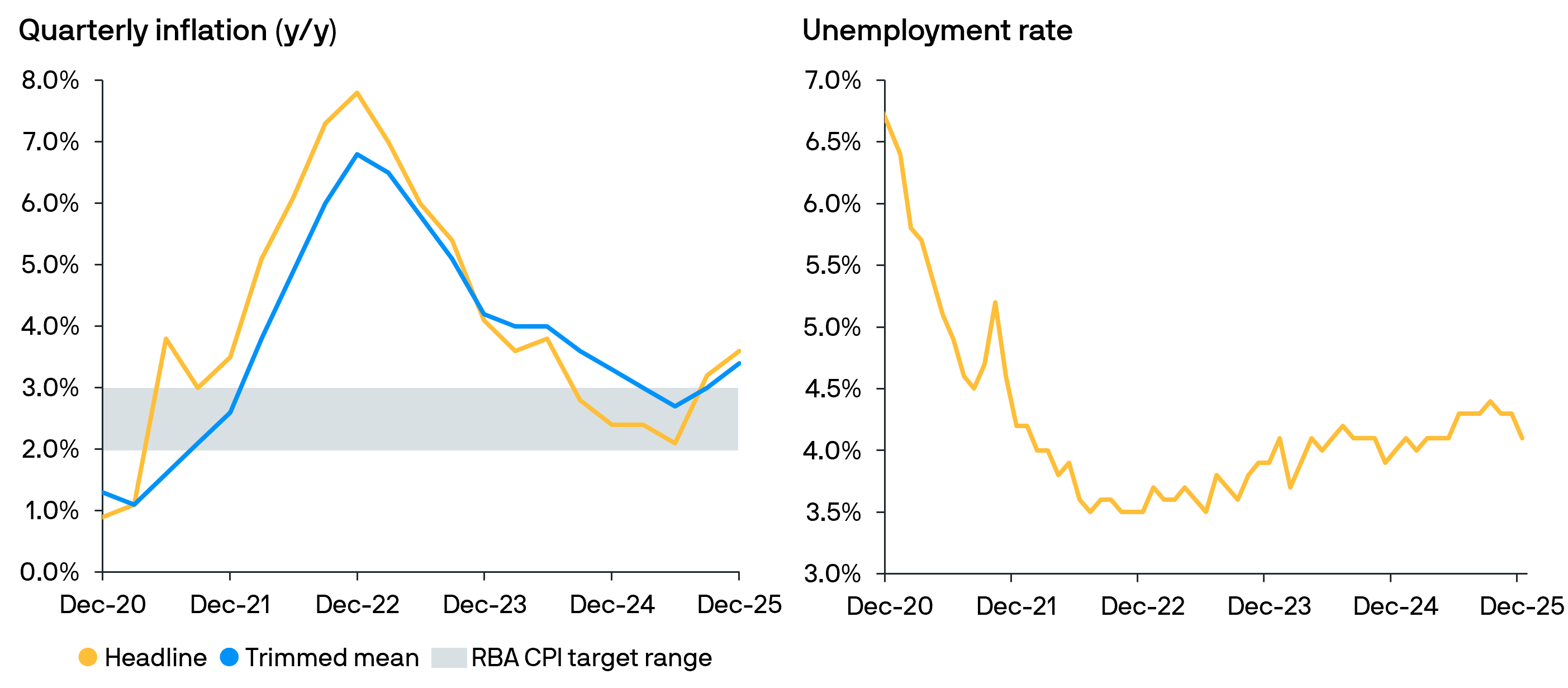
          The February decision confirms these concerns have intensified, with the central bank acknowledging that “inflationary pressures picked up materially in the second half”. Private demand has strengthened “substantially more than expected,” with both consumption and investment driving growth. The housing market remains hot, and credit conditions are supportive. Labour market conditions are still “a little tight,” with unemployment lower than expected and wage growth strong. With inflation risks tilted to the upside, the RBA was forced to act, citing concerns that “inflation is likely to remain above target for some time.”

          Fig 2:  Headline and core inflation remain above the RBA target range; low unemployment hints at capacity constraints. 


          Source: Bloomberg and J.P. Morgan Asset Management; data as at 3rd February 2026.


          RBA Setting a New Course

          With this rate hike, the RBA signals a new phase in its policy cycle, shifting from a “wait and see” approach to a more proactive stance to contain inflation. The Board restated it remains data-dependent, considering the evolving outlook for inflation, growth, and the labour market.  However, its hawkish tone confirms the risk now is that inflation expectations remain elevated, necessitating additional policy action.  Conversely, if price pressures ease and growth slows, this hike could be a one-off risk management move. This would help curb inflation and allow a return to a more neutral stance.

          For AUD cash investors, the RBA’s hike—making it the first major central bank to tighten—is welcome news. Overnight deposit rates will rise, and the yield curve has steepened in anticipation of further moves. However, given ongoing uncertainty, we continue to stress the importance of caution. Diversification across maturities and instruments remains key to achieve optimal risk-adjusted returns.

          Diversification does not guarantee investment returns and does not eliminate the risk of loss.
          This information is generic in nature provided to illustrate macro trends based on current market conditions that are subject to change from time to time. This generic information does not take into account any investor’s specific circumstances or objectives and should not be construed as offer, research or investment advice.