
logo
  • My collections
    View saved content and presentation slides
  • Log out
  • Products

      Funds

      • Performance & Yields
      • Liquidity
      • Ultra-Short
      • Short Duration
      • European domiciled products

      Solutions

      • Cash Strategies
      • Cash Segmentation
      • Separately Managed Accounts
      • Managed Reserves Strategy

      Fund Information

      • Regulatory Updates
    • Insights

        Liquidity Insights

        • Liquidity Insights Overview
        • Global Liquidity Investment Outlook

          Global Liquidity Investment Outlook

        • Tokenization

          Explore the full whitepaper to learn how tokenized MMFs can transform your approach to cash management and position your organization at the forefront of digital finance.

        • Cash Cookbook

          The Cash Cookbook, your guide to cash and liquidity management success, helps you choose the right liquidity solution for your needs and risk tolerance.

        • Case Studies

          Read about companies with specific cash management challenges and the solutions when they worked with J.P. Morgan Asset Management.

        • Partnership with fintechs

          A focus on digital innovation and institutional liquidity solutions drive our dynamic partnership with fintech.

        • ESG Resources for Liquidity Investors

          We’ve created a clear, rigorous ESG process meets the many needs of liquidity investors.

        • Leveraging the Power of Cash Segmentation

          The most effective strategy incorporates a clear investment policy, well-defined goals and parameters for liquidity, quality and return.

        • Cash Investment Policy Statement

          How to write an investment policy statement for your organization

        Market Insights

        • Market Insights Overview
        • Eye on the Market

          Explore Eye on the Market, timely commentary that offers views on the economy, markets, and investment portfolios by Michael Cembalest.

        • Guide to the Markets

          The J.P. Morgan Guide to the Markets illustrates a comprehensive array of market and economic histories, trends and statistics through clear charts and graphs.

        • Market Updates

          Read our weekly commentaries to get market insights that may help inform your investment strategy.

        • Podcast: Markets Explained

          Signal or noise? In this weekly podcast, Karen and Hugh digest the newsflow in an increasingly tumultuous world and work out what it means for global investors.

        Portfolio Insights

        • Portfolio Insights Overview
        • Currency

          Our currency team provides solutions for clients, controlling risk using passive management strategies and generating returns by actively managing global currencies.

        • Fixed Income

          A complex mix of monetary, credit and fiscal forces is changing the bond landscape. Discover how flexible fixed income approaches can seek returns, income and resilience.

        • Long-Term Capital Market Assumptions

          Our Long-Term Capital Market Assumptions (LTCMAs) deliver forward-looking return, volatility and correlation estimates for 200+ asset and strategy classes in 20+ base currencies.

        • Sustainable investing

          We believe that ESG considerations can play a critical role in a long-term investment strategy.

        • Strategic Investment Advisory Group

          The Strategic Investment Advisory Group approaches today’s investment challenges with a global view across asset classes.

      • Resources
          • Overview
          • MORGAN MONEY
          • Account Management & Trading
          • Global Liquidity Investment Academy
          • Announcements
        • About us

            About us

            Backed by $4.6T in assets, we harness our active edge to deliver timely ideas and actionable insights that empower investors to achieve what matters most.

            • Overview
            • Diversity, Opportunity & Inclusion
            • Spectrum: Our Investment Platform
            • Our Leadership Team
            • Our Commitment to Research
          • Contact us
          • English
          • MORGAN MONEY LOGIN
            • My collections
              View saved content and presentation slides
            • Log out
          • Log in
          • MORGAN MONEY LOGIN
          Log in
          You are about to leave the site Close
          J.P. Morgan Asset Management’s website and/or mobile terms, privacy and security policies don't apply to the site or app you're about to visit. Please review its terms, privacy and security policies to see how they apply to you. J.P. Morgan Asset Management isn’t responsible for (and doesn't provide) any products, services or content at this third-party site or app, except for products and services that explicitly carry the J.P. Morgan Asset Management name.
          CONTINUE Go Back
          Global Liquidity Investment Outlook 2H26 - Asia Pacific

          <p>Balancing on pause</p>

          Asia Pacific central banks are shifting into “wait and see” mode. Energy-driven inflation risks and uneven, AI-led resilience complicate the outlook. The easing cycle looks over; if inflation accelerates, the next move may be hikes.

            1. Home
            2. Insights
          1. Liquidity Insights Overview
          2. Liquidity Updates

          In brief

          Geopolitics is shaping the market

          Geopolitics remains the dominant macro swing factor, primarily via higher energy prices.  The Middle East conflict has created an uncomfortable global trade-off, fueling inflation while threatening growth.

          Uneven resilience across APAC

          In APAC, supply disruptions are affecting imported energy-dependent markets.  Strong AI-linked investment and export demand remains a key stabilizer, but the economic boost is uneven across markets. 

          Wait-and-see policy stance

          Given elevated uncertainty, regional central banks are converging on a data dependent “wait and see” stance. The direction is clear: the interest rates cutting cycle looks over, and if inflation expectations shift faster than growth slows, the next move may be hikes.

          Overview: APAC growth holds up, but trade-offs are more challenging

          Two forces, geopolitics and AI, have been the dominant drivers of APAC markets and economics in 2026.  Elevated uncertainty stemming from the Middle East conflict has had clear economic consequences for the region: higher oil prices, tighter supply, and softer confidence. This creates a headwind to growth, especially in economies dependent on imported energy. 

          The counterweight, AI-related tech demand and investment, have kept growth across APAC more resilient than expected.  Government intervention (via fuel tax waivers, subsidies, and strategic reserve releases) has also helped cushion consumers and businesses from the worst of higher energy prices. 

          For central banks, this mix is uncomfortable. Higher energy prices are pushing headline inflation up and increasing the risk of second-round effects, even as the longer-run impact is likely slower growth. That creates a difficult policy trade-off and raises the risk of a policy mistake in either direction.  For now, most regional central banks are converging on “wait and see” data dependent stance.  But this strategy is not risk free and could leave policy makers struggling to respond to fast moving geopolitical and market factors.
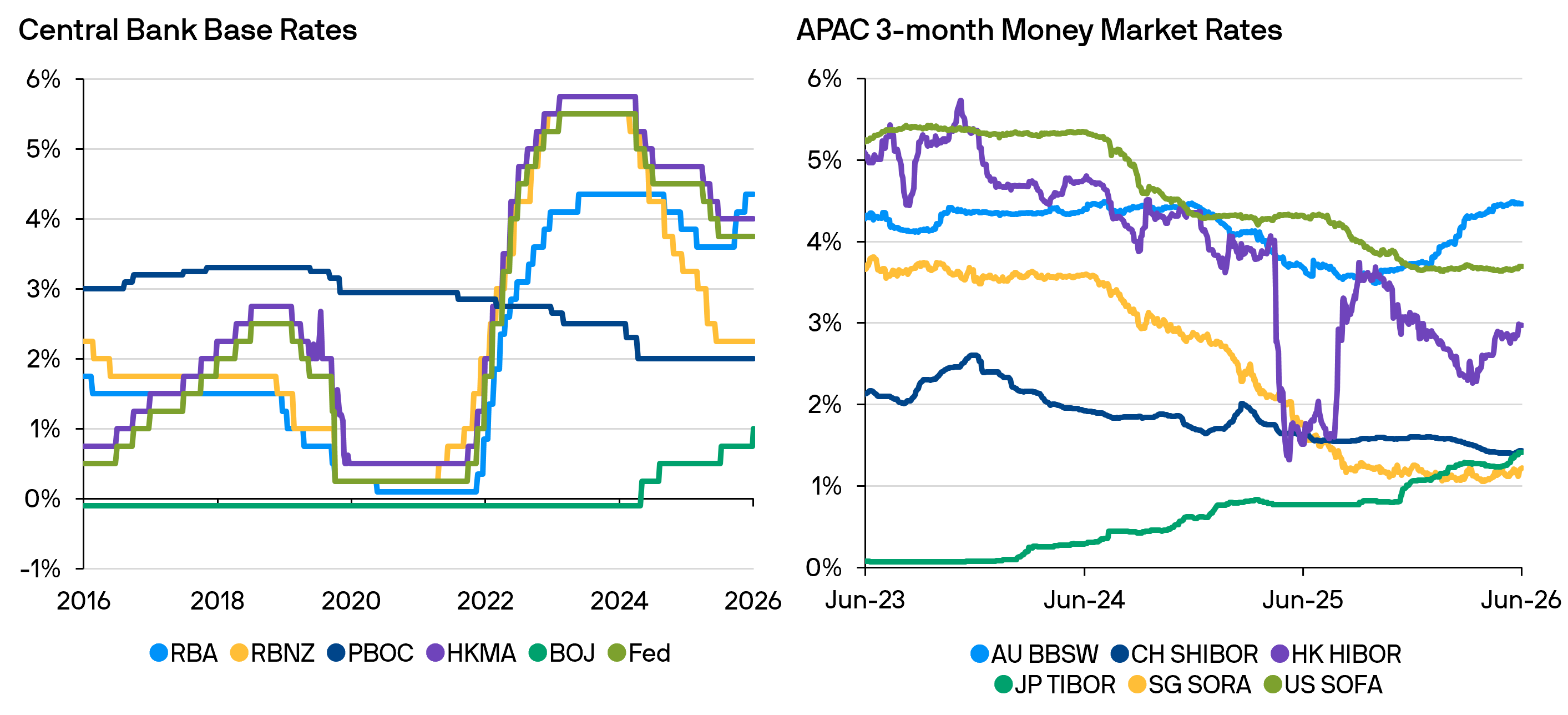
          Source: Bloomberg, as at 19 June 2026. 

          Provided for information only to illustrate macro trends, not to be construed as offer, research or investment advice

          Regional central bank trends

          Australia: Narrowing policy path

          Australia entered the energy shock with sticky inflation, a tight labor market, and signs of an overheating economy. This has  triggered three successive hikes by the Reserve Bank of Australia (RBA), back to the prior cycle high. Higher energy prices have increased the risk that inflation becomes more embedded, even if growth cools. 

          At the June meeting, the RBA held the cash rate at 4.35%. It paused to assess the cumulative impact of tightening and the oil-supply disruption, while stressing it would hike again if inflation risks intensified. With activity indicators softening and policy already restrictive, the RBA may be close to the peak, with scope to shift toward a hawkish hold if inflation moderates.

          China: Facing economic gravity

          China’s headline growth looks robust, but the outlook remains mixed. The divergence between strong external demand and softer domestic momentum is clear. Exports have rebounded sharply, supporting industrial profits and manufacturing. Meanwhile, retail sales, investment, and credit demand remain weak amid still-soft property conditions.

          Inflation has risen and producer prices are increasing. This reduces deflation risks without confirming broad-based domestic reflation. While real rates remain restrictive, the People’s Bank of China (PBOC) appears reluctant to let nominal rates fall too far. The implication is a continued dovish bias but with an emphasis on targeted tools and calibrated support rather than rate cuts, especially if near-term energy risks fade.

          1070913588

          Hong Kong’s activity data has been notably stronger in 2026. First quarter growth rose at the fastest pace in three years, driven by robust exports, a recovery in tourism and a rebound in private consumption. Headline inflation has edged higher but remains relatively muted as lower food prices offset higher energy costs. 

          The key risks facing the Hong Kong Monetary Authority (HKMA) are higher local yields and persistent Middle East tensions.  As markets unwind expectations for Fed cuts and reprice tightening risk, HIBOR yields have moved higher. Given the HKD peg constrains independent rate policy, the practical implication is continued sensitivity of domestic financial conditions to global rates and risk sentiment.

          Japan: Navigating politics and inflation

          Japan is dealing with a cost-of-living squeeze. Higher prices but flat wages have weakened consumer and business confidence. Policymakers are balancing stubbornly high inflation against growth concerns and political sensitivity. 

          In June 2026, the Bank of Japan (BOJ) resumed its hiking cycle, increasing the overnight call rate to a three-decade high of 1.00%. The split decision underscored internal caution, but the rationale was clear: underlying inflation risks remain elevated while fiscal spending is increasing.  Real rates are still negative and financial conditions remain too accommodative. The hawkish-but-cautious BOJ is likely to continue policy normalization but with heightened focus on market volatility.

          Singapore: Defying uncertainty

          Singapore’s growth has been supported by strong manufacturing and exports, while domestic activity is more muted, though still positive.  Even so, the government retained its 2026 growth range, flagging downside risks from the Middle East conflict.  While inflation has surprised to the downside, energy related shocks are weighing on real demand and could still trigger second round effects.

          The Monetary Authority of Singapore (MAS)  is likely to maintain a hawkish bias. With the conflict lasting longer than expected, the odds of further tightening have risen even if oil prices ease. Still, the base case is for policy to stay unchanged as MAS assesses inflation dynamics and the durability of the AI investment boom.

          Conclusion: The end of easing


          The second half of 2026 is shaping up as a regime shift for APAC central banks: from a gradual easing narrative to one defined by inflation vigilance, asymmetric energy risks, and uneven AI-driven growth. 


          Most central banks are opting for caution, the policy starting point matters.  Economies entering the shock with more restrictive policy have more scope to wait and see; while those with neutral or accommodative settings face sharper credibility trade-offs.  In any case, the direction is clear: the interest rate cutting cycle is over and if inflation accelerates, the next move may be hikes.


          For regional cash investors, higher yields and a still upward sloping yield curve continue to offer higher current income and opportunities to tactically extend duration and lock in attractive yields.  A disciplined and diversified investment approach remains essential amid geopolitical uncertainty and market volatility.

          Diversification does not guarantee investment returns and does not eliminate the risk of loss.

          This information is generic in nature provided to illustrate macro trends based on current market conditions that are subject to change from time to time. This generic information does not take into account any investor’s specific circumstances or objectives and should not be construed as offer, research or investment advice.