logo
  • My collections
    View saved content and presentation slides
  • Log out
  • Products

      Funds

      • Performance & Yields
      • Liquidity
      • Ultra-Short
      • Short Duration
      • European domiciled products

      Solutions

      • Cash Strategies
      • Cash Segmentation
      • Separately Managed Accounts
      • Managed Reserves Strategy

      Fund Information

      • Regulatory Updates
    • Insights

        Liquidity Insights

        • Liquidity Insights Overview
        • Global Liquidity Investment Outlook

          Global Liquidity Investment Outlook

        • Cash Cookbook

          The Cash Cookbook, your guide to cash and liquidity management success, helps you choose the right liquidity solution for your needs and risk tolerance.

        • Case Studies

          Read about companies with specific cash management challenges and the solutions when they worked with J.P. Morgan Asset Management.

        • Partnership with fintechs

          A focus on digital innovation and institutional liquidity solutions drive our dynamic partnership with fintech.

        • ESG Resources for Liquidity Investors

          We’ve created a clear, rigorous ESG process meets the many needs of liquidity investors.

        • Leveraging the Power of Cash Segmentation

          The most effective strategy incorporates a clear investment policy, well-defined goals and parameters for liquidity, quality and return.

        • Cash Investment Policy Statement

          How to write an investment policy statement for your organization

        Market Insights

        • Market Insights Overview
        • Eye on the Market

          Explore Eye on the Market, timely commentary that offers views on the economy, markets, and investment portfolios by Michael Cembalest.

        • Guide to the Markets

          The J.P. Morgan Guide to the Markets illustrates a comprehensive array of market and economic histories, trends and statistics through clear charts and graphs.

        • Market Updates

          Read our weekly commentaries to get market insights that may help inform your investment strategy.

        • Podcast: Markets Explained

          Signal or noise? In this weekly podcast, Karen and Hugh digest the newsflow in an increasingly tumultuous world and work out what it means for global investors.

        Portfolio Insights

        • Portfolio Insights Overview
        • Currency

          Our currency team provides solutions for clients, controlling risk using passive management strategies and generating returns by actively managing global currencies.

        • Fixed Income

          A complex mix of monetary, credit and fiscal forces is changing the bond landscape. Discover how flexible fixed income approaches can seek returns, income and resilience.

        • Long-Term Capital Market Assumptions

          Our Long-Term Capital Market Assumptions (LTCMAs) deliver forward-looking return, volatility and correlation estimates for 200+ asset and strategy classes in 20+ base currencies.

        • Sustainable investing

          We believe that ESG considerations can play a critical role in a long-term investment strategy.

        • Strategic Investment Advisory Group

          The Strategic Investment Advisory Group approaches today’s investment challenges with a global view across asset classes.

      • Resources
          • Overview
          • MORGAN MONEY
          • Account Management & Trading
          • Global Liquidity Investment Academy
          • Announcements
        • About us

            About us

            Backed by $4.6T in assets, we harness our active edge to deliver timely ideas and actionable insights that empower investors to achieve what matters most.

            • Overview
            • Diversity, Opportunity & Inclusion
            • Spectrum: Our Investment Platform
            • Our Leadership Team
            • Our Commitment to Research
          • Contact us
          • English
          • MORGAN MONEY LOGIN
            • My collections
              View saved content and presentation slides
            • Log out
          • Log in
          • MORGAN MONEY LOGIN
          Log in
          You are about to leave the site Close
          J.P. Morgan Asset Management’s website and/or mobile terms, privacy and security policies don't apply to the site or app you're about to visit. Please review its terms, privacy and security policies to see how they apply to you. J.P. Morgan Asset Management isn’t responsible for (and doesn't provide) any products, services or content at this third-party site or app, except for products and services that explicitly carry the J.P. Morgan Asset Management name.
          CONTINUE Go Back
          1. What are financial conditions and why do they matter?

          • LinkedIn Twitter Facebook WhatsApp

          What are financial conditions and why do they matter?

          05-11-2015

          Brandon Merrill

          There are generally four components to financial conditions analysis:

          1. The US Dollar
          2. Corporate bond spreads
          3. Equity market levels
          4. The level of interest rates at different maturities

          Changes in each of these components in isolation influence the economy in different ways. In general, a stronger dollar acts to restrain growth via reduced demand for exports. Higher corporate bond spreads restrain lending growth and corporate investment. Lower equity prices suppress growth in consumer spending through the wealth effect, and finally, the overall level of interest rates is a key component of mortgage rates and corporate borrowing rates. It is through this lens of financial conditions, broadly defined, that we should view current Fed policy.

          When the Fed raises the short rate, their goal is to suppress latent inflation pressure, and tighter financial conditions are the transmission mechanism through which this occurs. The short rate, by itself, does not influence the economy at large.In reality, Fed policy changes act to influence the factors discussed above, which in turn influence the broader economy. And to complicate matters, an incremental change in the short rate does not always have the same incremental effect on financial conditions, i.e., the transmission mechanism of monetary policy is not constant. For this reason, it’s critical to watch not only what the Fed says (and ultimately does), but how the markets react. A disproportionate reaction in the markets to a given action by the Fed is likely to be met with resistance in the opposite direction.

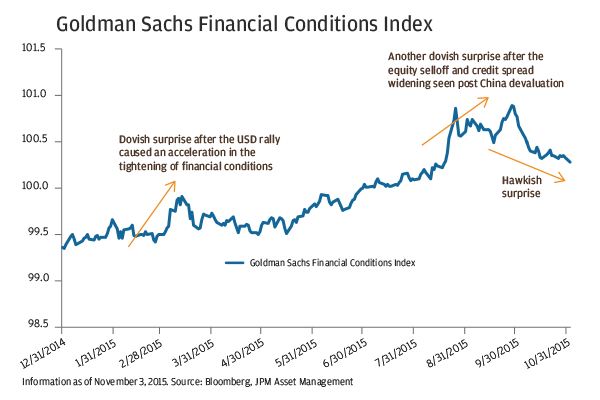
          Three times this year, the market has been caught off guard by the Federal Reserve statement. Twice the Fed acted more dovishly than expected (March and September), and most recently at its October meeting the Fed shifted more hawkishly than expected. Interestingly, each of these three meetings saw large changes in the rate of change of financial conditions in the weeks leading up to their meeting (see chart below). Is this a coincidence, or is it possible that perceived changes in financial conditions play a larger role in the Fed’s policy framework than they have previously indicated?

          Interestingly, one of the early adopters of the financial conditions framework was the Fed’s own Bill Dudley. He is now the president of the NY Fed and is considered part of Janet Yellen’s inner circle, but earlier in his career as an economist in the private sector, he worked to develop the financial conditions index that is the industry standard today. As one of its original authors, it is natural to believe that he would still be a large proponent of the index today. In fact, he has said as much in recent speeches.*

          As we look toward the December meeting, it seems that the rate of change of the financial conditions index will be a key determinant of whether or not the Fed hikes rates. Meaning, unless the current trend reverses, the Fed will likely hike rates in December. For that to happen, equities need to stay around current levels or higher, and the dollar cannot strengthen too much, even though the Fed wouldn’t spell it out just like this.
          *http://www.newyorkfed.org/newsevents/speeches/2014/dud141201.html

          • Central Banks
          • Market Views
          • Monetary Policy
          • Rates
          • Economic Outlook

          RELATED ARTICLES

          FOMC Statement: September 2021

          Following the Fed’s announcement, find our latest market views from the Global Fixed Income Currency & Commodities (GFICC) U.S. Rates team.

          Read more

          FOMC statement & potential impact on fixed income

          Following the Fed's announcement, find our latest market views from the Global Fixed Income, Currency & Commodities Team (GFICC).

          Read more

          FOMC statement & potential impact on fixed income

          Following the Fed's announcement, find our latest market views from the Global Fixed Income, Currency & Commodities Team (GFICC).

          Read more