logo
  • My collections
    View saved content and presentation slides
  • Log out
  • Products

      Funds

      • Performance & Yields
      • Liquidity
      • Ultra-Short
      • Short Duration
      • European domiciled products

      Solutions

      • Cash Strategies
      • Cash Segmentation
      • Separately Managed Accounts
      • Managed Reserves Strategy

      Fund Information

      • Regulatory Updates
    • Insights

        Liquidity Insights

        • Liquidity Insights Overview
        • Global Liquidity Investment Outlook

          Global Liquidity Investment Outlook

        • Cash Cookbook

          The Cash Cookbook, your guide to cash and liquidity management success, helps you choose the right liquidity solution for your needs and risk tolerance.

        • Case Studies

          Read about companies with specific cash management challenges and the solutions when they worked with J.P. Morgan Asset Management.

        • Partnership with fintechs

          A focus on digital innovation and institutional liquidity solutions drive our dynamic partnership with fintech.

        • ESG Resources for Liquidity Investors

          We’ve created a clear, rigorous ESG process meets the many needs of liquidity investors.

        • Leveraging the Power of Cash Segmentation

          The most effective strategy incorporates a clear investment policy, well-defined goals and parameters for liquidity, quality and return.

        • Cash Investment Policy Statement

          How to write an investment policy statement for your organization

        Market Insights

        • Market Insights Overview
        • Eye on the Market

          Explore Eye on the Market, timely commentary that offers views on the economy, markets, and investment portfolios by Michael Cembalest.

        • Guide to the Markets

          The J.P. Morgan Guide to the Markets illustrates a comprehensive array of market and economic histories, trends and statistics through clear charts and graphs.

        • Market Updates

          Read our weekly commentaries to get market insights that may help inform your investment strategy.

        • Podcast: Markets Explained

          Signal or noise? In this weekly podcast, Karen and Hugh digest the newsflow in an increasingly tumultuous world and work out what it means for global investors.

        Portfolio Insights

        • Portfolio Insights Overview
        • Currency

          Our currency team provides solutions for clients, controlling risk using passive management strategies and generating returns by actively managing global currencies.

        • Fixed Income

          A complex mix of monetary, credit and fiscal forces is changing the bond landscape. Discover how flexible fixed income approaches can seek returns, income and resilience.

        • Long-Term Capital Market Assumptions

          Our Long-Term Capital Market Assumptions (LTCMAs) deliver forward-looking return, volatility and correlation estimates for 200+ asset and strategy classes in 20+ base currencies.

        • Sustainable investing

          We believe that ESG considerations can play a critical role in a long-term investment strategy.

        • Strategic Investment Advisory Group

          The Strategic Investment Advisory Group approaches today’s investment challenges with a global view across asset classes.

      • Resources
          • Overview
          • MORGAN MONEY
          • Account Management & Trading
          • Global Liquidity Investment Academy
          • Announcements
        • About us

            About us

            Backed by $4.6T in assets, we harness our active edge to deliver timely ideas and actionable insights that empower investors to achieve what matters most.

            • Overview
            • Diversity, Opportunity & Inclusion
            • Spectrum: Our Investment Platform
            • Our Leadership Team
            • Our Commitment to Research
          • Contact us
          • English
          • MORGAN MONEY LOGIN
            • My collections
              View saved content and presentation slides
            • Log out
          • Log in
          • MORGAN MONEY LOGIN
          Log in
          You are about to leave the site Close
          J.P. Morgan Asset Management’s website and/or mobile terms, privacy and security policies don't apply to the site or app you're about to visit. Please review its terms, privacy and security policies to see how they apply to you. J.P. Morgan Asset Management isn’t responsible for (and doesn't provide) any products, services or content at this third-party site or app, except for products and services that explicitly carry the J.P. Morgan Asset Management name.
          CONTINUE Go Back
          1. The miraculous japanese labour force

          • LinkedIn Twitter Facebook WhatsApp

          The miraculous japanese labour force

          31-05-2018

          Jason Davis

          Japan has one of the lowest unemployment rates globally. Business surveys continue to indicate significant labour shortages and the working age population is no longer growing. So how is it possible that the economy added the most number of jobs since records began in Q1?
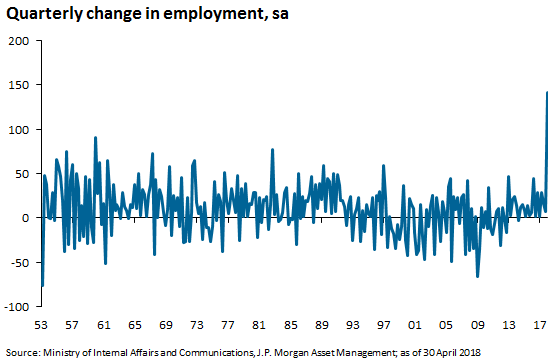
          First some caveats – there are likely some seasonal adjustment issues with this data which may lead to downward revisions going forward. That said, on an unadjusted basis, Japan still added jobs in a quarter that historically sees large falls due to retirements and college students leaving work.

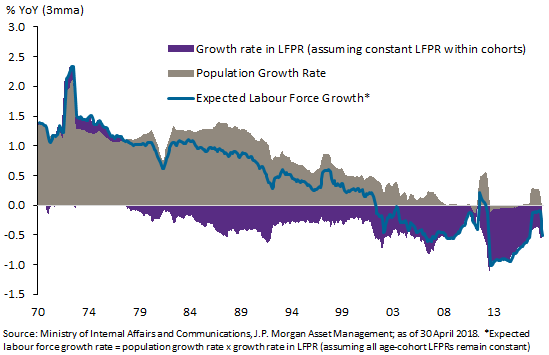
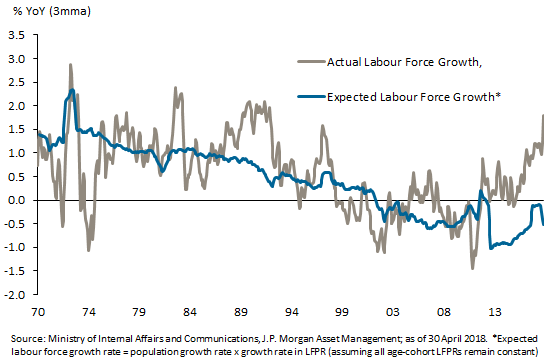
          Given the demographics in Japan, the labour force should not be growing at the fastest pace since the 1990s. In fact, it should be shrinking. Labour force growth consists of population growth and the growth in the labour force participation rate (LFPR). Assuming a constant LFPR within age cohorts, a stagnant and aging population should be generating a negative labour force growth rate:
          In reality, the labour force is growing just under 2% per year:
          So where is the outlet and can other countries follow this same path as they approach full employment?

          In Japan, there are two key sources of hidden slack. The most obvious and impactful is rising participation rates, especially female participation. The surge in women joining the labour force has been dramatic, especially into part-time employment.
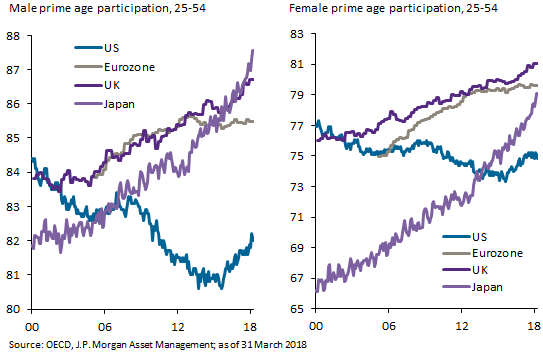
          This is a phenomenon that has been ongoing for some time. Whilst there is clearly a limit to this (only 100% of the population can join the labour force), there is no reason it cannot continue for some time yet as the labour market continues to tighten.

          A similar trend has been happening to a lesser extent in other DM economies. The US, however, is a different story. Despite the male prime age LFPR rising since its depths in late 2015, this series has been on a structural downtrend for decades whilst female LFPR remains stubbornly flat. The IMF attributes this structural trend down to several factors including large numbers of incarcerations, the opioid crisis and shorter maternity leave. Whilst I do not expect a speedy rebound in a multi-year structural trend, the US may follow in the footsteps of Japan, at least cyclically, as the labour market tightens beyond full employment.

          The second and less obvious outlet is immigration. Japan has a very strict immigration policy which only tends to give work visas to highly skilled workers in specific industries. Whilst the share of foreign workers in the labour force remains low (~2%), it has been rising and contributing to employment growth.

          As can be seen below, a lot of the rise in foreign workers has come from students and trainees. The former can work up to 28 hours per week whilst the latter can work full-time after a certain amount of training in the first year of their entry. The second graph shows that a lot of these workers are coming from South East Asian countries with a much lower per capita GDP and a higher population growth rate.
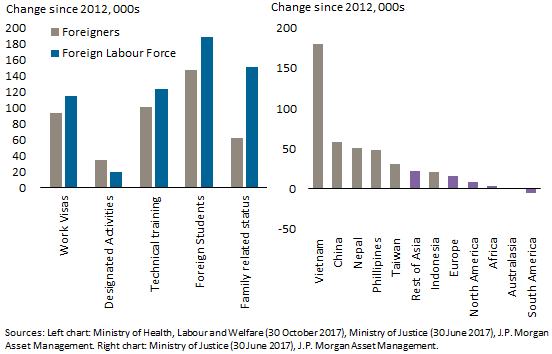
          Whilst I do not expect there to be an explicit change in immigration policy in Japan, this source of foreign labour is being implicitly allowed, even encouraged, as labour market shortages start to bite. Although this is becoming an important source of hidden slack in Japan, it is unlikely to be as important in the rest of the developed markets where foreign labour shares are much higher.

          Overall, Japanese employment should not be growing. However, as the labour market tightens, slack continues to emerge, allowing the economy to continuing growing comfortably above trend.

          • APAC
          • Growth

          RELATED ARTICLES

          China’s Interest Rate Pivot

          While China’s post-Covid-19 economic data is showing signs of normalization, the government’s focus on stability will have significant implications for monetary policy and interest rates

          Read more

          The PBoC – Rate Cuts and Policy Clarification

          The Peoples Bank of China recent policy actions help address the concerns that its policy response was lagging the aggressive actions taken by other central banks.

          Read more

          Singapore Dollar – no longer defying gravity

          The Singapore Dollar is no longer defying gravity – we discuss why and the implications for cash investors.

          Read more