logo
  • My collections
    View saved content and presentation slides
  • Log out
  • Products

      Funds

      • Performance & Yields
      • Liquidity
      • Ultra-Short
      • Short Duration
      • European domiciled products

      Solutions

      • Cash Strategies
      • Cash Segmentation
      • Separately Managed Accounts
      • Managed Reserves Strategy

      Fund Information

      • Regulatory Updates
    • Insights

        Liquidity Insights

        • Liquidity Insights Overview
        • Global Liquidity Investment Outlook

          Global Liquidity Investment Outlook

        • Cash Cookbook

          The Cash Cookbook, your guide to cash and liquidity management success, helps you choose the right liquidity solution for your needs and risk tolerance.

        • Case Studies

          Read about companies with specific cash management challenges and the solutions when they worked with J.P. Morgan Asset Management.

        • Partnership with fintechs

          A focus on digital innovation and institutional liquidity solutions drive our dynamic partnership with fintech.

        • ESG Resources for Liquidity Investors

          We’ve created a clear, rigorous ESG process meets the many needs of liquidity investors.

        • Leveraging the Power of Cash Segmentation

          The most effective strategy incorporates a clear investment policy, well-defined goals and parameters for liquidity, quality and return.

        • Cash Investment Policy Statement

          How to write an investment policy statement for your organization

        Market Insights

        • Market Insights Overview
        • Eye on the Market

          Explore Eye on the Market, timely commentary that offers views on the economy, markets, and investment portfolios by Michael Cembalest.

        • Guide to the Markets

          The J.P. Morgan Guide to the Markets illustrates a comprehensive array of market and economic histories, trends and statistics through clear charts and graphs.

        • Market Updates

          Read our weekly commentaries to get market insights that may help inform your investment strategy.

        • Podcast: Markets Explained

          Signal or noise? In this weekly podcast, Karen and Hugh digest the newsflow in an increasingly tumultuous world and work out what it means for global investors.

        Portfolio Insights

        • Portfolio Insights Overview
        • Currency

          Our currency team provides solutions for clients, controlling risk using passive management strategies and generating returns by actively managing global currencies.

        • Fixed Income

          A complex mix of monetary, credit and fiscal forces is changing the bond landscape. Discover how flexible fixed income approaches can seek returns, income and resilience.

        • Long-Term Capital Market Assumptions

          Our Long-Term Capital Market Assumptions (LTCMAs) deliver forward-looking return, volatility and correlation estimates for 200+ asset and strategy classes in 20+ base currencies.

        • Sustainable investing

          We believe that ESG considerations can play a critical role in a long-term investment strategy.

        • Strategic Investment Advisory Group

          The Strategic Investment Advisory Group approaches today’s investment challenges with a global view across asset classes.

      • Resources
          • Overview
          • MORGAN MONEY
          • Account Management & Trading
          • Global Liquidity Investment Academy
          • Announcements
        • About us

            About us

            Backed by $4.6T in assets, we harness our active edge to deliver timely ideas and actionable insights that empower investors to achieve what matters most.

            • Overview
            • Diversity, Opportunity & Inclusion
            • Spectrum: Our Investment Platform
            • Our Leadership Team
            • Our Commitment to Research
          • Contact us
          • English
          • MORGAN MONEY LOGIN
            • My collections
              View saved content and presentation slides
            • Log out
          • Log in
          • MORGAN MONEY LOGIN
          Log in
          You are about to leave the site Close
          J.P. Morgan Asset Management’s website and/or mobile terms, privacy and security policies don't apply to the site or app you're about to visit. Please review its terms, privacy and security policies to see how they apply to you. J.P. Morgan Asset Management isn’t responsible for (and doesn't provide) any products, services or content at this third-party site or app, except for products and services that explicitly carry the J.P. Morgan Asset Management name.
          CONTINUE Go Back
          1. A “structural reform” for the kids

          • LinkedIn Twitter Facebook WhatsApp

          A “structural reform” for the kids

          20-07-2017

          Andrew Norelli

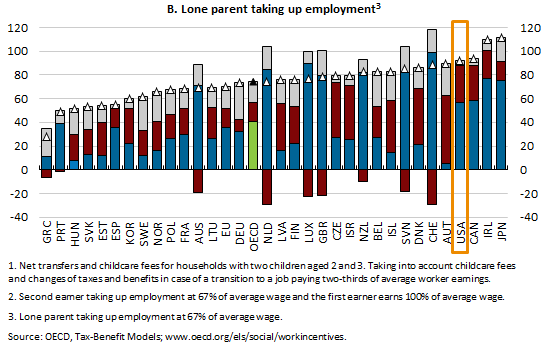
          The Group of 20’s stated goal is “strong, sustainable, balanced, and inclusive growth.” Amen to that. The quality-of-life triple threat of low productivity, unfavorable demographics, and stifling income inequality would all be licked if the G20 achieves that goal. The challenge of course is how to get there. Policy makers, economists, and the group itself all fall back on the tried-and-true prescription of “structural reforms.” That catch-all phrase is prominent in their publications, but one usually has to dig deep to uncover the specifics of what, really, these folks are recommending. For the US, infrastructure investment, tax reform, and regulatory reform—to the extent they rigorously address inefficiency, productivity, or inequality—would all count. Today, however, I want revisit in more detail a different proposal that I’ve discussed in the past, and expand on it with three key charts from the Organisation for Economic Co-operation and Development (OECD).

          In short, a wholesale change in the US approach to childcare could have a profoundly positive impact on growth and quality of life. The idea is unusual, in that it is motivated by two factors which are often in conflict but here are aligned: first, a clinical focus on key macroeconomic outcomes, and second, deferential attention to small-scale outcomes for human individuals which improve the opportunities, incentives, and quality of life for families in the economy. The result could unlock significant gains in both productivity and hours worked, while at the same time counteract rising inequality—the three keys to sustainable and inclusive growth.

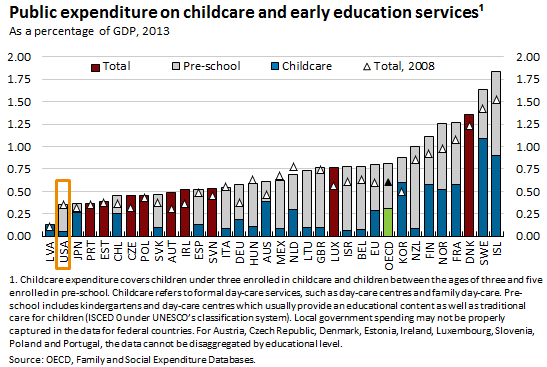
          The United States government spends the second-least on preschool and childcare of the 32 individual countries plus the EU, measured as a whole, studied by the OECD:
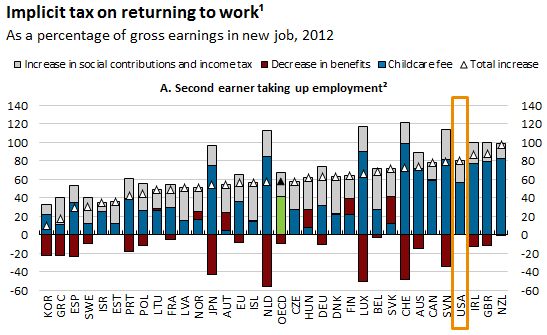
          When parents consider re-entering the workforce, childcare costs are a significant deterrent to doing so. For single parents, as well as the second earner in a two-parent household re-entering the workforce in the United States, the implicit tax rate is the fourth-worst in the OECD. It totals some 80%+ of gross pay just for taxes, childcare, and benefit reductions:
          The result is an inefficient system, where primary caregivers are compelled to provide in-home childcare in lieu of participating in the wider economy. The impediments persist as children grow and their care needs are only partially met by primary school, with summer holidays and significant portions of the traditional workday hours still not covered. Parents are forced to accept jobs which can accommodate a certain schedule, rather than jobs which allow them to maximize their productivity, earnings, and participation in the economy.

          If the United States treated childcare like public education, where every parent who wished could enroll their children in all-day, enriching childcare at little or no out-of-pocket cost, the economic benefits on both a macro and micro scale could be substantial:

          1. Job creation: the many primary caregivers who are talented and passionate about the work could do it professionally (and this is a job that is not easily automated!). The infrastructure needs on an upfront and ongoing basis are also potentially significant, requiring skilled construction work, regardless whether the programs are publicly or privately administered.

          2. Increased labor force participation and hours worked: the implicit “re-entry tax” would be removed as a serious disincentive to join the labor force and barrier to pursuing new skills training.

          3. Increased productivity: individuals, as they see fit, can pursue jobs to maximize their quality of life, earnings, and contribution to the economy, at a level greater than the (purely monetary) cost of caring for 1.9 children per day, which is the average number of children under 18 in each household with children.

          4. Decreased inequality: childcare is a benefit for all families, paid for by the existing progressive tax system.

          5. The first four are dispassionate assessments of the raw 1st order macroeconomic effects, which would be critical to justifying the expense and helping pay for it over the short term, but there is a bigger issue at the heart of the proposal with longer-term implications. Providing all children with equal access to robust early childhood education, reliable care, and a structure through which other basic health and nutrition needs can be met efficiently and consistently will help strengthen the youngest generation of Americans. They are the future US economy.
             

          Clearly any program like this, whether it’s done with physical structures, extensions of the public education system, or through vouchers and refundable tax credits would be costly. However, the realistic potential growth uplift outlined above allows “dynamic scoring” to be used with confidence for at least partial self-funding. Dynamic scoring uses future growth expectations, realized in the form of higher tax revenues, to fund current expenditures. The concept is frequently abused because growth forecasts are too optimistic, but in this case the pure economic effects are pretty simple. Near term funding through progressive taxation can provide a plausible bridge to a period of sustainably higher and more inclusive growth. Higher sustainable growth with less inequality allows a larger share of the economy to eventually make meaningful tax contributions. The ability of the economy to sustain less progressivity in the tax code ought to be a “win” for both political parties.

          Any structural reform which can plausibly create jobs, increase labor force participation, increase productivity, and reduce inequality would produce meaningful progress toward “strong, sustainable, balanced, and inclusive growth.” Reforming the childcare system could potentially do all of this, while encouraging participation and engagement in the economy by all parents who wish to do so.

          • Fiscal Policy
          • Latest

          RELATED ARTICLES

          Is there green in the graying baby boomers? Why we like non-profit tax-exempt senior living bonds

          At our recent IQ meeting, we concluded municipal high yield was one of our best ideas. In this piece we take a deep dive into one of the more opportunistic sectors in the tax-exempt market.

          Read more

          Will a “Blue Wave” carry UBI onto the shore?

          The potential outcomes of the U.S. elections could usher in more than just higher taxes.

          Read more

          Shock, crisis, rinse, repeat

          We’ve seen Fed rate cuts before, during the 2008 crisis—this one removes a question mark for the economy.  Now small businesses also need support.

          Read more