logo
  • My collections
    View saved content and presentation slides
  • Log out
  • Insights

      Liquidity Insights

      • Liquidity Insights Overview
      • Global Liquidity Investment Outlook

        Global Liquidity Investment Outlook

      • Tokenization

        Explore the full whitepaper to learn how tokenized MMFs can transform your approach to cash management and position your organization at the forefront of digital finance.

      • Case Studies

        Read about companies with specific cash management challenges and the solutions when they worked with J.P. Morgan Asset Management.

      • Partnership with fintechs

        A focus on digital innovation and institutional liquidity solutions drive our dynamic partnership with fintech.

      • ESG Resources for Liquidity Investors

        We’ve created a clear, rigorous ESG process meets the many needs of liquidity investors.

      • Leveraging the Power of Cash Segmentation

        The most effective strategy incorporates a clear investment policy, well-defined goals and parameters for liquidity, quality and return.

      • Cash Investment Policy Statement

        How to write an investment policy statement for your organization

      Market Insights

      • Market Insights Overview
      • Eye on the Market

        Explore Eye on the Market, timely commentary that offers views on the economy, markets, and investment portfolios by Michael Cembalest.

      • Guide to the Markets

        The J.P. Morgan Guide to the Markets illustrates a comprehensive array of market and economic histories, trends and statistics through clear charts and graphs.

      • Market Updates

        Read our weekly commentaries to get market insights that may help inform your investment strategy.

      • Podcasts

        Insights from Tai Hui, Chief Market Strategist, Asia, on what is happening in financial markets, from our Asia Pacific headquarters in Hong Kong.

      • Guide to Investing in Asia

        The Guide to Investing in Asia explores the diverse economies, markets and investment trends across Asia, including Japan, India, China and Southeast Asia.

      Portfolio Insights

      • Portfolio Insights Overview
      • Currency

        Our currency team provides solutions for clients, controlling risk using passive management strategies and generating returns by actively managing global currencies.

      • Fixed Income

        We highlight themes and implications from various fixed income teams to help guide your portfolio decisions.

      • Long-Term Capital Market Assumptions

        Our Long-Term Capital Market Assumptions (LTCMAs) deliver forward-looking return, volatility and correlation estimates for 200+ asset and strategy classes in 20+ base currencies.

      • Sustainable investing

        Sustainable Insights

      • Strategic Investment Advisory Group

        The Strategic Investment Advisory Group approaches today’s investment challenges with a global view across asset classes.

    • Resources
        • All Resources
        • MORGAN MONEY
        • Account Management & Trading
        • Global Liquidity Investment Academy
        • Announcements
      • About us

          About us

          Backed by $4.6T in assets, we harness our active edge to deliver timely ideas and actionable insights that empower investors to achieve what matters most.

          • Overview
          • Spectrum: Our Investment Platform
          • Our Leadership Team
          • Diversity, Opportunity & Inclusion
        • Contact us
        • English
        • MORGAN MONEY LOGIN
          • My collections
            View saved content and presentation slides
          • Log out
        • Log in
        • MORGAN MONEY LOGIN
        Log in
        You are about to leave the site Close
        J.P. Morgan Asset Management’s website and/or mobile terms, privacy and security policies don't apply to the site or app you're about to visit. Please review its terms, privacy and security policies to see how they apply to you. J.P. Morgan Asset Management isn’t responsible for (and doesn't provide) any products, services or content at this third-party site or app, except for products and services that explicitly carry the J.P. Morgan Asset Management name.
        CONTINUE Go Back
        1. PBOC: small move, strong signal

        • LinkedIn Twitter Facebook Line WhatsApp

        PBOC: Small move, strong signal

        13/12/2019

        Aidan Shevlin

        The People’s Bank of China’s (PBoC) recent and notable dovish pivot – after having been one of the most hawkish of the major central banks for months has significant implications for Chinese money market rates and investors.

        What happened?

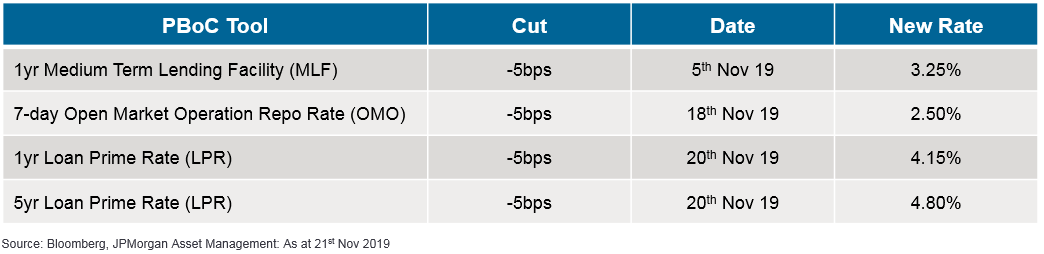
        The surprise quasi-monetary policy (Fig 1) rate cuts – the PBoC’s de-facto policy tools since official deposit and lending rates were left unchanged since 2015 - will ease liquidity conditions for commercial banks and borrowers while sending a strong signal of PBoC monetary policy intentions.

        Fig 1: Key quasi-monetary policy rate cuts:
        Why now?

        Chinese economic conditions remain challenging with economic growth slowing, trade tensions elevated, inflation spiking and shadow banking risks still a concern.  Given this backdrop, the PBoC has pursued a two-pronged strategy of maintained a hawkish/neutral policy stance to reducing shadow banking, support the currency and prevent further asset price bubbles; while injecting additional liquidity to support smaller commercial banks and private enterprises.

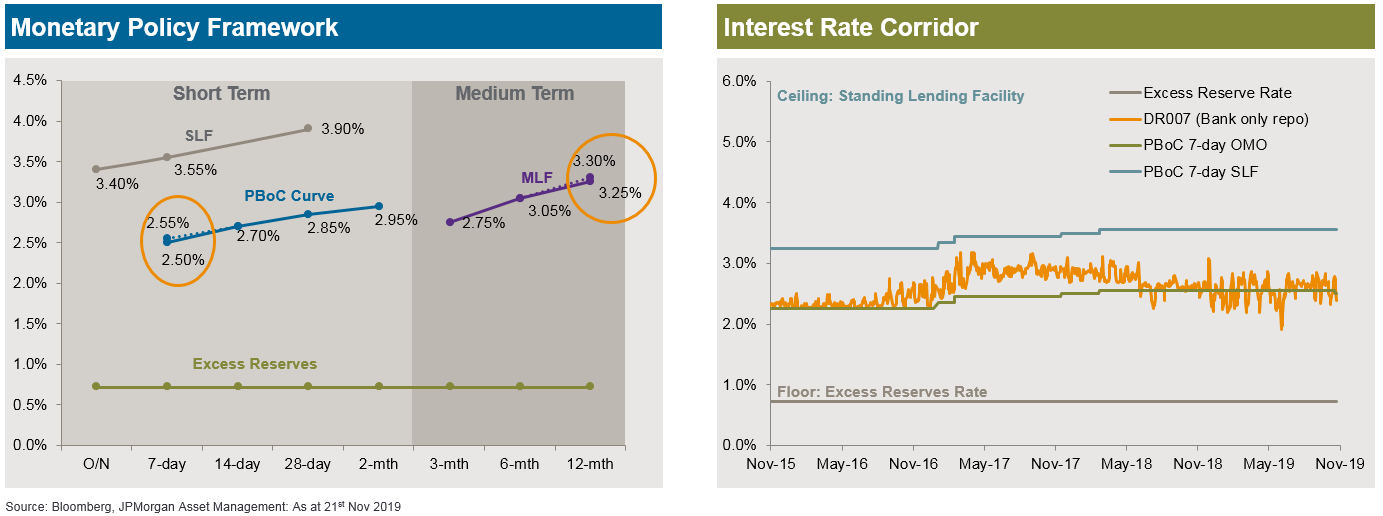
        Recent economic data releases were much weaker than expected, forcing the central bank to assume a more dovish policy stance and cut rates.  Fortunately, three Fed rate cuts and recent RMB stabilization offered the PBoC a window of opportunity with the central bank highlighting the need to “enhance counter-cyclical adjustment measures to improve liquidity supply” (Fig 2). 

        This was the first OMO cut in over four years and will reduce commercial banks short term funding costs, while the MLF cut will reduce longer term funding costs.  With the 1-year LPR rates directly linked to the MLF, the reduction in the former was expected after the PBoC actions, but the reduction in the 5-year LPR rate – which will impact retail mortgage rates – was a surprise.

        Notably, the small scale of rate cuts highlights the central banks residual concerns about high inflation and a reluctance to re-stimulate property and shadow banking markets.

        Fig 2: Quasi-monetary policy tools are seen as the de-facto policy rates in China
        What happens next?

        Even if a trade deal is agreed, structural issues suggest the Chinese economy will remain weak.  With the PBoC apparently willing to temporarily ignore the current inflation spike - additional, gradual, monetary policy easing is likely; especially as the benefits of earlier government fiscal stimulus fades.

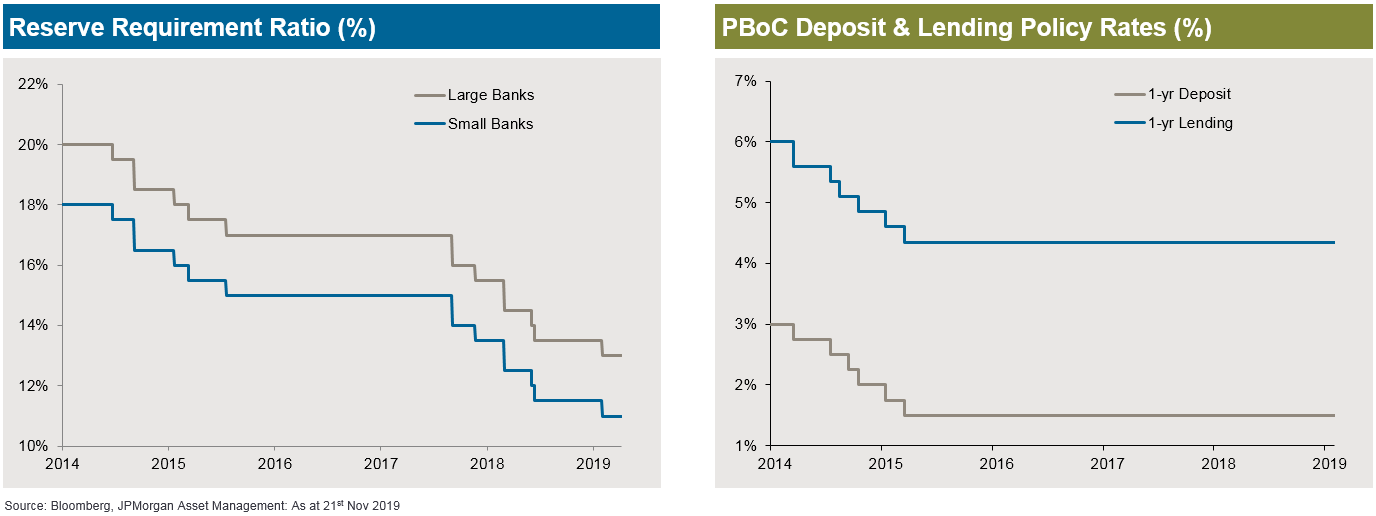
        Future potential monetary policy steps include; further reductions in MLF and OMO plus additional cuts to the Standing Lending Facility (SLF) and Reserve Requirement Ratio (RRR) - all targeted at supporting the real economy and increase credit growth (Fig 3). 

        Nevertheless, there is a limit to how much further quasi-monetary policy rates can be cut before adversely impacting commercial banks willingness and ability to lend; the blocked monetary transmission mechanism has already muted the impact of the recent monetary easing.  Reducing the benchmark deposit and lending rates would be significantly more beneficial, but remains unlikely.

        Fig 3: The PBoC’s key deposit and lending rates have remained unchanged since 2015
        What does it mean for money market rates and investors?

        The PBoC’s dovish pivot will push interest rates lower and further flatten the yield curve.   While short maturity yields have already declined, maintaining a long duration position provides insurance against further flattening and the opportunity for capital gains.  An additional economic slowdown, will adversely impact weaker commercial banks asset quality and weaker corporate’s profitability.  With little sign of an economic turnaround, China credit fundamentals are not expected to improve and detailed, independent credit analysis remains important prior to investment.

        • China
        • Liquidity
        • APAC

        RELATED ARTICLES

        IOER – does the latest fed move have any practical implications for cash investors?

        The Fed’s interest on excess reserves (IOER) shot to prominence following an unprecedented adjustment by the central bank. We explore its impact on investors.

        Read more

        China’s Interest Rate Pivot

        While China’s post-Covid-19 economic data is showing signs of normalization, the government’s focus on stability will have significant implications for monetary policy and interest rates

        Read more

        The PBoC – Rate Cuts and Policy Clarification

        The Peoples Bank of China recent policy actions help address the concerns that its policy response was lagging the aggressive actions taken by other central banks.

        Read more
        J.P. Morgan Asset Management

        • Investment stewardship
        • About us
        • Contact us
        • Privacy policy
        • Cookie policy
        • Complaint Resolution
        • Sitemap
        J.P. Morgan

        • J.P. Morgan
        • JPMorgan Chase
        • Chase

        READ IMPORTANT LEGAL INFORMATION. CLICK HERE >

        The value of investments may go down as well as up and investors may not get back the full amount invested.

        Copyright 2026 JPMorgan Chase & Co. All rights reserved.