



Head of International Liquidity Fund Management

In Brief
- The MAS pivoted to a more hawkish stance at its April policy meeting, increasing the S$NEER appreciation rate to counter rising imported inflation driven by energy shocks and global supply disruptions.
- Singapore’s economic growth remains resilient but is expected to moderate. Inflation forecasts have been increased as the central bank signals a continued tightening bias to safeguard price stability.
- For SGD cash investors, the S$NEER is likely to remain in the upper half of its policy range and interest rates are expected to continue to trend lower. Amid heightened volatility, a diversified and disciplined investment strategy remains essential to ensure optimal investment outcomes.
MAS Decision and Rationale:
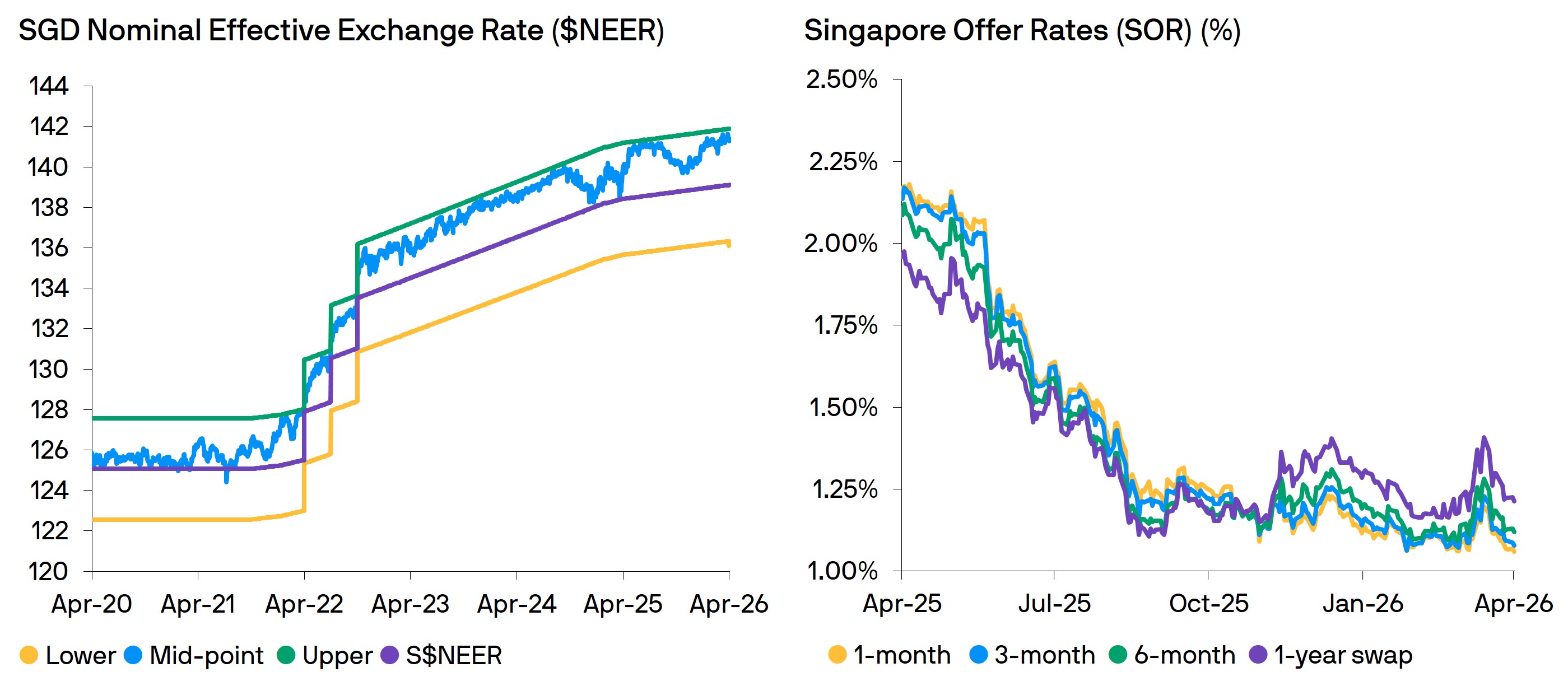
At its April 2026 policy meeting, the Monetary Authority of Singapore (MAS) made a hawkish pivot, announcing a “slight” increase in the rate of appreciation of the Singapore dollar nominal effective exchange rate (S$NEER) policy band (estimated by 0.5% to 1.0%), while keeping the width and centre of the band unchanged.
The widely anticipated move marks a clear shift from MAS’s recent neutral stance, though it was more measured than some investors expected given heightened geopolitical uncertainty. The central bank cited surging imported energy prices, driven by the Middle East crisis, and warned that broader import cost are likely to rise as physical crude oil shortages spread through the APAC region.
By tightening policy pre-emptively, MAS hopes to use the stronger currency as a buffer against imported inflation. However, the modest scale of the adjustment also signals a desire to avoid over-tightening amid ongoing uncertainty and longer-term downside risks to growth.
Fig 1: The MAS has increased the slope of the S$NEER; short tenor SOR interest rates have declined over recent months.
Source: Goldman Sachs, Bloomberg and J.P. Morgan Asset Management, data as of 14 April 2026.
Growth and Inflation:
Advance estimates show Singapore’s economy expanded by a robust 4.6%y/y in Q1 2026, supported by manufacturing linked to the global AI capex cycle. The MAS expects growth to moderate during the remainder of 2026 as higher energy costs and supply disruptions weigh on Singapore’s major trading partners. Domestically, rising input costs will pressure energy-dependent industries and dampen consumer demand. Still, resilient AI-related investment and steady public infrastructure and housing projects should help stabilize growth.
MAS Core CPI held steady at 1.2% y/y in January–February 2026, but the inflation outlook has worsened. Surging global energy prices will push up electricity, gas, and transport-related CPI inflation in the coming months. As higher energy costs filter through supply chains, a broader range of Singapore’s import costs will also increase. Even if Middle East supplies are restored, the MAS expects energy prices to stay elevated as supply recovers slowly and governments rebuild reserves. Reflecting these pressures, MAS has raised its 2026 forecasts for both Core Inflation and CPI-All Items inflation to 1.5%–2.5%, up from 1.0%–2.0% in January.
Conclusion and Outlook
The MAS’s April statement signaled a clear hawkish shift. With imported inflation risks mounting and growth momentum moderating, the central bank is currently prioritizing price stability through tighter policy. Despite MAS emphasized its readiness to address further inflationary pressures, it is also taking a more cautious and flexible stance given the asymmetric downside risks to growth. As a result, the timing and scale of any additional policy tightening remain uncertain.
For SGD investors, this points to continued currency strength, with the S$NEER likely to remain in the upper half of its policy-band and MAS maintaining a tightening bias until inflation risks subside. Short-term interest rates have already declined substantially in recent months and are expected to trend lower, though at a slower pace. In this environment, tactical duration extensions and a disciplined, diversified investment approach remain essential amid ongoing market volatility.