


Global Bond Monitor Q3 2026
Investors have typically looked to bonds for two outcomes:
1. A steady stream of income
2. Diversification against riskier assets if the growth outlook deteriorates.
Yet both benefits were steadily eroded after the turn of the century, as a long bull market in fixed income pushed yields to record lows.
At the heart of this decline was a global savings glut: a world in which the desire to save increasingly exceeded the demand for investment. Following the 1997 Asian financial crisis, many Asian economies built larger reserves, increasing demand for safe assets. The 2008 global financial crisis then triggered a decade of deleveraging and weaker investment, while the subsequent eurozone sovereign debt crisis reinforced this trend as governments tightened fiscal policy. Together with low inflation, these forces drove yields steadily lower until the Covid pandemic.
Since then, the backdrop has changed. Capital has become scarcer, bond supply has increased, and fixed income investors have been able to demand higher yields. This shift reflects a world in which both governments and companies are spending more. Governments, faced with a more fractious geopolitical landscape, are investing in strategic sectors such as technology, energy and defence. At the same time, the artificial intelligence (AI) buildout has become the most capital-intensive investment cycle since the telecoms boom during the dot-com era, contributing to higher corporate debt issuance.
Higher starting yields strengthen the case for bonds in balanced portfolios. Although inflation risks and uncertainty surrounding the war in the Middle East may keep volatility elevated, investors are again being paid to lend. With prudent risk management, fixed income can once again offer meaningful income and diversification within multi-asset portfolios.
-
Rise in government bond yields primarily driven by higher real yields
-
Be mindful of inflation, but the risk of a wage-price spiral appears limited
-
Higher income gives investors a cushion against further yield increases
-
Corporate credit spreads are supported by high all-in yields and solid fundamentals
-
Emerging market debt is supported by earlier policy discipline
The rise in nominal yields since 2020 has primarily been driven by higher real yields, while longer-term inflation expectations have remained relatively stable. Bond markets are trying to assess whether yields are rising because of “good” spending or “bad” spending. Good spending should support sustainable real growth, helping to lift tax revenues and corporate earnings. Bad spending can fuel consumer price inflation, finance wasteful projects or result in a misallocation of capital, leading investors to demand higher inflation and fiscal risk premia. For fixed income investors, this makes issuer selection increasingly important, as markets assess the quality of spending by governments and companies. Encouragingly, inflation expectations have so far remained relatively contained, while higher yields have been accompanied by stronger nominal growth and improving corporate earnings.
Components of 10-year US Treasury yields
%
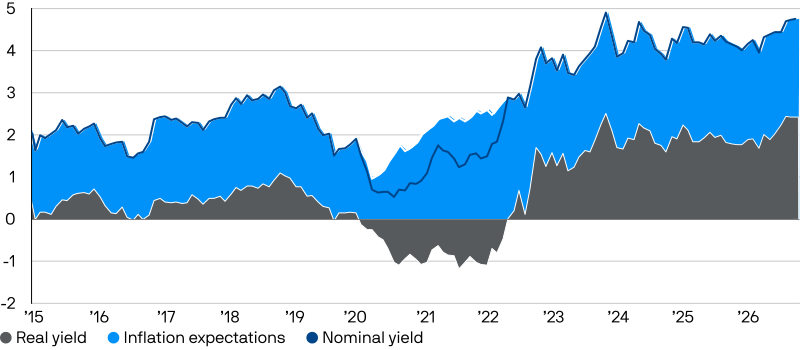
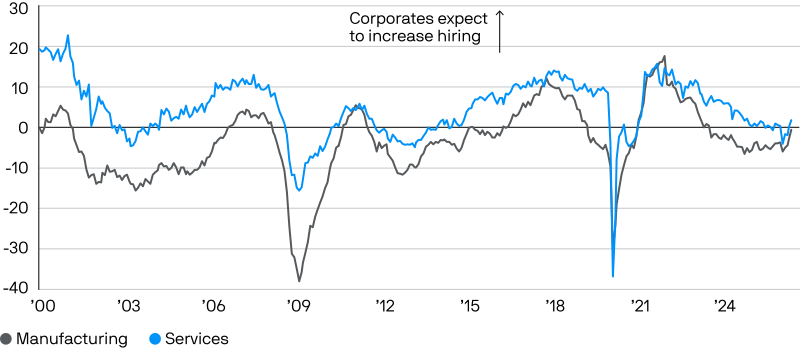
The rise in yields is being supported by the structural shift towards higher spending by governments and companies. The war in the Middle East, which began in late February, has added further upward pressure on yields as higher energy prices increase inflation risk. Expectations for central bank policy rates have adjusted accordingly, with markets now pricing a stricter central bank stance than at the start of the year. Investors should be mindful that central banks may need to raise policy rates further. However, the likelihood of an extended rate-hiking cycle derailing bond markets appears limited. Unlike in 2022, labour markets are less tight, which should reduce workers’ ability to secure higher wages in response to rising energy costs. This lowers the risk of energy driven inflation broadening into a more persistent wage-price spiral.
Eurozone employment expectations
Net balance
Source: European Commission, LSEG Datastream, J.P. Morgan Asset Management. Guide to the Markets - EMEA. Data as of 3 September 2026.
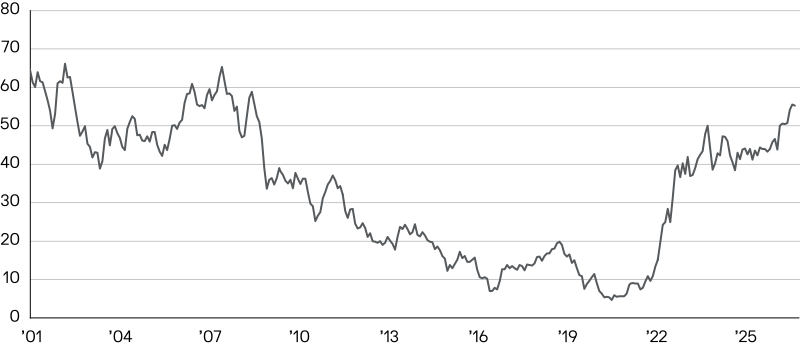
The rise in yields since the Covid pandemic has also improved the “yield cushion” available to government bond investors. This measures how far yields can rise before capital losses wipe out one year’s worth of income. At the start of the year, the inflation outlook appeared relatively benign across the US, the UK and the eurozone. Since then, the war in the Middle East and higher energy prices have increased uncertainty around the path ahead. At the same time, markets are trying to gauge the policy direction of the Federal Reserve (Fed) under its new chair, Kevin Warsh, whose tenure began in May. These dynamics have contributed to higher interest rate volatility. However, the yield cushion for global government bonds is now back to its highest level since 2007. Higher income therefore offers investors greater protection against further interest rate increases and volatility.
Global government bond yield cushion
Basis point change over 12 months
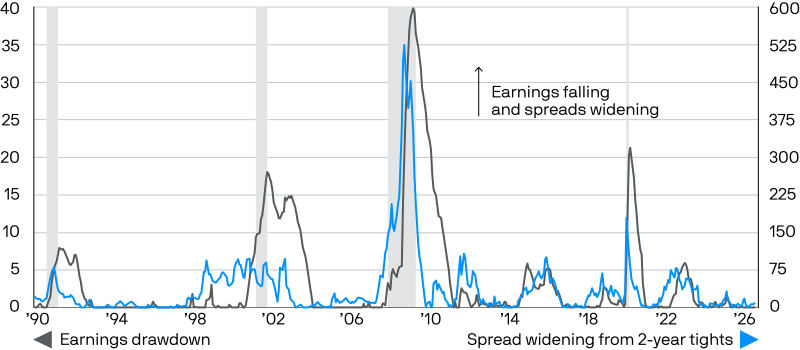
The capital intensity of the AI buildout has continued to increase, leading to elevated debt issuance from the largest US technology companies. We do not expect this new wave of supply to derail the investment-grade corporate credit market, but it is reshaping it and offering investors a more defensive way to access the AI theme. Spreads for these technology companies have widened, reflecting heavier supply. However, given their relatively limited weight within broader indices, the impact on overall index spread levels has been contained. Investment-grade corporate credit continues to be supported by high all-in yields and solid corporate fundamentals, which have attracted further inflows. Corporate earnings growth remains strong and, as the chart shows, this helps limit the risk of meaningful spread widening. For more on hyperscaler debt issuance and its impact on the investment-grade credit market, read our recent On the Minds of Investors article, Hyperscalers: Now also a credit story.
US earnings drawdowns and USD investment grade spread
% drawdown from previous peak (LHS); basis points (RHS)
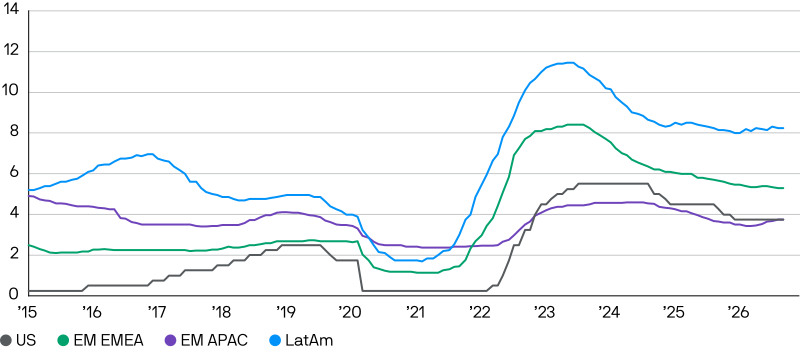
Emerging market debt faces the same reality as developed market debt: the war in the Middle East has pushed energy prices higher, adding upward pressure on inflation. Many emerging market central banks and governments responded to the 2022 energy shock in a disciplined and timely manner, with central banks raising policy rates ahead of the Fed’s hiking cycle. This pre-emptive policy response helped emerging markets preserve their fundamentals across debt ratios, current accounts, fiscal balances, real policy rates and currency reserves. That resilience has been reflected in the performance of the asset class relative to other areas of fixed income so far this year, despite a challenging global backdrop.
Central bank policy rates
%
Conclusion
Following the reset in yields, 10-year government bond yields are trading in their highest ranges since at least 2011. This creates a better entry point for investors, with fixed income again offering income and improved diversification potential against riskier assets. Absent a growth shock, solid corporate fundamentals should help keep credit spreads contained, allowing investors to position portfolios to capture the income on offer. At the same time, selectivity remains important. Bond markets are trying to distinguish between governments and companies that are spending responsibly and those that are not. This should create opportunities for active management across the fixed income universe.