logo
  • My collections
    View saved content and presentation slides
  • Log out
  • Products

      Funds

      • Performance & Yields
      • Liquidity
      • Ultra-Short
      • Short Duration
      • European domiciled products

      Solutions

      • Cash Strategies
      • Cash Segmentation
      • Separately Managed Accounts
      • Managed Reserves Strategy

      Fund Information

      • Regulatory Updates
    • Insights

        Liquidity Insights

        • Liquidity Insights Overview
        • Global Liquidity Investment Outlook

          Global Liquidity Investment Outlook

        • Tokenization

          Explore the full whitepaper to learn how tokenized MMFs can transform your approach to cash management and position your organization at the forefront of digital finance.

        • Cash Cookbook

          The Cash Cookbook, your guide to cash and liquidity management success, helps you choose the right liquidity solution for your needs and risk tolerance.

        • Case Studies

          Read about companies with specific cash management challenges and the solutions when they worked with J.P. Morgan Asset Management.

        • Partnership with fintechs

          A focus on digital innovation and institutional liquidity solutions drive our dynamic partnership with fintech.

        • ESG Resources for Liquidity Investors

          We’ve created a clear, rigorous ESG process meets the many needs of liquidity investors.

        • Leveraging the Power of Cash Segmentation

          The most effective strategy incorporates a clear investment policy, well-defined goals and parameters for liquidity, quality and return.

        • Cash Investment Policy Statement

          How to write an investment policy statement for your organization

        Market Insights

        • Market Insights Overview
        • Eye on the Market

          Explore Eye on the Market, timely commentary that offers views on the economy, markets, and investment portfolios by Michael Cembalest.

        • Guide to the Markets

          The J.P. Morgan Guide to the Markets illustrates a comprehensive array of market and economic histories, trends and statistics through clear charts and graphs.

        • Market Updates

          Read our weekly commentaries to get market insights that may help inform your investment strategy.

        • Podcast: Markets Explained

          Signal or noise? In this weekly podcast, Karen and Hugh digest the newsflow in an increasingly tumultuous world and work out what it means for global investors.

        Portfolio Insights

        • Portfolio Insights Overview
        • Currency

          Our currency team provides solutions for clients, controlling risk using passive management strategies and generating returns by actively managing global currencies.

        • Fixed Income

          A complex mix of monetary, credit and fiscal forces is changing the bond landscape. Discover how flexible fixed income approaches can seek returns, income and resilience.

        • Long-Term Capital Market Assumptions

          Our Long-Term Capital Market Assumptions (LTCMAs) deliver forward-looking return, volatility and correlation estimates for 200+ asset and strategy classes in 20+ base currencies.

        • Sustainable investing

          We believe that ESG considerations can play a critical role in a long-term investment strategy.

        • Strategic Investment Advisory Group

          The Strategic Investment Advisory Group approaches today’s investment challenges with a global view across asset classes.

      • Resources
          • Overview
          • MORGAN MONEY
          • Account Management & Trading
          • Global Liquidity Investment Academy
          • Announcements
        • About us

            About us

            Backed by $4.6T in assets, we harness our active edge to deliver timely ideas and actionable insights that empower investors to achieve what matters most.

            • Overview
            • Diversity, Opportunity & Inclusion
            • Spectrum: Our Investment Platform
            • Our Leadership Team
            • Our Commitment to Research
          • Contact us
          • English
          • MORGAN MONEY LOGIN
            • My collections
              View saved content and presentation slides
            • Log out
          • Log in
          • MORGAN MONEY LOGIN
          Log in
          You are about to leave the site Close
          J.P. Morgan Asset Management’s website and/or mobile terms, privacy and security policies don't apply to the site or app you're about to visit. Please review its terms, privacy and security policies to see how they apply to you. J.P. Morgan Asset Management isn’t responsible for (and doesn't provide) any products, services or content at this third-party site or app, except for products and services that explicitly carry the J.P. Morgan Asset Management name.
          CONTINUE Go Back

          <p>Global Bond Monitor Q1 2026</p>

          This piece uses five charts from the Guide to the Markets to explain why, despite investor concerns about the trajectory of government debt, we still see compelling opportunities across the fixed income landscape.

            1. Home
            2. Insights
          1. Portfolio Insights Overview
          2. Fixed Income Insights | Portfolio Insights

          Global Bond Monitor Q1 2026

          Investors have typically looked to bonds for two outcomes:


          1. A steady stream of income;


          2. Diversification against riskier assets if the growth outlook deteriorates.


          In the decade following the global financial crisis the ability of bonds to offer either of these elements had steadily diminished as a long bull market compressed yields to record low levels. The subsequent reset in 2022 was deeply painful. As yields normalised, the global aggregate bond index fell by 16%, the worst annual decline since the index began in 1990. But the fixed income reset is now complete. Yields have established new trading ranges and the role of bonds in a balanced portfolio has been restored.


          A combination of tariff-related inflation concerns and expansionary fiscal policy across the developed world has kept bond market volatility high and led some investors to remain nervous about the asset class. However, taking a step back, it is clear that the two key characteristics that bonds have historically provided remain relevant, and the bond market of today is not the same as the bond market of 2022. With prudent risk management, fixed income still deserves its place in multi-asset portfolios.

          • High starting yields have historically led to positive returns

          • Investors have a wider range of attractive options to choose from

          • Higher starting yields give bonds more breathing room

          • Earnings growth should support corporate spreads

          • Diversification potential has improved

          Our first chart looks at the impact of starting yields on subsequent returns. Investors are aware of the impact of equity valuations on subsequent medium-term returns, and the same dynamic is true in fixed income. After the period of low interest rates following the global financial crisis, government bond yields have now returned to a more normal range. This reset in yields significantly improves the return profile of fixed income, as higher starting yields have historically led to higher subsequent returns. From current starting yields, investors have typically enjoyed annualised returns of around 6% over the subsequent five years.

          Global government bond yields and subsequent 5y returns

          %, subsequent return is % change annualised
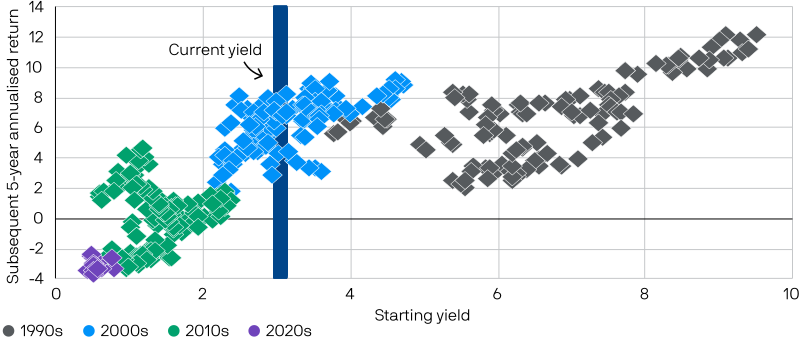
          exhibit-1-global-bond-monitor-1q26-emea
          Source: Bloomberg, LSEG Datastream, J.P. Morgan Asset Management. Index used is the Bloomberg Global Aggregate – Treasuries Index in US dollars and thus returns include currency effects. Past performance is not a reliable indicator of current and future results. Guide to the Markets - EMEA. Data as of 27 February 2026.

          Higher developed market government bond yields have fed through to the broader universe, and yields are attractive in most major sectors. Higher yields give investors a wider range of options to pick from when building diversified fixed-income portfolios. Positive yields in all major government bond markets allow investors to reduce exposure to any specific country risk, while credit markets offer additional yield for those looking to maximise income. With bond markets having to step in to discipline government spending plans, there remains the risk of individual sovereign market volatility, which will require nimbleness to navigate. Investors should look to allocate to managers who can take advantage of the full menu on offer to deliver better risk-adjusted returns.

          Fixed income yields

          %
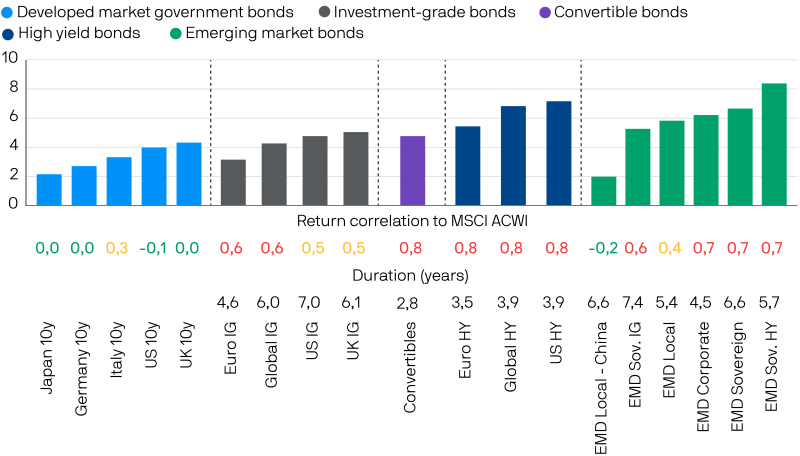
          exhibit-2-global-bond-monitor-1q26-emea

          Source: Bloomberg, ICE BofA, J.P. Morgan Economic Research, LSEG Datastream, J.P. Morgan Asset Management. Return correlation to MSCI ACWI is calculated using monthly total returns since 2008. Indices used are as follows: Euro IG: Bloomberg Euro-Aggregate – Corporate; Global IG: Bloomberg Global Aggregate – Corporate; UK IG: Bloomberg Sterling Aggregate – Corporate; US IG: Bloomberg US Aggregate – Corporate; Convertible bonds: Bloomberg Global Convertible Rate Sensitive hedged to USD; Euro HY: ICE BofA Euro Developed Markets Non-Financial High Yield Constrained Index; Global HY: ICE BofA Global High Yield Index; US HY: ICE BofA US High Yield Constrained Index; EMD corporate: CEMBI Broad Diversified; EMD local: GBI-EM Global Diversified; EMD local – China: J.P. Morgan GBI-EM Broad Diversified China; EMD sovereign: EMBI Global Diversified; EMD sov. IG: EMBI Global Diversified IG; EMD sov. HY: EMBI Global Diversified HY. Past performance is not a reliable indicator of current and future results. Yields are not guaranteed and may change over time. Guide to the Markets - EMEA. Data as of 26 February 2026.

          Global rates volatility remains elevated as governments grapple with fiscal realities, and markets shift their focus to whichever country is currently in the spotlight. However, these pressures are reflected in higher starting yields, which provide a meaningful buffer against bond losses. The yield cushion on global government bonds, which shows how much sovereign yields need to rise over the next 12 months before capital depreciation wipes out one year’s worth of income, has risen from its pre-pandemic low to around 45 basis points. As a result, fixed income investors benefit from a substantial buffer against ongoing policy-related uncertainty.

          Global government bond yield cushion

          Basis point change over 12 months
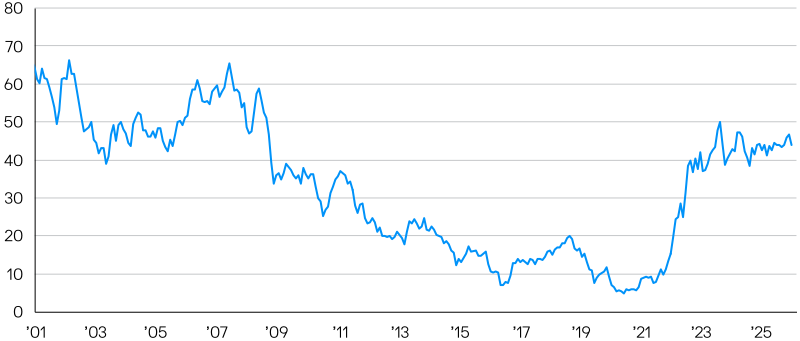
          exhibit-3-global-bond-monitor-1q26-emea
          Source: Bloomberg, LSEG Datastream, J.P. Morgan Asset Management. Yield cushion refers to how far yields can rise before capital depreciation wipes out one year’s worth of income. Index used is the Bloomberg Global Aggregate – Treasuries Index. Guide to the Markets - EMEA. Data as of 27 February 2026.

          Corporate credit spreads remain tight across all major credit markets. However, these rich valuations are underpinned by strong fundamentals. Corporate balance sheets are healthy and global growth should support corporate earnings. Spreads typically remain tight for extended periods of time and generally only widen when corporate earnings come under pressure. While there is little room for spreads to tighten further, and investors should expect income to form the bulk of credit returns, the supportive economic backdrop means spreads are also unlikely to widen significantly. This environment should give investors confidence in stepping out into credit to take advantage of the additional income on offer.

          US earnings drawdowns and US investment grade spreads

          % drawdown from previous peak (LHS); basis points (RHS)
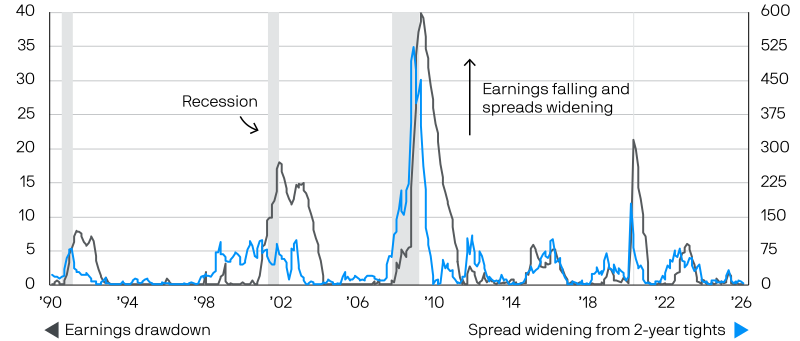
          exhibit-4-global-bond-monitor-1q26-emea
          Source: Bloomberg, LSEG Datastream, J.P. Morgan Asset Management. US IG: Bloomberg US Aggregate – Corporate; Euro IG: Bloomberg Euro-Aggregate – Corporate. Past performance is not a reliable indicator of current and future results. Guide to the Markets - EMEA. Data as of 27 February 2026.

          Our final chart considers the total return that investors would receive from government bonds, depending on how yields move over the next 12 months. If the economic outlook deteriorates, the pressure on central banks to cut interest rates will only intensify. In this scenario, bond yields still have significant room to fall from current levels. In the event that 10-year government bond yields fell by 100 basis points over the next 12 months, investors could expect a return of more than 10%. This return would provide the kind of meaningful diversification against equity losses that multi-asset investors rely on when constructing balanced portfolios, and which has not been available for several years given the very low level of yields.

          Government bond return scenarios

          %, total return over 12 months
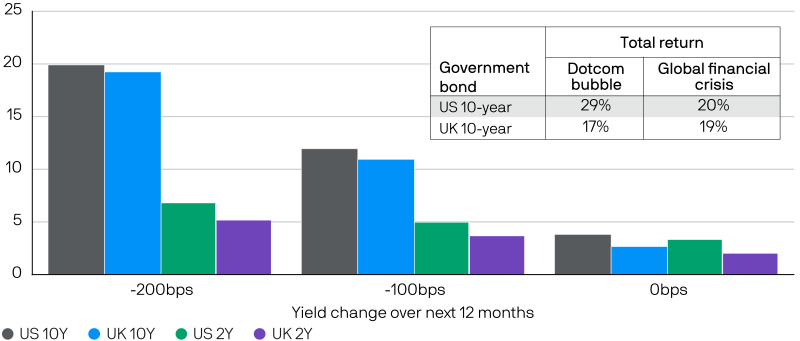
          exhibit-5-global-bond-monitor-1q26-emea
          Source: LSEG Datastream, J.P. Morgan Asset Management. Chart indicates the calculated total return achieved by purchasing the given government bond at its current yield and selling in 12 months’ time given various changes in yield. For illustrative purposes only. Dotcom bubble: Aug 2000 to Sep 2002; Global financial crisis: Oct 2007 to Feb 2009. Past performance is not a reliable indicator of current and future results. Guide to the Markets - EMEA. Data as of 27 February 2026.

          Conclusion

          The opportunities available in fixed income remain attractive. The reset higher in yields means bonds can deliver sustainable income in the medium term, while also providing a buffer against further volatility. Absent a shock to growth, yields and spreads are likely to remain contained and investors should position their portfolios to capture the income on offer. However, if the outlook does deteriorate then government bond yields have room to fall, providing diversification against equity losses.