Investment themes for emerging market debt - Q1 2026
- Positive backdrop for EMD assets extended by economic resilience and Fed cuts
- Long EM rates with more differentiation along fiscal and political risks
- EMFX supported by carry and lower volatility
- Credit valuations driven tighter by supportive fundamentals and technicals
- Risks: US inflation and fiscal policy, recession, AI, geopolitics
-
Positive backdrop for EMD assets extended by economic resilience and Fed cuts
-
Long EM rates with more differentiation along fiscal and political risks
-
EMFX supported by carry and lower volatility
-
Credit valuations driven tighter by supportive fundamentals and technicals
-
Risks
Emerging market debt (EMD) had a phenomenal run in 2025. Corporate markets returned 8.7%, sovereigns added 14.3% and local currency bonds were up 19.3%. Investors are now asking whether this performance can continue.
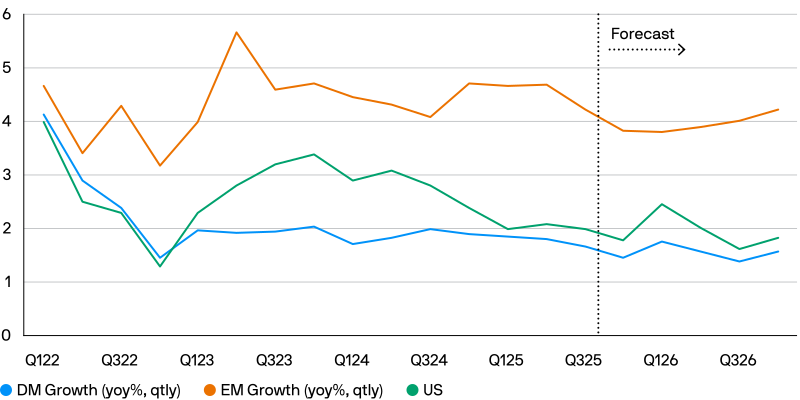
Fundamentals suggest yes. Economic growth is supportive, with just a slight slowdown expected from 4.3% in 2025 to 4.0% in 2026. Although slightly lower, the emerging market (EM)-developed market (DM) growth alpha should remain healthy at 2.4% in 2026, similar to pre-pandemic trends. Emerging markets have navigated and adapted to tariffs in 2025 and are in a strong position going into 2026.
All things equal, emerging markets should be on track to deliver strong returns in 2026.
Emerging market growth is far above developed markets
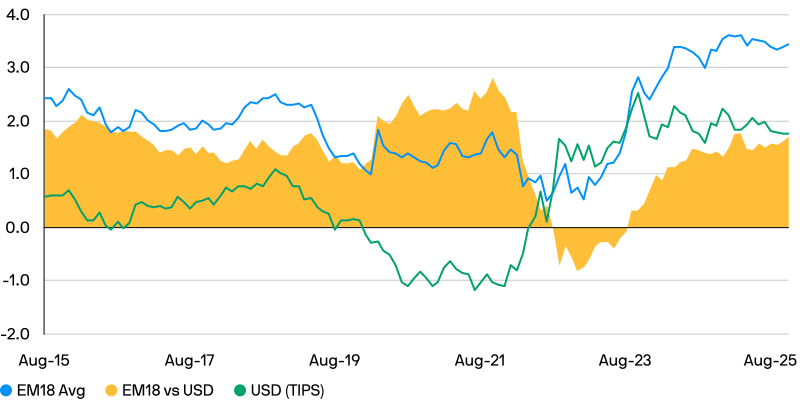
Inflation has reduced significantly over 2025 for EM countries and is now back to target levels. Rates, however, remain high, as we estimate that EM central banks are only halfway through their cutting cycle. Combining these elements leads to high real rates. We are long duration in the countries where we believe central banks will show the most willingness and ability to cut policy rates, while being more tactical in those countries with upcoming fiscal and political risks.
EM local currency debt markets have been undergoing a structural change over many years. EM policy frameworks have substantially improved with the number of EM countries with inflation targeting regimes and fiscal rules doubling over the past 15 years. In addition, the domestic investor base continues to grow and now represents over 100% of GDP in many EM countries. In turn, the risk associated with EM local currency debt is reduced by the accumulation of domestic assets by domestic investors.
Real yields remain compelling in local currency
%
A concern for many investors when considering EMD is the risk associated with EM foreign exchange (EMFX). In 2025, EMFX has added considerably to portfolios as the dollar weakened following Liberation Day. Putting this move in context, however, highlights that there may be further potential for appreciation in EMFX over the coming years given that currencies are still cheap.
With this appreciation, we have seen EMFX volatility converge with the volatility of DMFX. While this convergence may seem unintuitive, on a longer-term historical basis, it’s not atypical.
The flow of capital could reasonably be expected to slow due to increased tariffs. However, world trade volumes have reached new historical highs led by strong EM exports despite declining US imports. Investor capital flows have been strong into EM local currency debt markets over 2025 and we expect more investors to add to the asset class in 2026 following the strong returns this year. Even when accounting for the inflows this year, international investor allocations are still near historical lows with the door open for future investments.
EMFX valuations still cheap despite recent appreciation

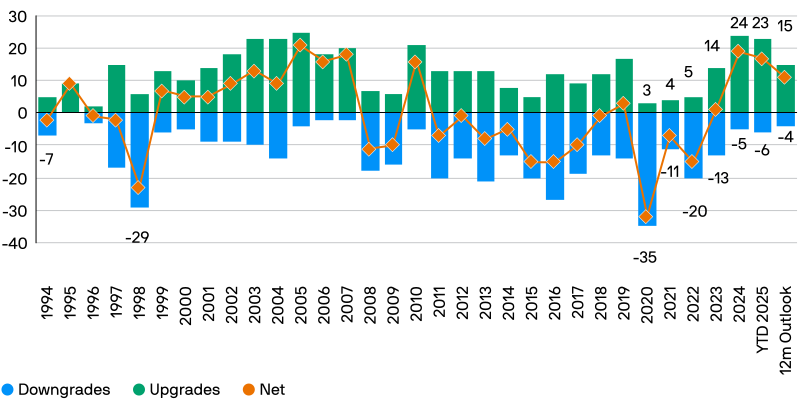
We predict that EM Sovereign fundamentals will continue improving in 2026 following a strong 2025. EM countries reported lower deficits and zero defaults in 2025, continuing the trend of zero defaults in 2024. In 2026 we predict limited defaults with 0.4% of the index at risk. Strong fundamentals are being reflected in upgrades from credit rating agencies.
EM corporate fundamentals are more stable but present sector divergence, which provides the possibility for alpha generation. We expect mid-single digit EBITDA growth, stable leverage and a small increase in defaults due to idiosyncratic issues.
While valuations may seem tight based on historical data, we find they are justified by these strong fundamental factors and technicals. We predict corporate markets will have the fifth consecutive year of negative net supply. Meanwhile, sovereign issuance is expected to be driven by investment grade issuers, and high yield issuance is expected to also be negative on a net basis. As such, current spread levels are supported by demandsupply technical and further inflows could lead to spread tightening.
Sovereigns upgrades continue to exceed downgrades in 2026
EM Sovereigns Rating Changes (Middle M/S/F)
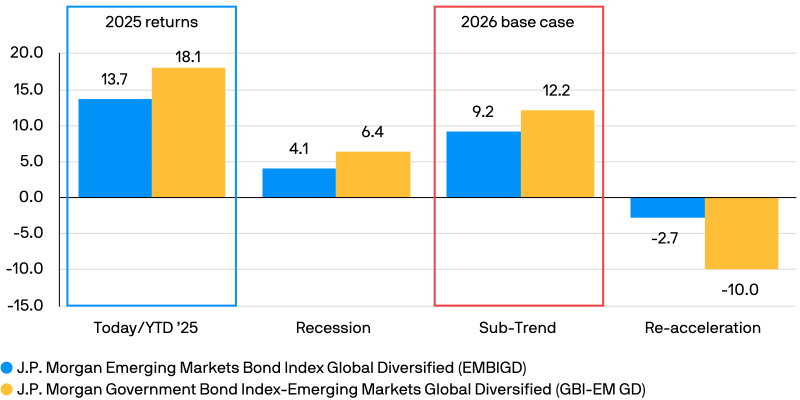
We break down our market environment scenarios into three categories: recession, sub-trend growth, and re-acceleration. Our central scenario of sub-trend growth has the highest upside, with returns between 9% and 12% for sovereign and local markets. However, our expectations of tail risk scenarios are increasing.
Re-acceleration is the most negative scenario for EMD, with increasing inflation leading to a stronger US dollar and central banks not being able to cut rates as expected, which would impact local currency debt. Improving quality combined with a spread buffer leads to less negative returns in sovereign markets.
A recessionary market environment would deliver positive returns in EMD. Sovereigns would benefit from US policy rate cuts while spreads in the investment grade portion of the market would be expected to remain contained and act as a ballast for the market. In local debt markets, high policy rates give EM central banks capacity to significantly cut rates, offsetting US dollar strength.
Probability-weighted, we see positive returns for both sovereign and local markets in 2026, of around 6%.
2026 return scenarios