This page provides historical returns by major global asset class over the past 10 years, together with their annualized return and volatility year-to-date. It is important to highlight that there is not one single asset class that has consistently outperformed or underperformed over the past 10 years, highlighting the fact that diversification is key in constructing a portfolio that will generate stable risk and return compared to holding only one asset class.
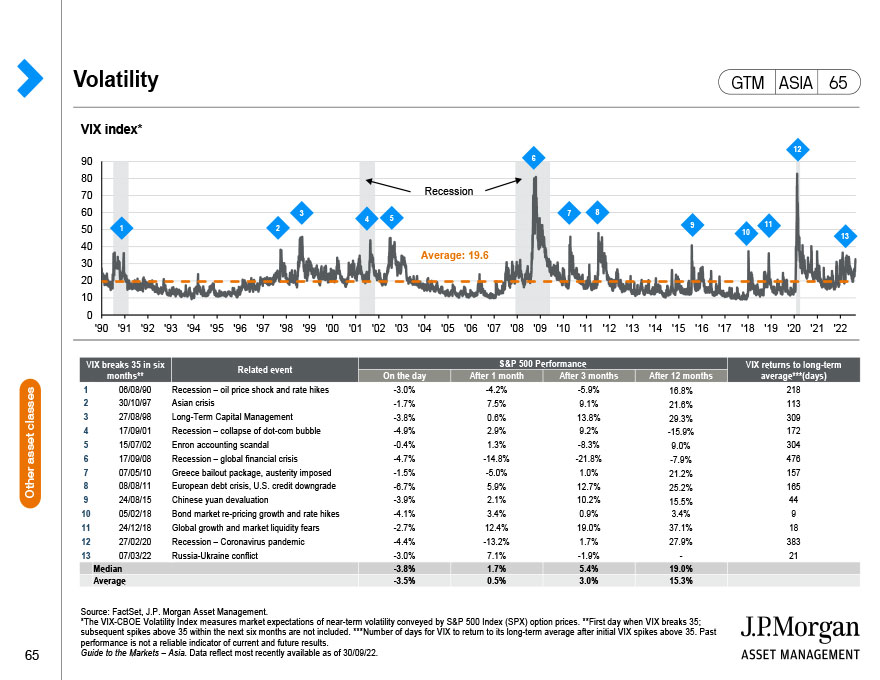
Volatility has the potential to disrupt any portfolio. This page shows us how volatility has behaved historically for the equity market, as represented by the VIX index. The table illustrates short- and long-term U.S. equity market performance follow a sharp rise in market volatility.
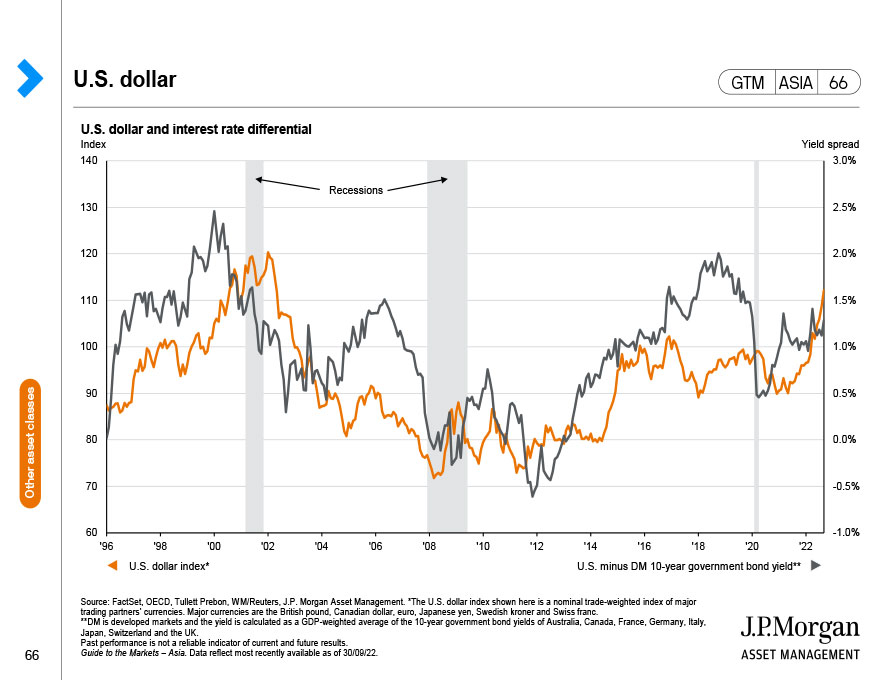
This page shows the performance of the U.S. dollar represented by the trade-weighted U.S. dollar index and the interest rate differential between the U.S. and a weighted average of major developed markets
This page shows currency valuations based on the real effective exchange rate and that the U.S. dollar is trading above to its long-term average.
This page looks at various emerging market countries' currency movements, current account balance and level of reserve adequacy to cover foreign currency obligations. From this we can attempt to gauge their ability to withstand shocks from capital outflow.
This page displays commodity prices and returns from commodity related equities. Prices, in the context of recent history, are displayed. The annual returns over the last five years and returns of the most recent full quarter of investable indices linked to these commodities, together with their annualized return and volatility, are also shown.
From this chart we can see that the price of gold and the yield on inflation protected treasuries have an inverse relation. As the yield falls, gold prices rise. Given the current environment of falling yields and growth uncertainty, the performance of gold has received more attention.
This page shows the short-term dynamics of the oil market including price, a comparison of cost of production for various countries against each other and the current oil price, as well as estimated supply and demand levels.
This page shows that there is broad spectrum of asset classes that can deliver alternative sources of income. Other than the traditional asset classes like fixed income and equities, investors can also consider looking at the alternative space (e.g. infrastructure, convertibles, and maritime).
This page highlights the benefits of including alternative investments in your portfolio. The left chart shows the diversification benefits of including alternatives in various portfolios, in terms of higher returns and lower risk. The chart on the right displays the correlation between public markets and alternatives, showing us that there can be a number of diversification opportunities from investing in alternatives.