Real gross domestic product (GDP) growth and the manufacturing purchasing managers' index (PMI) within the Asia ex-China region is shown here. Given Asia's rising importance within the global economy, the growth and economic health of its manufacturing sector play a significant role. Investment and exports, two of the main drivers of Asian economies, are shown on the right hand side. They are key indicators for future growth prospects of the region.
Following the strong rebound in exports in the ASEAN region in 2017, export growth in 2019 declined after trade tensions between the U.S. and its trade partners undermined sentiment. While this decline stabilized after the Phase 1 trade deal, the COVID-19 outbreak has hit ASEAN export and consumption growth in 1H'2020. Varying levels in the current account balance have resulted in some countries being more vulnerable than others regarding currency movements and foreign flows. Indonesia and the Philippines are the standout examples.
On this slide, we look at monetary and fiscal policy in ASEAN. The COVID-19 outbreak has prompted ASEAN central banks to loosen monetary policy. The fiscal position gives us an idea of whether governments have been increasing their expenditure versus their revenue, resulting in either greater or smaller supportive measures for the economy.
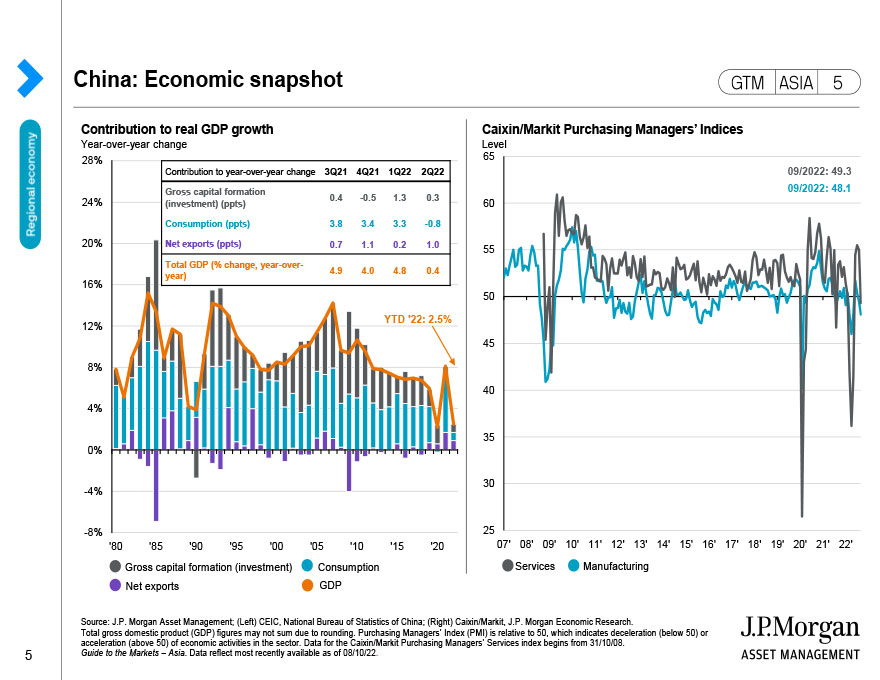
China’s basic economic indicators are displayed here. Gross domestic product (GDP) growth—and the contribution to it by expenditure —are shown on the left. Services and Manufacturing Purchasing Managers’ Indices are another way of measuring growth momentum in these two segments of the economy. These monthly indices measure activity in these sectors from a survey of purchasing managers. A reading above 50 indicates expansion, below 50 indicates contraction.
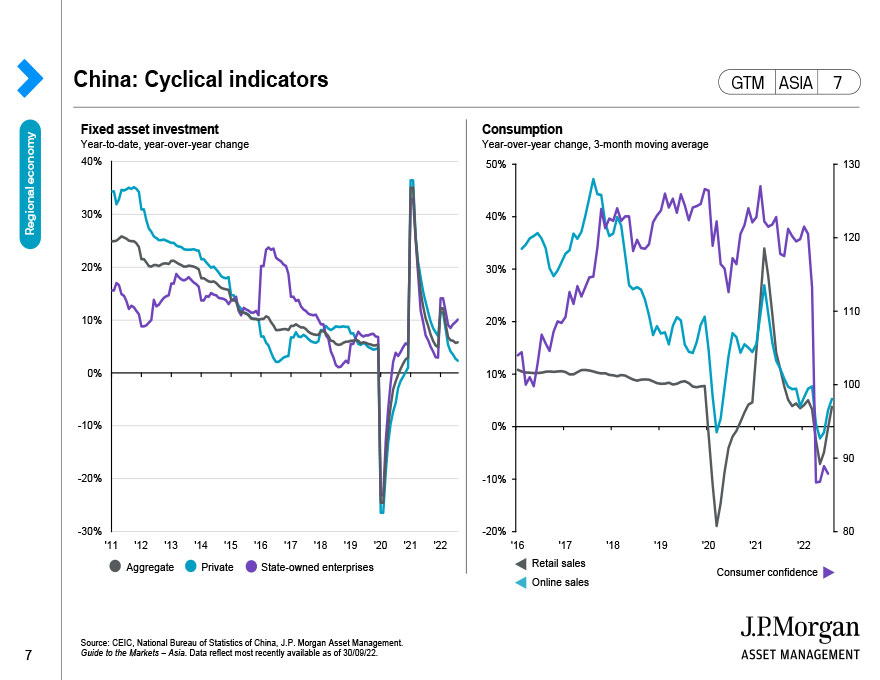
This page examines several indicators of where China is in its short-term economic cycle. Retail and online sales, shown on the right, reflect the health of the domestic consumer. Fixed asset investment on the left, demonstrates government and private capex investment momentum.
Fiscal policy is an important tool for the government to support the Chinese economy. This page shows government fiscal revenue and expenditure growth trends, which are critical in maintaining domestic growth. This page also reflects on the bond issuance by the central government and local governments. This can be seen as a pre-cursor to additional fiscal boost that local and central governments are planning to deploy.
The page shows a number of indicators to measure liquidity conditions and Chinese authorities' policy stance. The credit impulse chart on the left illustrates the central bank's policy stance, which has been swinging between supporting growth (trending upwards) and preventing asset bubbles (trending downwards). Given the pressure from COVID-19 pandemic and due to the weak GDP, monetary policy bias do seem to swing towards stimulus to support growth, thereby boosting business confidence and potentially supporting future output and demand. However, if we look at the right chart, which shows the key policy rates that reflect the funding costs, it shows that People's Bank of China has been quite balanced in its monetary policy. China has been trying to engineer a recovery by leaning on the credit channel and adopting a sector-specific, low-income household-specific targeted measures, rather than rolling out traditional quantitative easing/ universal policy easing measures like the developed markets.
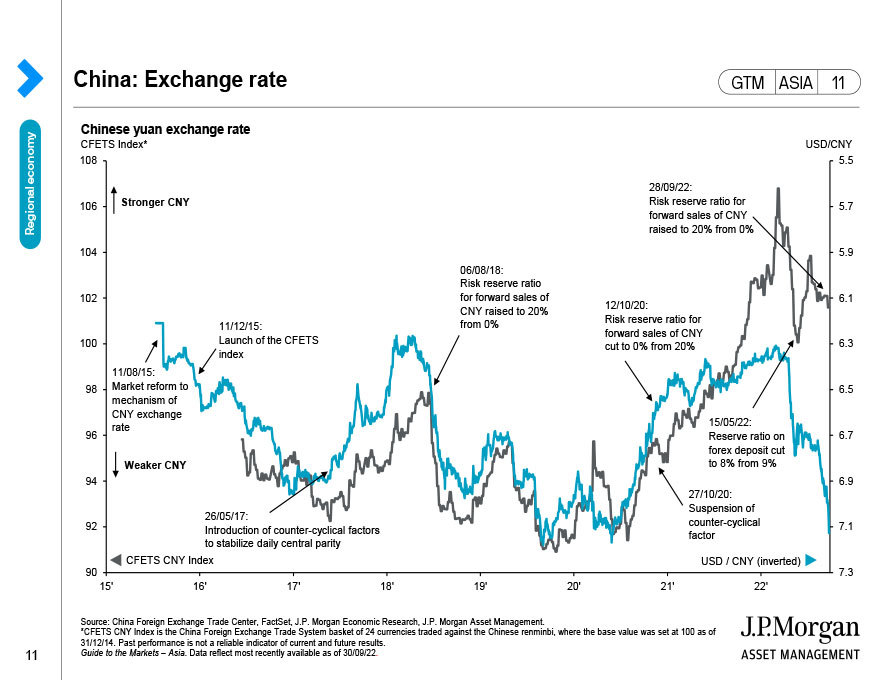
This page illustrates China's exchange rate development. The left shows the Renminbi's movement against the U.S. dollar and a trade-weighted basket. The right chart shows the change in foreign exchange reserve and currency movement, reflecting capital flows.