logo
  • My collections
    View saved content and presentation slides
  • Logout
  • Products

      Funds

      • Performance & Yields
      • Liquidity
      • Ultra-Short
      • Short Duration
      • European domiciled products

      Solutions

      • Cash Strategies
      • Cash Segmentation
      • Separately Managed Accounts
      • Managed Reserves Strategy

      Fund Information

      • Regulatory Updates
    • Insights

        Liquidity Insights

        • Liquidity Insights Overview
        • Global Liquidity Investment Outlook

          Global Liquidity Investment Outlook

        • Tokenization

          Explore the full whitepaper to learn how tokenized MMFs can transform your approach to cash management and position your organization at the forefront of digital finance.

        • Cash Cookbook

          The Cash Cookbook, your guide to cash and liquidity management success, helps you choose the right liquidity solution for your needs and risk tolerance.

        • Case Studies

          Read about companies with specific cash management challenges and the solutions when they worked with J.P. Morgan Asset Management.

        • Partnership with fintechs

          A focus on digital innovation and institutional liquidity solutions drive our dynamic partnership with fintech.

        • ESG Resources for Liquidity Investors

          We’ve created a clear, rigorous ESG process meets the many needs of liquidity investors.

        • Leveraging the Power of Cash Segmentation

          The most effective strategy incorporates a clear investment policy, well-defined goals and parameters for liquidity, quality and return.

        • Cash Investment Policy Statement

          How to write an investment policy statement for your organization

        Market Insights

        • Market Insights Overview
        • Eye on the Market

          Explore Eye on the Market, timely commentary that offers views on the economy, markets, and investment portfolios by Michael Cembalest.

        • Guide to the Markets

          The J.P. Morgan Guide to the Markets illustrates a comprehensive array of market and economic histories, trends and statistics through clear charts and graphs.

        • Market Updates

          Read our weekly commentaries to get market insights that may help inform your investment strategy.

        • Podcast: Markets Explained

          Signal or noise? In this weekly podcast, Karen and Hugh digest the newsflow in an increasingly tumultuous world and work out what it means for global investors.

        Portfolio Insights

        • Portfolio Insights Overview
        • Currency

          Our currency team provides solutions for clients, controlling risk using passive management strategies and generating returns by actively managing global currencies.

        • Fixed Income

          A complex mix of monetary, credit and fiscal forces is changing the bond landscape. Discover how flexible fixed income approaches can seek returns, income and resilience.

        • Long-Term Capital Market Assumptions

          Our Long-Term Capital Market Assumptions (LTCMAs) deliver forward-looking return, volatility and correlation estimates for 200+ asset and strategy classes in 20+ base currencies.

        • Sustainable investing

          We believe that ESG considerations can play a critical role in a long-term investment strategy.

        • Strategic Investment Advisory Group

          The Strategic Investment Advisory Group approaches today’s investment challenges with a global view across asset classes.

      • Resources
          • Overview
          • MORGAN MONEY
          • Account Management & Trading
          • Global Liquidity Investment Academy
          • Announcements
        • About us

            About us

            Backed by $4.6T in assets, we harness our active edge to deliver timely ideas and actionable insights that empower investors to achieve what matters most.

            • Overview
            • Diversity, Opportunity & Inclusion
            • Spectrum: Our Investment Platform
            • Our Leadership Team
            • Our Commitment to Research
          • Contact us
          • English
          • MORGAN MONEY LOGIN
            • My collections
              View saved content and presentation slides
            • Logout
          • Log in
          • MORGAN MONEY LOGIN
          Log in
          You are about to leave the site Close
          J.P. Morgan Asset Management’s website and/or mobile terms, privacy and security policies don't apply to the site or app you're about to visit. Please review its terms, privacy and security policies to see how they apply to you. J.P. Morgan Asset Management isn’t responsible for (and doesn't provide) any products, services or content at this third-party site or app, except for products and services that explicitly carry the J.P. Morgan Asset Management name.
          CONTINUE Go Back
          1. A Road to Recovery

          • LinkedIn Twitter Facebook WhatsApp

          A Road to Recovery

          24-07-2020

          Jason Davis

          In response to Europe’s biggest growth shock in a generation, the European Union (EU) council agreed on the outline of the “Recovery Fund”[1] to help cushion the EU’s economic fallout from the coronavirus pandemic.

          After four days of negotiations, marking the second longest European Union (EU) summit to date, the EU Council finally agreed on the outline of the Recovery Fund. The Recovery Fund itself is EUR 750 billion which equates to 5.5% of 2019 EU GDP. Grants have been reduced from the initial proposal of EUR 500 billion to EUR 390 billion, however, this was mostly at the pan-European level, while grants within the core Recovery & Resilience Fund were actually increased. At the same time, loans have been increased from EUR 250 billion to EUR 360 billion and will only go to sovereigns where it would actually reduce funding costs.

          The main beneficiaries are therefore peripheral and Eastern Europe. In fact, over four years, we can expect Italy to receive up to 12% of GDP in loans and grants, greatly helping reduce the funding needs resulting from the pandemic.

          Percent of GDP over four years
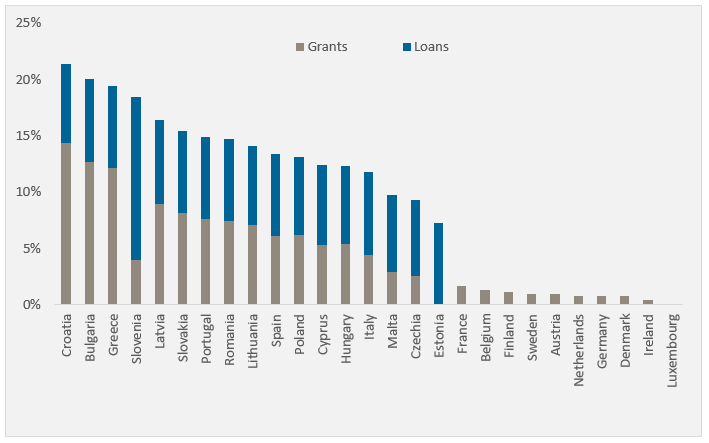
          Source: ECB, Bloomberg, JPMAM as of July 2020

          This episode is particularly impressive. Although a fiscal union is a long way off, the combination of joint issuance, joint taxation and net transfers from the stronger to weaker sovereigns is a powerful response, and certainly a step in that direction.

          Political risks will remain in the Eurozone and may flare up again as countries haggle over their recovery plans or argue over when to re-impose some form of fiscal prudence. That said, at the very least, this agreement removes the tail risks of a Eurozone break up and should make Euro assets structurally more attractive. If the Eurozone can find a way through the COVID-recession, then surely it can handle anything thrown its way. The Eurozone has gone from being as vulnerable as its weakest member, towards becoming as strong as its aggregate balance sheet.

          Of course there were some concessions to get a deal over the line. Importantly, rebates were increased to keep the frugal Northern European countries happy. Over 7 years, these sum to approximately EUR 54 billion. This reduces the net transfers within the Eurozone, but not by much:

          Percent of GDP (grants minus GDP weight)
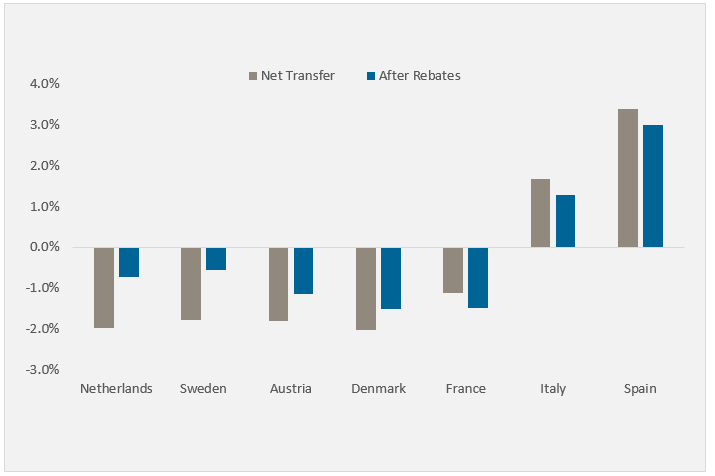
          Source: ECB, Bloomberg, JPMAM as of July 2020

          Combined with an ECB that is buying EUR 1.2 trillion of bonds this year alone, the first implication for portfolios is that Eurozone spread risk has a very powerful backstop. We remain structurally positive periphery in portfolios with room to add further on any cheapening as the supply returns after the summer.

          The second implication is that a lot of supply will be coming to the market in the next few years. The EU needs to issue EUR 850 billion, which represents 40% of the current AAA stock of bonds outstanding. All else equal, this should lead to an underperformance of European core duration relative to higher yielding countries with steeper curves.

          AAA Debt Outstanding (nominal, fixed)
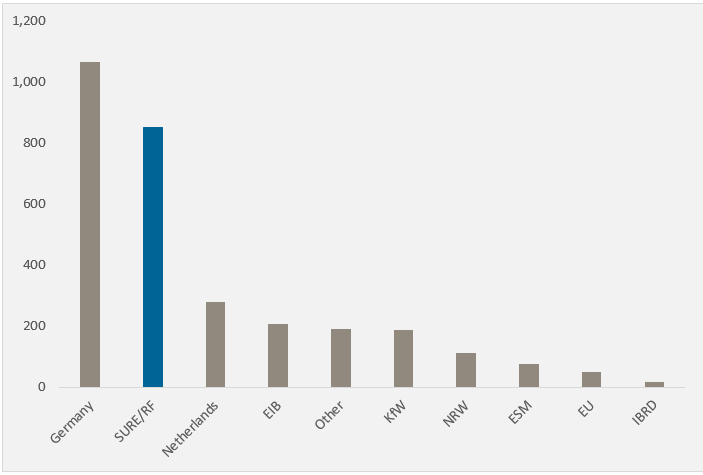
          Source: ECB, Bloomberg, JPMAM as of July 2020

          Despite some watering down of the plan, the details are still very positive and represent a big moment for EU solidarity. There have been ample opportunities over the past two decades for the Eurozone project to fail, and each time, Europe’s leaders have found a way to end the impasse.


          [1] Note the EU has not passed the Recovery Fund but agreed on the fund in principle. It still needs to be passed by all parliaments. 

          • Monetary Policy
          • European Central Bank
          • Eurozone

          RELATED ARTICLES

          The ECB's strategy review: Actions speak louder than words

          With the ECB quickly running out of tools and inflation still some way from their current target, the market will be keen to hear what comes next.

          Read more

          Make the Fed Cut Again

          While no one knows for certain what 2020 or 2022 will bring to the White House and the Fed, staffing changes and increasing political pressure within the Fed is a near-certainty.

          Read more

          Trading the thrill of the ECB chase

          We review July's ECB monetary policy and determine the impacts on the ECB and the Eurozone.

          Read more