
logo
  • My Collections
    View saved content and presentation slides
  • Log out
  • Products

      Funds

      • Performance & Yields
      • Liquidity
      • Ultra-Short
      • Short Duration
      • European domiciled products

      Solutions

      • Cash Strategies
      • Cash Segmentation
      • Separately Managed Accounts
      • Managed Reserves Strategy

      Fund Information

      • Regulatory Updates
    • Insights

        Liquidity Insights

        • Liquidity Insights Overview
        • Global Liquidity Investment Outlook

          Global Liquidity Investment Outlook

        • Cash Cookbook

          The Cash Cookbook, your guide to cash and liquidity management success, helps you choose the right liquidity solution for your needs and risk tolerance.

        • Case Studies

          Read about companies with specific cash management challenges and the solutions when they worked with J.P. Morgan Asset Management.

        • Partnership with fintechs

          A focus on digital innovation and institutional liquidity solutions drive our dynamic partnership with fintech.

        • ESG Resources for Liquidity Investors

          We’ve created a clear, rigorous ESG process meets the many needs of liquidity investors.

        • Leveraging the Power of Cash Segmentation

          The most effective strategy incorporates a clear investment policy, well-defined goals and parameters for liquidity, quality and return.

        • Cash Investment Policy Statement

          How to write an investment policy statement for your organization

        Market Insights

        • Market Insights Overview
        • Eye on the Market

          Explore Eye on the Market, timely commentary that offers views on the economy, markets, and investment portfolios by Michael Cembalest.

        • Guide to the Markets

          The J.P. Morgan Guide to the Markets illustrates a comprehensive array of market and economic histories, trends and statistics through clear charts and graphs.

        • Market Updates

          Read our weekly commentaries to get market insights that may help inform your investment strategy.

        • Podcast: Markets Explained

          Signal or noise? In this weekly podcast, Karen and Hugh digest the newsflow in an increasingly tumultuous world and work out what it means for global investors.

        Portfolio Insights

        • Portfolio Insights Overview
        • Currency

          Our currency team provides solutions for clients, controlling risk using passive management strategies and generating returns by actively managing global currencies.

        • Fixed Income

          A complex mix of monetary, credit and fiscal forces is changing the bond landscape. Discover how flexible fixed income approaches can seek returns, income and resilience.

        • Long-Term Capital Market Assumptions

          Our Long-Term Capital Market Assumptions (LTCMAs) deliver forward-looking return, volatility and correlation estimates for 200+ asset and strategy classes in 20+ base currencies.

        • Sustainable investing

          We believe that ESG considerations can play a critical role in a long-term investment strategy.

        • Strategic Investment Advisory Group

          The Strategic Investment Advisory Group approaches today’s investment challenges with a global view across asset classes.

      • Resources
          • Overview
          • MORGAN MONEY
          • Account Management & Trading
          • Global Liquidity Investment Academy
          • Announcements
        • About us

            About us

            We harness our active edge to deliver timely ideas and actionable insights that empower investors to achieve what matters most.

            • Overview
            • Diversity, Opportunity & Inclusion
            • Spectrum: Our Investment Platform
            • Our Leadership Team
            • Our Commitment to Research
          • Contact us
          • English
          • MORGAN MONEY LOGIN
            • My Collections
              View saved content and presentation slides
            • Log out
          • Log in
          • MORGAN MONEY LOGIN
          Log in
          You are about to leave the site Close
          J.P. Morgan Asset Management’s website and/or mobile terms, privacy and security policies don't apply to the site or app you're about to visit. Please review its terms, privacy and security policies to see how they apply to you. J.P. Morgan Asset Management isn’t responsible for (and doesn't provide) any products, services or content at this third-party site or app, except for products and services that explicitly carry the J.P. Morgan Asset Management name.
          CONTINUE Go Back
          Liquidity Insights

          PBoC Monetary Framework Shifts to Overnight Policy Rate

          AS
          Aidan Shevlin

          Head of International Liquidity Fund Management

          Published: 16-11-2026

          PBoC Monetary Framework Shifts to Overnight Policy Rate

          In Brief

          • The PBoC announced to shift its main policy rate from the 7-day reverse repo to an overnight reverse repo rate. The new benchmark was set at 1.25%, effective from November 2.
          • The move is aimed at improving the central bank’s management of short-term interest rates .  It will align operations more closely with the interbank overnight rate (DR001) and make short-rate guidance more precise.
          • For RMB cash investors, the shift toward DR001 as the anchor raises the importance of overnight rates - which should become the primary determinants of money-market pricing and cash yields.


          Introduction

          At the Financial Street Forum on the 19th of October, PBoC Governor Pan Gongsheng outlined several significant updates to China’s monetary policy framework, including a planned shift in the main policy benchmark from the 7-day reverse repo rate to an overnight reverse repo rate. On 30 October, sooner than many market participants had expected, the PBoC formally confirmed the transition, setting the new overnight policy rate at 1.25%, effective from 2 November.

          In parallel, the PBoC signaled a broader change in pricing conventions: greater use of the interbank overnight repo rate (DR001) as a reference for loan pricing for stronger corporates, continued LPR use for households and smaller firms, and an eventual retirement of legacy benchmark deposit and lending rates. The Governor also flagged a new liquidity tool to help non-bank institutions manage large redemptions and reduce bond-market instability risks.

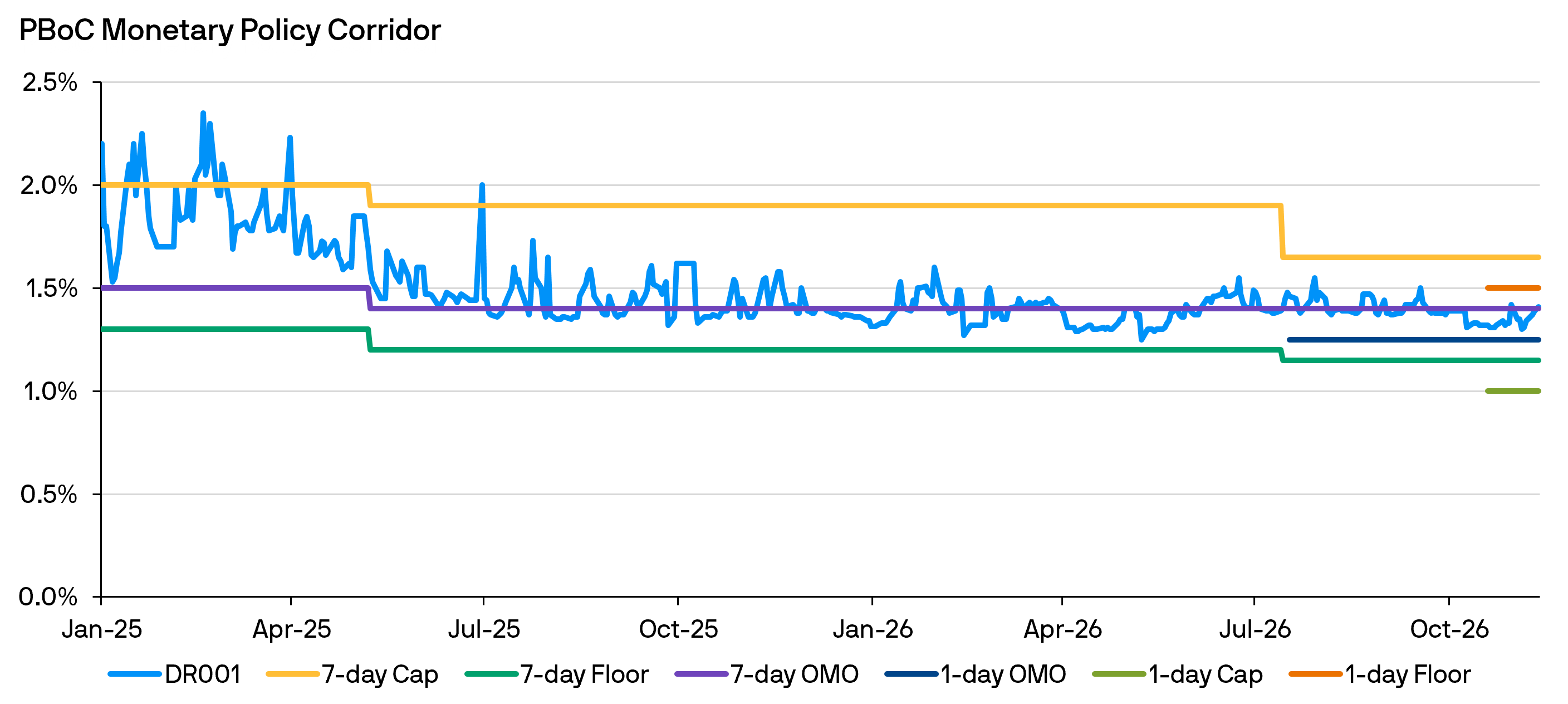
          The announcement builds on recent changes to both the short-end policy rate corridor and the PBoC’s liquidity management tools. In June, the PBoC tightened the corridor from 70bp to 50bp by setting temporary overnight repo and reverse repo rates at 25bp below and 25bp above the 7-day policy rate, respectively. It also began conducting routine overnight reverse repo operations in late June, which have been used more frequently to address seasonal swings in liquidity.

          The PBoC will now conduct overnight reverse repo operations daily at a fixed rate, with the amount determined by liquidity demand. Meanwhile, the previous 7-day operations (at 1.40%) will no longer serve as a fixed policy benchmark, rather being used mainly around liquidity needs such as tax dates and month-ends, with a fixed amount and bids on the rate. Related facilities (including the previous cap and floor) have also been re-anchored, lowering the policy corridor by 15bp to 1.00–1.50%.


          Fig 1: The migration to overnight interest rates will shift China’s interest rate corridor lower.
           

          Source: J.P. Morgan Asset Management, data as of 2 November 2026.


          Implications

          Historically, the PBoC has relied on a complex patchwork of monetary policy tools to control the price, quantity and availability of liquidity.  The latest announcement is a continuation of the decades long modernization of China’s monetary policy mechanisms, moving towards a more priced based framework and more effective policy transmission.  

          The change strengthens the role of overnight funding (particularly DR001) in money-market pricing, consistent with the framework shift anticipated following the original PBoC announcement. While the 15bps adjustment to the interest rate corridor is not a de-facto rete cut, it does suggest easier liquidity conditions and puts downward pressure on Chinese bond yields and swap rates.  The move may also support a bull-flattening bias, while leaving less scope for another near-term policy-rate cut.

          For RMB cash investors, the center of gravity shift is further shifting toward overnight focus: short tenor repo behavior, corridor calibration, and O/N OMO sizing (especially around month- and quarter-end) will matter more for carry, roll-down, and reinvestment risk. Overall, the reforms point to a more price-based, market-driven framework where future easing could increasingly arrive via benchmark migration and improved transmission, not only conventional policy cuts.

          Diversification does not guarantee investment returns and does not eliminate the risk of loss.
          This information is generic in nature provided to illustrate macro trends based on current market conditions that are subject to change from time to time. This generic information does not take into account any investor’s specific circumstances or objectives and should not be construed as offer, research or investment advice.

          About the Author

          Latest from the Author

          RBA: An unconvincingly hawkish hike
          November 04, 2026 Aidan Shevlin
          RBA resumes hikes as inflation risks materialize
          October 02, 2026 Aidan Shevlin
          Resilient growth keeps MAS’s tightening stance alive
          July 27, 2026 Aidan Shevlin
          Liquidity Resilience in a Repricing World
          June 23, 2026
          Global Central Banks: Caught in the Crossfire
          May 11, 2026 Aidan Shevlin
          • Liquidity