

John Bilton, CFA,
Global Head of Strategic Research, Multi-Asset Solutions
In brief
- Attempting to time the market and holding excessive cash allocations can drive long-term portfolio underperformance. Staying invested to compound returns prevails over the long haul.
- Across almost any time horizon or region, balanced portfolios, such as a 60/40 stock-bond mix or a 60/40 that includes alternatives, have historically outperformed cash, both in nominal and real terms.
- The tendency to cut winners early and run losing trades too long (the disposition effect) manifests in all investor types and market conditions but is prevalent among individual investors.
- Even during challenging periods, such as Japan’s “lost decades,” diversified portfolios have recovered. Missing market rebounds significantly reduces long-term gains.
- While high valuations act as a drag on expected returns, they are a poor signal of the timing of any market correction. Investors today can choose from among a wide range of investing vehicles that are low cost, tax efficient and offer simplified access to a diversified investment portfolio. In our view, today’s typical individual, on average, still holds too much cash than is optimal for long-term goals.
-
Find your balance
-
The hunter and the farmer
-
An uphill battle against psychology
-
Two wealth-destroying habits
-
Getting invested, staying invested
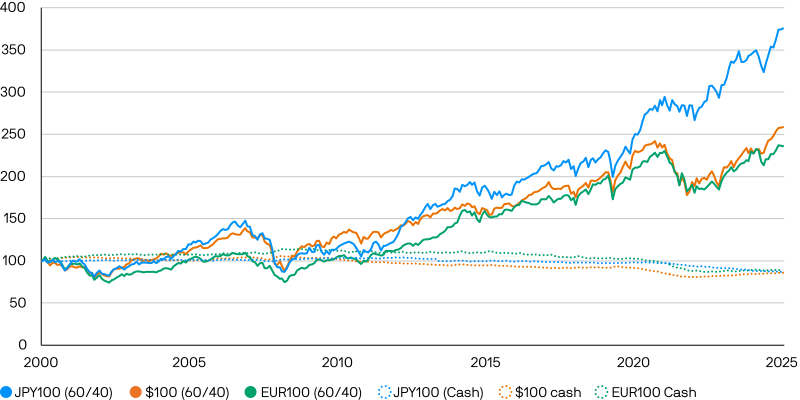
Over almost any time horizon, and in virtually all regions, strong empirical evidence shows that balanced investment portfolios beat cash in both nominal and real terms. Investment portfolios can vary widely: from a simple balanced equity and bond allocation to sophisticated global multi-asset portfolios utilizing both public and private assets. It’s fair to say that there is a balanced portfolio for every type of saver. The simplest balanced portfolio, the global equity-aggregate bond1 60/40 portfolio, beats cash 79% of the time over a one-year horizon and 97% of the time over a five-year horizon.2 In real terms and local currencies, adjusted for inflation, USD100 invested in such a portfolio 25 years ago is worth USD258 today; USD100 in cash over the same period, meanwhile, is worth just USD86 today (Exhibit 1).
The same holds internationally too, in real terms EUR100 invested in a 60/40 25 years ago is worth EUR236 today compared to EUR100 in cash being worth just EUR89. And in JPY, even allowing for lengthy bouts of deflation, JPY100 in a 60/40 has swelled to JPY375 while JPY100 in cash is worth just JPY87.
The key to realizing those returns is getting invested and staying invested. History shows us that compounding returns builds wealth, yet savers and investors often fall into two wealth-destroying habits: attempting to time the market (difficult even for experienced financial professionals) and holding excessive allocations to cash. For many savers, the tendency to buy assets that have already performed, only to sell them after a market panic, materially weakens returns. Excess cash, meanwhile, can feel like a safety blanket. But although cash is a risk-free asset in terms of market risk, inflation erodes its purchasing power. Cash also comes with outsized reinvestment risk over a cycle.
In real terms a global 60/40 has provided strong returns in the last 25 year, while the real value of cash has fallen
Exhibit 1: Growth in real terms of a global 60/40 compared to cash since 2000
The financial press and social media can also exacerbate suboptimal investor behavior. Panic sells papers and drives clicks, so it is unsurprising that during bear markets sensationalist media headlines can increase savers’ anxiety and overstate the risk of staying invested. Meanwhile social media has contributed to the gamification of investing, sometimes threatening to suck investors too late into assets that have already risen sharply.
Here, we unpack some of the truths and myths about successful long-term investing, building on the Principles of Investing3 work from our Market Insights team. We ask what stops savers from being more optimally invested for the long run and examine what strategies can help offset the behavioral tendency – a human instinct we all share – of swinging between excess caution and unjustified optimism.
Of course, it’s no surprise that an asset management firm advocates being invested. But we show empirically that even a conservative allocation beats hiding in cash over multiple investment horizons. We also explore how to objectively consider valuations and different elements of risk that affect portfolios of all types.
1 U.S. aggregate bonds comprise ca. 40% U.S. Treasuries across maturities, 30% mortgage-backed securities and 30% investment grade credit.
2 MSCI ACWI/U.S. aggregate bond 60/40 vs. 3-month T-bill index, monthly data for last 25 years, annualized average of rolling 1 year and 5 year return differential, average 60/40-cash over 1 year is 6.0% (positive 79% of the time), over 5 year is 5.3% (positive 97% of the time).
3 “Principles for successful long-term investing,” J.P. Morgan Asset Management.
Investors, and Wall Street more broadly, are often portrayed in popular media as hunters who stalk, track, and trap the winning trades that represent their prey. But for most professional investors, the phrase “Eat what you kill” went out with ticker tape and brick-sized mobile phones. It might not fit the outdated narrative the media sometimes like to spin, but investors are much more like farmers than hunters.
A farmer builds their wealth by using their fields (markets), understanding the weather (market risk), planting seeds (cash) to germinate into crops (assets) to produce a harvest (returns). A farmer repeats this process season after season – knowing that some seasons will be better than others – to build a successful farm. Farmers don’t wake each day trying to outsmart the weather. They plant, tend, rotate, manage, and wait for their harvest. A hunter, by contrast, believes success comes from timing, agility and decisive action. The broad swath of history suggests that farmers are generally wealthier than hunters.
Some savers aspire to be hunters, trying to time markets that are driven by factors beyond their control. They take decisive actions, often at just the wrong point and with ruinous consequences. Others choose to be farmers but keep too much of their seed – their cash – in the barn, waiting for the perfect weather for planting and thus foregoing many reasonable harvests in a vain search for the perfect one.
The farming analogy to investing is not new but it remains powerful. Investors are in the business of harvesting risk premia: over long horizons risk premia tend to be positive, so we plant, we invest. Weather – or market risk – can suddenly turn and occasionally it will wipe out a crop. But seldom does bad weather destroy a farm which has taken care to rotate its crops and diversify its harvest.
Few investors or savers will dispute the empirical evidence that over the long haul, stocks tend to do better than bonds, which in turn outpace cash. The greater the potential near-term volatility in price, the better the long-term rewards3. Yet investors often fixate on the near-term volatility rather than the long-term rewards.
This tendency is especially pronounced among individual investors.4, 5, 6 They often allocate too much to cash for too long after market lows and can be pulled into riskier assets late in bull markets, after momentum has already pushed prices much higher. Industry surveys7, 8 suggest that over the long-term individual investors hold around a quarter of their investable assets in cash, compared to a typical recommended allocation of 5-10%. Many increased cash allocations during the pandemic volatility but were slow to reinvest as the market recovered. Over the long term we find that these patterns can reduce long-term portfolio returns by over 100 basis points annually.9
A related phenomenon – cutting winners too early and running losing trades too long– is known as the disposition effect.10 As many as 70% of individual investors11 demonstrate a tendency to the disposition effect, leading to a material negative impact on returns. Professional investors are not immune to the disposition effect, but the discipline and checks and balances embedded in their investment process can minimize the impact of the disposition effect.
More recently, social media has amplified psychological biases (including the disposition effect) and helped to spur the gamification of investing. Social media intensifies investor reactions to news, increasing volatility and trading volume, especially among individual investors. Meanwhile, gamified trading platforms increase trading frequency and risk-taking, and magnify behavioral biases. Empirical studies suggest that users of gamified investing platforms underperform by 3%–5% annually compared with individual investors not using game-like tools.12
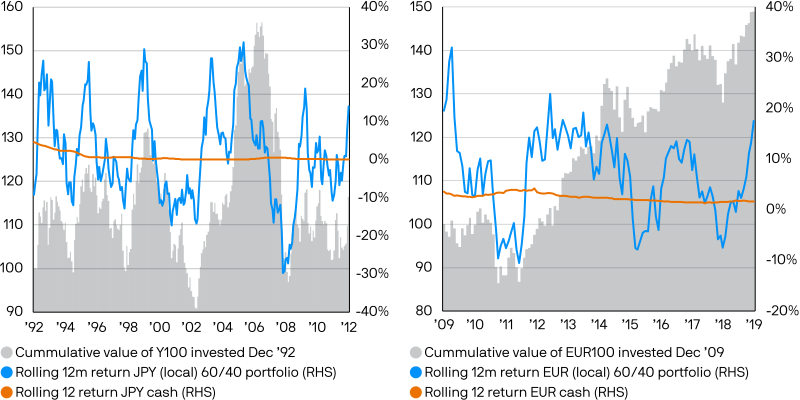
Although the benefits of staying invested are clear, there are periods when even a well-constructed balanced portfolio will suffer drawdowns. During the two “lost decades” in Japan from the early 1990s to the beginning of “Abenomics13”, the rolling three-year real return for a JPY 60/40 portfolio lagged cash 46% of the time. Still, over the full period, the 60/40 annualized 75bps better returns than cash. Similarly, in the 10 years that followed the eurozone crisis in the early 2010s, rolling three-year real returns for an EUR 60/40 lagged cash 17% of the time, yet the 60/40 annualized over 500bps better returns (Exhibit 2A and Exhibit 2B).
In both cases, other markets continued to perform. Global stocks powered ahead during the Japanese lost decades and the eurozone crisis, and bond markets delivered strong returns. For investors caught and burned by these drawdowns, the better response was not to sit on the sidelines but to diversify.
Prolonged periods of economic weakness can mean more volatility in returns, but diversifying an invested portfolio across regions remains preferable to hiding in cash
Exhibit 2A and 2B: Returns of a local JPY 60/40 vs. cash in Japan’s ‘lost decades’ and returns of a local EUR 60/40 vs. cash in the eurozone sovereign crisis
4 Maarten Van Rooij, Annamaria Lusardi and Rob Alessie (), “Financial Literacy, Retirement Planning and Household Wealth,” Economic Journal 122, no. 560 2012.
5 John Y. Campbell, “Household Finance,” Journal of Finance 61, no. 4, 2006.
6 Brad M. Barber and Terrance Odean, ”The Behavior of Individual Investors,” Handbook of the Economics of Finance, ed. George M. Constantinides, Milton Harris and René M. Stulz, vol. 2, Elsevier, 2013.
7 Empower/The Currency average portfolio mix by investor age, October 2025.
8 American Association of Individual Investors: Asset Allocation Survey, data set from 1987 to present.
9 Analysis of rolling 10yr realized USD 60/40 returns from 1995 to present with 0%, 5%, 10%, and 25% cash weightings
10 From Gemini: The disposition effect in behavioral finance is the irrational tendency for investors to sell assets with gains too early (to lock in profits) and hold onto assets with losses for too long (hoping for recovery)
11 Summary of industry studies including: Brad M. Barber, Terrance Odean and Ning Zhu, “Do Retail Trades Move Markets?” Review of Financial Studies 22, no. 1, 2009. and Ravi Dhar & Ning Zhu, Up Close and Personal: An Individual Level Analysis of the Disposition Effect Yale ICF Working Paper No. 02-20 Mar 2002
12 J. Anthony Cookson, Joseph Engelberg & William Mullins, “Echoes of a Market Crash: Evidence from Retail Investors in the COVID-19 Pandemic,” Journal of Finance 76, no. 5, 2021; Philipp Chapkovski, Mariana Khapko, and Marius Zoican, Trading gamification and investor behavior, October 2023; and Brad M. Barber, Xing Huang, Terrance Odean & Christopher Schwartz, “Attention Induced Trading and Returns: Evidence from Robinhood Users,” Journal of Finance 78, no. 2, 2023.
13 Abenomics refers to the economic reforms initially enacted by Shinzo Abe from late 2012 onwards
Both professional and individual investors need to understand and avoid the two primary drivers of long-run portfolio underperformance. This is especially important today when the economic cycle is advanced, and valuations are extended. The two key drivers, as we’ve discussed, are timing (or mistiming) the market and (over) investment in cash.
Timing (or mistiming) the market
Why do so many investors attempt to time markets? Investor behavior studies suggest a connection with the fact that for many investors, fear of loss is much greater than the satisfaction in steadily compounding gains.6, 14 Put another way, losses can be sudden and visceral, while gains often accrue gradually.
By any measure, market timing can be hazardous to your wealth: up to 90% of portfolio returns can be explained by asset allocation rather than market timing,15 and frequent traders experience returns as much as 500bps lower than average individual investor returns over the long run.16 In other words, a buy-and-hold decision means getting one trade right, while timing the market demands getting at least two right in order to achieve the same outcome over the longer run.
Professional investors acknowledge the challenge. When they try to time the market, they aim to minimize the overall portfolio impact. Even as they take profits or hedge positions, they tend to view their investments in asset markets as an evolving expression of how much they are compensated for a particular economic risk. Resulting allocation decisions thus become less about market timing and more about the evolution of relative views across available risk premia.
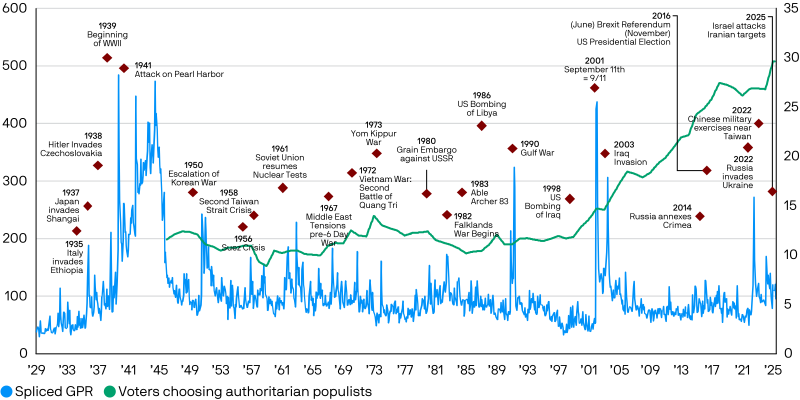
A perceived rise in geopolitical risk has prompted some investors to try to time the markets. Yet even in a more febrile political environment,17 the prevailing level of geopolitical risk is relatively low (Exhibit 3).18
Geopolitical risks are off their long run lows but well below true peaks, meanwhile political polarization is elevated today
Exhibit 3: The geopolitical risk index and measures of political extremism in the last 75 years
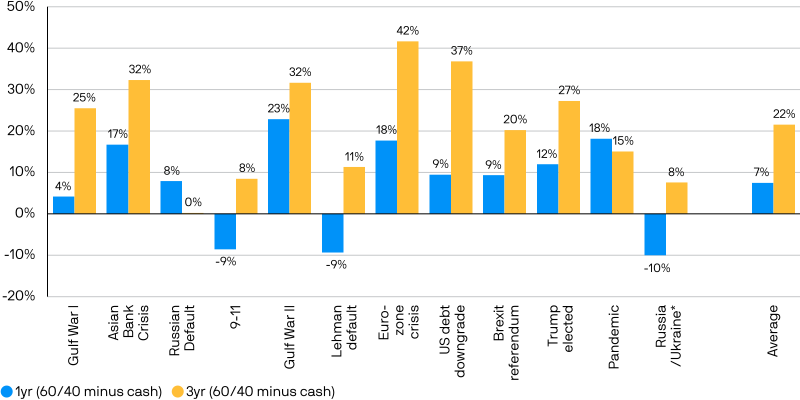
It is also notable how little geopolitics affects the long-term returns of a balanced portfolio, and how short-lived the effects are. An investor who invested in a 60/40 portfolio one month before each of the 12 spikes in the VIX since 1990 outperformed cash 75% of the time, by an average of 7%, after one year. The portfolio outperformed cash 100% of the time, by an average of 22%, after three years (Exhibit 4).
After Shocks, 60/40 beats cash 75% of the time by an average of 7% after 1 year, and 100% of the time by an average of 21% after 3 years
Exhibit 4: U.S. 60/40 vs. cash assuming an investment made in the month before a shock
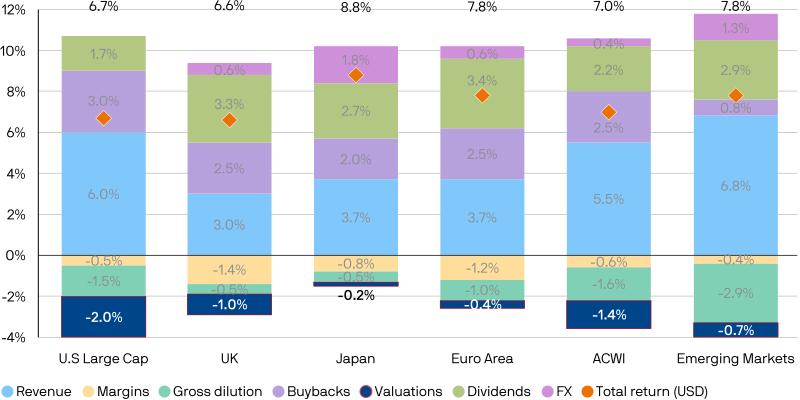
Valuations are another issue driving today’s investors to try to time the market. High valuations are a drag on long-term returns, a factor we acknowledge in our LTCMA forecasts (Exhibit 5), but valuations are a poor market timing indicator. Take, for example, cyclically adjusted price-earnings (CAPE) ratios, which are currently at elevated levels relative to history. However, while CAPE’s long-term predictive power for expected returns is statistically significant it is imprecise when it comes to timing.
High valuations are a drag on long term (10yr+) forward returns, but valuations are a poor market timing indicator
Exhibit 5: Equity return building blocks from our LTCMA forecasts
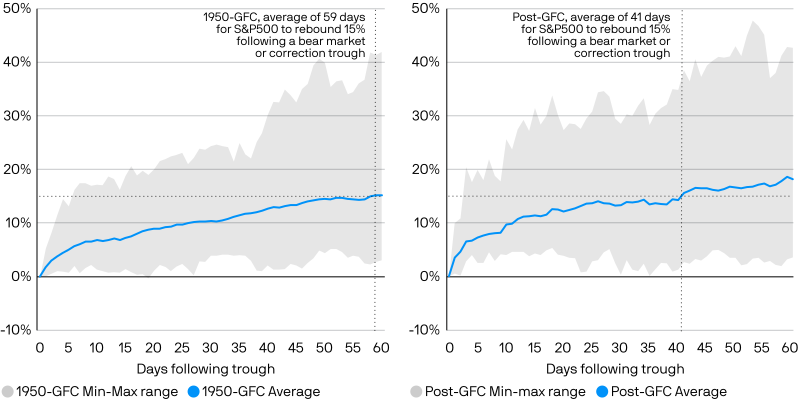
Investors attempting to time the market should also account for the clustering effect in which the market’s best days often come hot on the heels of the market’s worst days. If anything, the increasingly short and sharp corrections we’ve witnessed since the GFC may amplify this factor. Since investors are seldom nimble enough to get out and back in quickly enough, missing out on those sharp gains that so often follow a market low can have profound long-term effects on portfolio returns (Exhibit 6A and Exhibit 6B).
Post global financial crisis (GFC) rebounds from market lows have quickened
Exhibit 6A and 6B: S&P500 performance following a market trough 1950 to GFC, and post-GFC
(Over)investment in cash
In our farming analogy, cash is the equivalent of seed in the barn. It doesn’t bear the risk that a crop does from drought – total loss – but it remains exposed to other risks. In a portfolio, cash may not bear the market risk of other assets, but it bears meaningful reinvestment risk. Cash yields are often slashed by policymakers at the first sign of economic trouble, quickly undermining reinvestment returns. Not planting – or not investing excess cash – is a decision delayed, not a decision avoided.
While a small allocation to cash can enable investors to take advantage of market volatility, it is important to manage cash drag. As we’ve noted, as much as 23% of individual investors’ allocations sit in cash. That implies 300bps of returns left on the table compared with a fully invested portfolio over 2025. In the five years since the pandemic, a similar cash allocation would result in a USD100 million portfolio foregoing USD5.4 million of potential gains; after inflation, this represents a real-terms shortfall of USD4.3 million compared with a fully invested portfolio.
Some feel that cash provides a bunker against the most inclement of market conditions. But those fearing a growth slowdown may consider increasing their bond exposure. The very same policy response of lower rates that generates reinvestment risk for cash acts as a strong return driver for bonds.
Meanwhile, investors fearing inflation eroding their returns may consider the role of real assets or commodities within diversified portfolios. While cash may hold up moderately well as inflation rises, it nevertheless suffers a loss of purchasing power. And unless cash is redeployed swiftly, it has little capacity to recover its purchasing power, absent a period of deflation. Assets with duration can recover some of the hit, and since equities earn in the nominal space, a 60/40 portfolio can recover from an unpleasant spike in inflation in a way that the purchasing power of cash cannot.
14 Macrosynergy: understanding the disposition effect (webpage)
15 Gary P. Brinson, L. Randolph Hood and Gilbert L. Beebower, “Determinants of Portfolio Performance,” Financial Analysts Journal 42, no. 4, 1986 and Gary P Brinson, Brian D. Singer and Gilbert L. Beebower, “Determinants of Portfolio Performance II: An Update,” Financial Analysts Journal 47, no. 3, 1991.
16 Brad M. Barber and Terrance Odean, “Online Investors: Do the Slow Die First?" Review of Financial Studies 15, no. 2, 2002; Brad M. Barber and Terrance Odean, Trading Is Hazardous to Your Wealth: The Common Stock Investment Performance of Individual Investors, Journal of Finance, Vol 4, No. 2 April 2000; and Alexandra van Geen, Johan Bonekamp, Loan van Hoeven, Mark Wielstra, Comparing Wealth Effects of Saving and Index Investment, Dutch Authority for the Financial Markets, March 2022.
17 Andreas Johansson Heinö, Authoritarian populism index, Timbro, 2024.
18 Dario Caldara and Matteo Iacoviello, “Geopolitical Risk (GPR) Index, https://www.matteoiacoviello.com/gpr.htm.
After a 187% post-pandemic rally in U.S. stocks, muddied by an episode of double-digit inflation and, more recently, the highest multiples outside the dot-com era, it is unsurprising that investors are second guessing how to deploy capital. Still, our 10-year return forecasts for a 60/40 global stock-bond portfolio of 6.4% in USD and 5.4% in EUR are roughly in line with the 25-year average.
Over an economic cycle, the forecasted stock-bond frontier falls and flattens as equity multiples rise and bond yields move higher. Today’s frontier has flattened since the pandemic, but still implies some positive equity risk premium relative to duration. Such an environment may prompt some investors to take a more conservative allocation, at the margin. But since risk premia for both bonds and stocks are positive, today’s stock-bond frontier does not support outsized cash allocations or attempts to time the market.
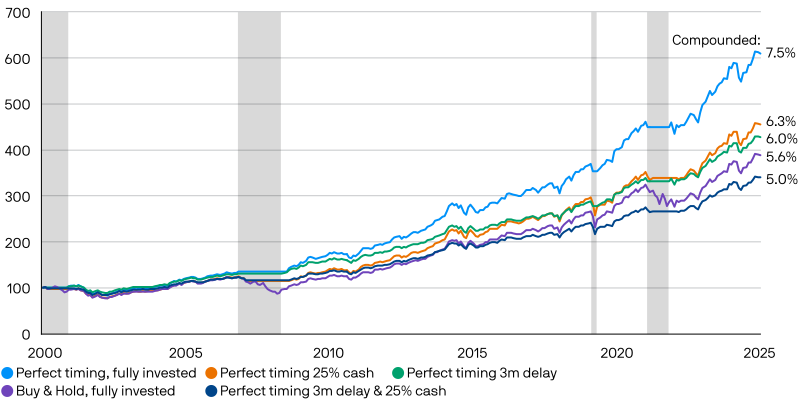
To put this into context, consider the case of a EUR investor who perfectly timed their exit from a global equity/euro aggregate bond 60/40 portfolio in the month that each of the equity bear markets of the last 25 years began, and succeeded in reinvesting within a month of the equity market low. That investor has compounded 7.5% returns. An investor who simply bought and held their 60/40 has compounded 5.6% returns.
But look what happens when a 25% EUR cash allocation is added to the mix. The investor with perfect foresight has now beaten the buy-and-hold investor by just 40bps annually. Had they eschewed cash but mistimed getting out and back into the market by only three months around corrections, their advantage vs. a buy-and-hold investor stands at 60bps annually.
Put the two factors together – reasonable but imperfect timing by just three months, and a tendency to hold cash in line with individual investor averages – and this approach underperformed a simple buy-and-hold strategy by 60bps annually over the last 25 years. The same holds for investors in USD and other currencies (Exhibit 7a and 7b). Even sophisticated investors are seldom consistently fortunate with market timing – highlighting the wealth-generating impact of staying invested for the long haul.
Too much cash and imperfect market timing quickly eat into returns compared to staying invested
Exhibit 7A: Impact of cash drag and imperfect market timing on global 60/40 returns in USD
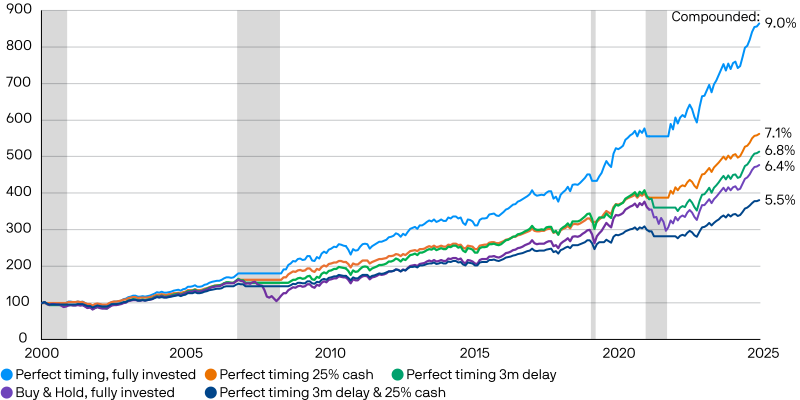
Exhibit 7B: Impact of cash drag and imperfect market timing on global 60/40 returns in EUR
Investors today can choose among a wide range of investment vehicles that are low cost, tax efficient and offer simplified access to a diversified investment portfolio. In our view, today’s economic environment, and the returns we believe are achievable for investors with a long-term outlook, support much lower cash allocations than typical individual investors hold. We acknowledge the rich valuations of some segments of the equity market. But we believe investors should take these into account when determining their relative bond vs. stock allocation and not use high multiples as a reason to time entry and exit points to the market. It’s a tempting approach, but rarely successful over the long term.
19 Stock-bond frontier is our representation of the capital markets line with varying ratios of equity-bond allocation plotted as expected return vs. expected risk (volatility).
20 Equity bear markets defined as worse than 20% peak to trough drawdown taken from Yardeni data and based on S&P 500 bear market and correction dates (from December 31, 2000 to December 31, 2025.)